The Land of Eternal Spring and Echoing Stone
Guatemala is not merely a country located on a map of Central America. It is a sensory experience defined by the verticality of its landscape and the deep, enduring resonance of its Mayan heritage. Known globally as the Land of Eternal Spring, its geography acts as a grand theater where tectonic fury and lush biodiversity meet. From the moment one sets foot in the cool, pine-scented highlands or descends into the sweltering, ancient mystery of the Petén Basin, it becomes clear that Guatemala is a place where time functions differently. Here, the deep past is not a footnote, but a living partner to the present, etched into every limestone temple and woven into the intricate, vibrant textiles of its modern communities.
The soul of Guatemala is found in its contradictions. It is a nation of dramatic altitudes, where thirty-seven volcanoes define the skyline, some perpetually exhaling wisps of ash, others resting in emerald-sloped dormancy. This dramatic topography has historically isolated villages, allowing a diverse tapestry of linguistic and cultural traditions to flourish in relative seclusion. To understand how these geographic features fostered the birth of one of the world's most sophisticated pre-Columbian civilizations, we invite you to explore the comprehensive history of Guatemala, which traces the evolution from the zenith of the Mayan empires through the colonial era and into the complexities of the modern republic.
Living Bridges: Connecting Antiquity to the Present
The genius of the Mayan civilization lies in their mastery of the tropical environment, turning jungle and swamp into thriving urban hubs. This intellectual legacy remains accessible today. For those who enjoy testing their grasp on the timeline of human ingenuity, our interactive history chronology puzzle offers a dynamic way to sequence the rise of the Classic period, the impact of the colonial encounter, and the subsequent path toward independence. As you assemble the timeline, you will see how each epoch serves as a layer, much like the stone tiers of Tikal itself, supporting the structure of the nation you see today.
Guatemala invites you to look closely at these layers through various lenses. The visual narrative of the nation is captured in our history cinematic showcase, where you can watch the progression of eras depicted through curated illustrations and educational summaries. Whether it is the artistic brilliance of the Preclassic era or the architectural resilience displayed during the colonial transformation of Antigua, the visual evolution of this land tells a story of adaptation, craftsmanship, and endurance that defines the Guatemalan spirit.
A Mosaic of Landscapes and Landmarks
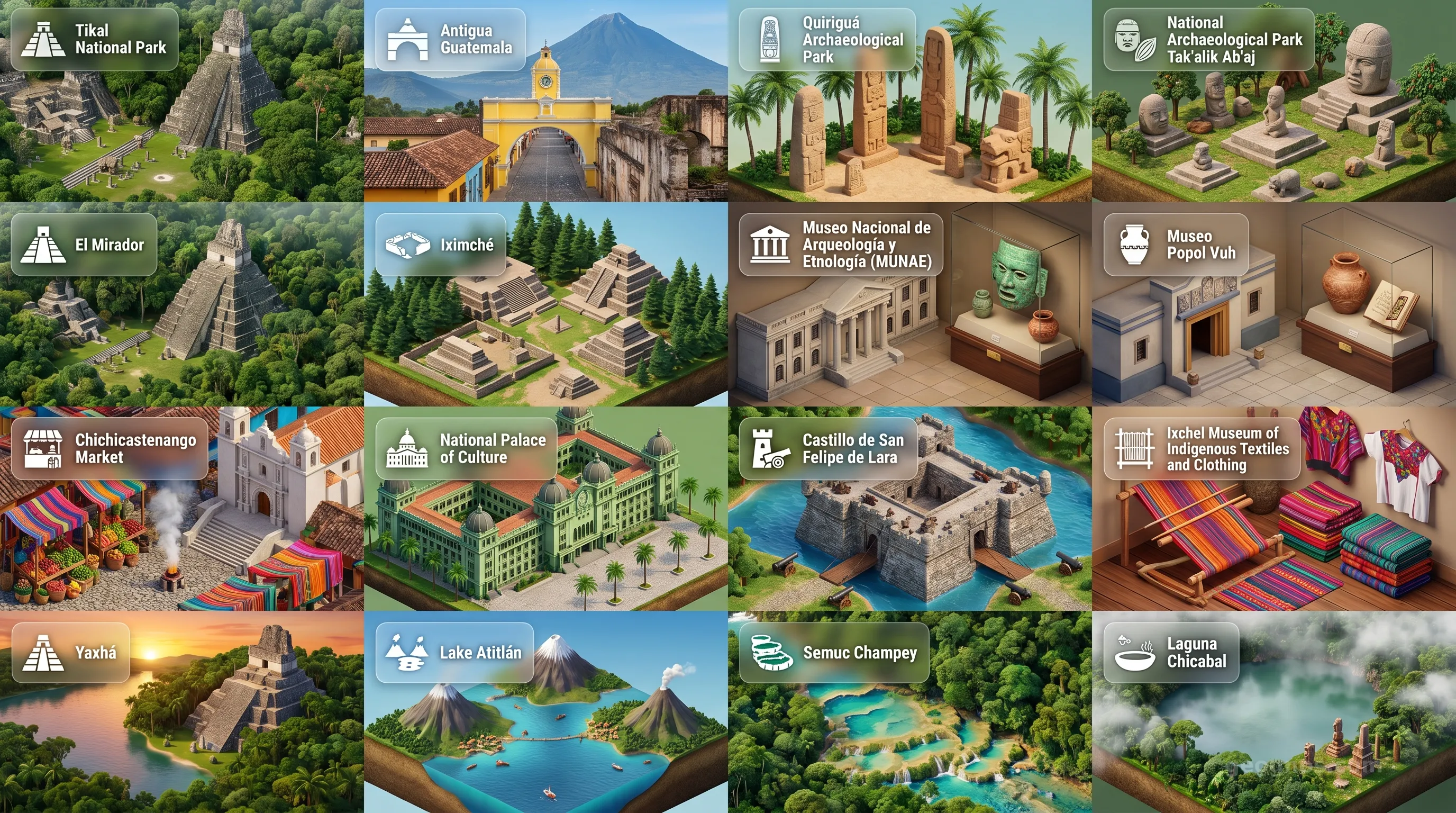
While the history provides the foundation, the modern geography provides the scenery. Guatemala serves as a vital biological corridor between the Americas, harboring cloud forests that capture the mist and lowlands that hold the breath of the Caribbean and Pacific coasts. The dramatic variation in climate allows for a staggering range of life. High-altitude coffee plantations compete with deep, shadowed cenotes and vast, bio-diverse nature reserves. To truly appreciate the range of settings, from the shimmering cobalt surface of Lake Atitlán to the dense, temple-crowned canopy of the northern Petén, you can peruse our points of interest cinematic showcase, which highlights the geography of the extraordinary sites that define the travel experience in this majestic country.
Every visitor and student who approaches Guatemala finds that the landscape dictates the itinerary. The steep slopes of the Sierra Madre and the deep valleys have necessitated a unique approach to transportation and community building. This has resulted in a nation of tight-knit highland markets, where commerce is conducted with a centuries-old cadence, and lowland gateways, where adventure seekers explore the archaeological mysteries that remain partially swallowed by the rainforest. The relationship between the ground, the spirit, and the community is the common thread that holds the Guatemalan experience together.
The Educator’s Perspective: Why Guatemala Matters
For our academic visitors, Guatemala serves as an essential case study in cultural endurance and environmental management. The ability of modern Mayan groups to preserve language, textile patterns, and agricultural techniques in a globalized world is nothing short of miraculous. Educators find the nation to be a living laboratory, where botany, archaeology, geology, and sociology overlap. It is a place that challenges the conventional definitions of development and value, focusing instead on the continuity of tradition and the resilience of a populace deeply connected to their ancestral lands.
Ultimately, Guatemala asks that you listen as much as you look. It is a land that speaks through the eruption of its peaks and the steady work of the artisans at their looms. It is a cornerstone of Mesoamerican history that refuses to be static, preferring instead to reinvent itself through the eyes of every generation that passes through its valleys. As we move deeper into the atlas of this remarkable country, we look forward to uncovering the specifics of its environment, the intricacies of its government, and the warmth of its people. We hope this foundation provides a starting point for a deeper journey into the geography and history of this extraordinary, evergreen nation.