The Resilience of the Grain Coast: Liberia's Singular Narrative
To look upon Liberia is to witness a profound experiment in the history of human freedom and the enduring power of geographical identity. Situated along the dramatic coastline of West Africa, where the Atlantic Ocean meets the lush, rain-drenched forests of the Upper Guinean biodiversity hotspot, Liberia occupies a space that is as distinct as it is symbolic. It is a nation whose very name translates to "Land of the Free," a designation that speaks volumes about its foundational aspirations and its unique position on the African continent.
Liberia's geography is defined by a rhythmic cycle of wet and dry seasons that transform its landscape. From the mist-covered peaks of Mount Wuteve in the north to the vibrant, sandy lagoons of its southern shores, the land pulsates with life. For travelers and scholars alike, understanding this country requires looking past the superficial map and peering into the layered experiences of those who built a nation against all odds. To truly grasp the complexity of this development, we encourage readers to explore the history of Liberia, where you can delve into the specific moments that forged a sovereign state out of diverse indigenous civilizations and repatriated settlers.
A Cross-Cultural Mosaic in the Heart of West Africa
The "soul" of Liberia is found in its vibrant mosaic of cultures. While the coastal corridors historically served as ports for international exchange, the hinterlands tell a deeper, ancient story of the Kpelle, Bassa, Kru, and Grebo peoples. This cultural synthesis has created a society that thrives on oral traditions, expressive music, and an enduring social resilience that informs daily life today. For those interested in visualizing the threads of this cultural tapestry, the History Cinematic Showcase offers an immersive experience, presenting a visual narrative of the events that helped shape the modern identity of the Liberian people through rare imagery and educational summaries.
It is within this framework that students and historians often find themselves testing their knowledge. Because Liberian history is deeply intertwined with global abolitionist movements and internal evolution, it provides a perfect subject for study. Those looking to sharpen their understanding of the timelines that dictate this national progression are invited to engage with our History Puzzle. By interacting with this chronology, you can earn badges while learning the sequence of foundational milestones that turned a vision of liberty into a tangible West African nation.
Geography as a Canvas for Potential
Liberia’s topography is a primary factor in its current and future development. The country is marked by high plateaus, low-lying coastal plains, and the sprawling drainage basins of rivers like the Saint Paul, the Saint John, and the Cavalla. These waterways have historically dictated patterns of migration, commerce, and settlement. The dense, evergreen forests of the interior serve as both an economic resource and a biological treasure trove, hosting rare flora and fauna that remain vital to global environmental health.
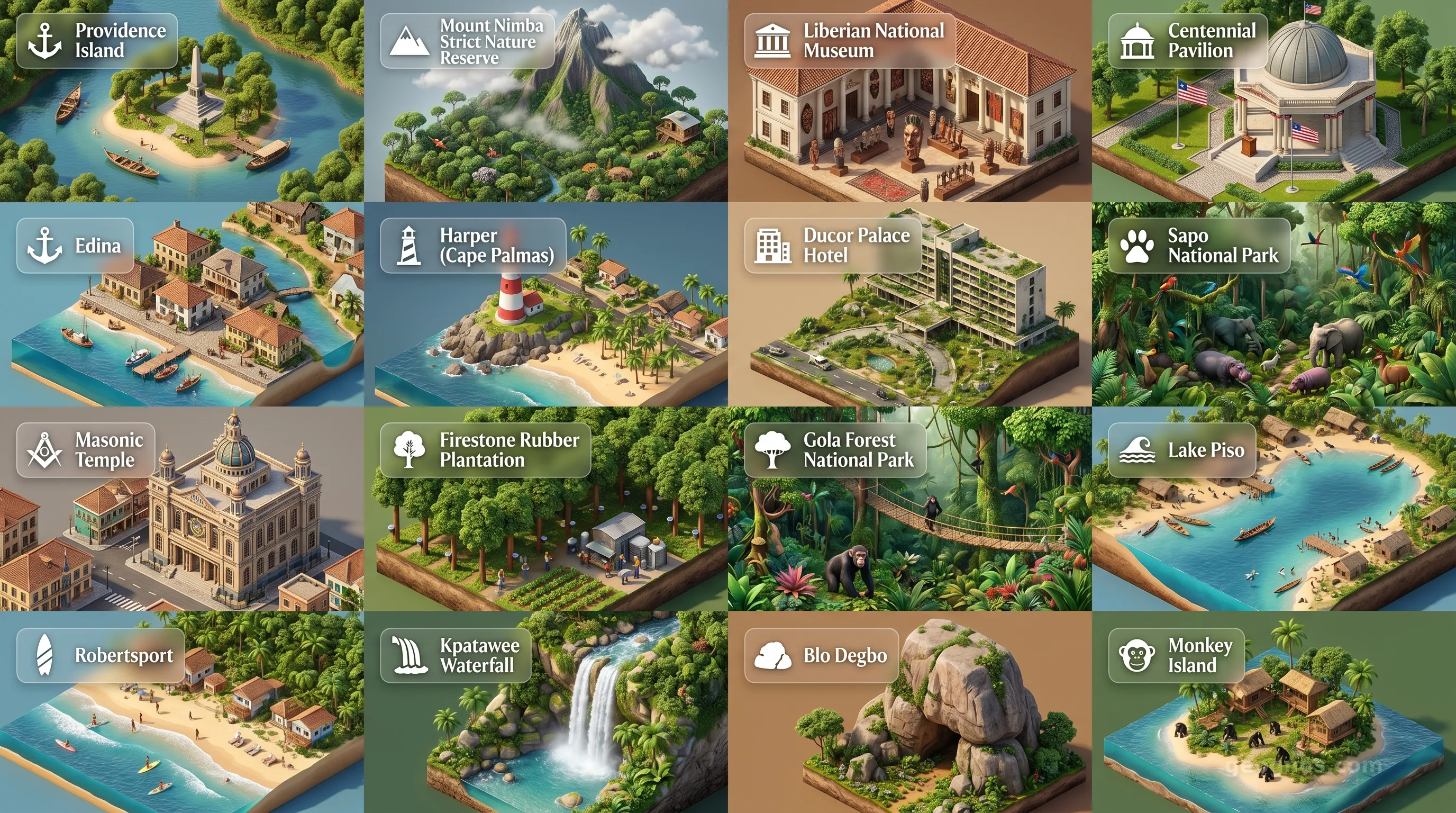
When planning a journey or conducting research, visual orientation is key to understanding why cities were established where they are or how topography affects infrastructure. We invite our users to view the POI Cinematic Showcase. This interactive tool provides a curated tour of the country's most significant landmarks, from the architectural remnants of its storied past in Monrovia to the pristine, untamed beauty of Sapo National Park. Seeing these locations in high-resolution detail provides a grounded context that bridges the gap between static textbook maps and the living, breathing environment of the nation.
A Vision Toward the Future
Liberia remains a country of untapped promise, standing at a crossroads of modernization and traditional values. As the nation continues to build its educational systems and economic infrastructure, its commitment to democratic processes and regional cooperation within ECOWAS signals a move toward stability and long-term progress. Educators often point to Liberia as a case study for the endurance of sovereign structures in post-colonial environments.
The spirit of Liberia is not merely written in its state documents, but felt in the optimism of its growing youth population and the preservation of its ecological wonders. As you traverse our portal dedicated to this fascinating nation, consider the intersections of geography and legacy. Liberia invites everyone, from the K12 student mapping the continent to the university researcher examining West African geopolitical shifts, to appreciate its ongoing journey. It is a land defined by its coastal gateways and forest heartlands, and we at GeoGnos are proud to document the path of this remarkable country as it shapes its destiny in the twenty-first century.