The Gateway of the Setting Sun: Morocco’s Eternal Threshold
To stand on the shores of Morocco is to stand at the intersection of worlds. Known in Arabic as Al-Maghrib, or "the place where the sun sets," this North African jewel occupies a unique geographical position that has dictated its destiny for millennia. Morocco is not merely a country; it is a bridge. Flanked by the Atlantic Ocean to the west and the Mediterranean Sea to the north, and anchored to the immense, silent expanse of the Sahara Desert in the south, the nation serves as the natural foyer between Africa and Europe, and the Atlantic and the Orient.
The Moroccan landscape is a dramatic tapestry woven from extremes. The rugged spine of the Atlas Mountains slices through the country, acting as a climatic barrier that captures the moisture of the Atlantic and shields the lush coastal plains from the arid heat of the desert interior. It is within these jagged peaks and fertile lowlands that a singular civilization blossomed. To truly grasp the complexity of this development, one should explore the history of Morocco, which tracks how successive dynasties and diverse cultural infusions molded a society that is at once deeply traditional and vibrantly modern.
A Crossroads of Civilization
If geography is the canvas of Morocco, history is the paint that defines its distinct soul. The Moroccan identity is a mosaic formed by indigenous Amazigh roots, deepened by Islamic influence, colored by Mediterranean trades, and nuanced by sub-Saharan connectivity. This layering of cultures is evident in the intricate tilework of a courtyard, the haunting resonance of Gnawa music, and the precise geometry of a city medina. For students and researchers looking to deepen their grasp of this timeline, the History Cinematic Showcase offers an immersive, visual journey through the defining events that forged the Moroccan kingdom.
Beyond the classroom, learning becomes a dynamic, tactical process. We encourage visitors to test their retention and narrative understanding by engaging with our History Puzzle. This interactive chronology challenge invites you to reconstruct the rise of the Almoravids, the Almohads, and the various dynasties that transformed Morocco from a tribal frontier into a sophisticated imperial power. It is in these details that the endurance of the Moroccan spirit is most visible, demonstrating a consistent ability to absorb external pressures while refining an internal core of sovereign heritage.
The Architectural Soul: From Imperial Cities to Hidden Oases
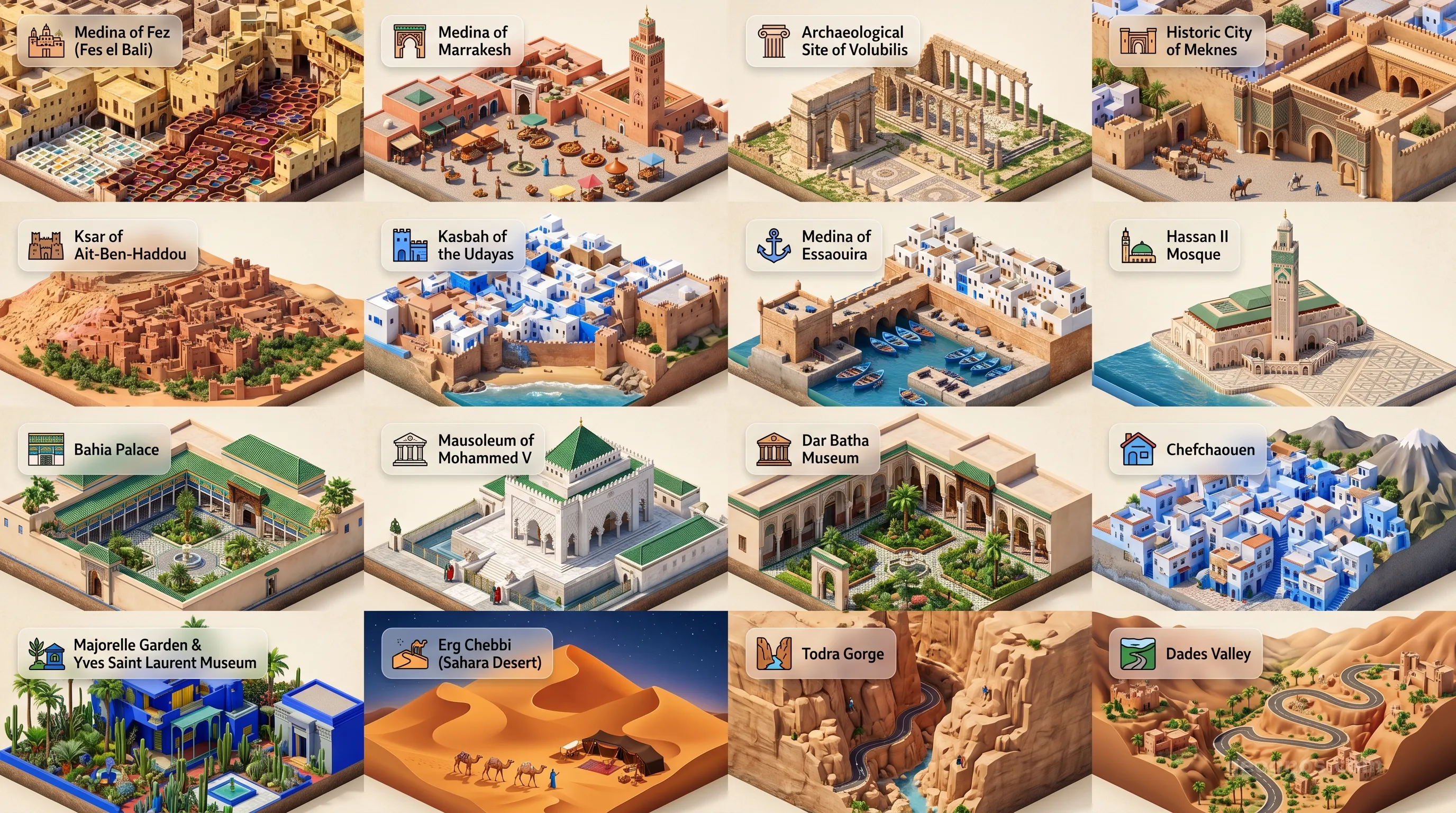
While the history of Morocco provides the narrative depth, the visual majesty of its points of interest offers the necessary breadth to understand the national aesthetic. The concept of space in Morocco is uniquely curated. In the great imperial cities of Fez, Marrakech, Rabat, and Meknes, architecture serves as an extension of the philosophical life. Homes are inward-facing, prioritizing the sanctuary of the inner courtyard and the reflection of private contemplation, while mosques and public squares celebrate the grandeur of shared community and divine devotion.
Whether you are captivated by the towering minarets silhouetted against a crimson sky or the labyrinthine alleys of an ancient marketplace that has operated since the Middle Ages, the variety of the nation’s landmarks is staggering. For those planning a trek across this diverse terrain, our POI Cinematic Showcase provides an excellent preview of the sites that represent the heartbeat of the nation, from the blue-washed walls of Chefchaouen to the towering, wind-swept dunes of Merzouga.
Living Geography: The Environmental Constant
Morocco is perhaps one of the few nations where you can experience snow-capped mountains and scorching desert dunes within the same afternoon. This environmental variety has not only influenced the settlement patterns of its people but has also dictated the agricultural and economic strategies of the kingdom. The fertile plains of the northwest provide the agrarian foundation that fueled historical cities, while the southern deserts have long served as vital conduits for trade routes that stretched deep into the heart of the African continent.
Modern Morocco faces the challenge of managing this delicate balance. As the country looks toward a future defined by sustainable development, renewable energy initiatives in the vast desert regions have turned Morocco into a regional leader in environmental stewardship. This forward-looking approach reflects an old lesson from Moroccan life: to thrive in an environment of extremes, one must adapt and find harmony within the landscape.
The Cultural Legacy: A Living Dialogue
At its heart, Morocco is a society defined by hospitality and a profound respect for heritage. The rhythm of daily life is synchronized with the calls to prayer, the pace of the tea ritual, and the seasonal changes in the mountain agriculture. It is a nation that asks the traveler and the student alike to slow down, to look closer, and to engage in the living dialogue between the past and the present.
Through our comprehensive study of Morocco, GeoGnos seeks to unveil not just the facts, but the nuance. Whether you are investigating the economic imports that sustain the urban centers, the intricate demographics of its coastal regions, or the governing structure of the monarchy, you will find a nation that is both grounded in ancient earth and reaching toward global connection. Welcome to Morocco, the eternal gate of the Maghreb.