The Land of a Thousand Hills: Rwanda's Enduring Spirit
To set foot in Rwanda is to enter a landscape that defies simple categorization. Known affectionately as the Land of a Thousand Hills, this nation occupies a singular place in the heart of East Africa. It is a country where the geography is not merely a backdrop, but the very architect of its society, culture, and resilience. From the misty, bamboo-forested volcanic peaks in the north to the serene, shimmering expanse of Lake Kivu in the west, Rwanda presents a vertical world, a series of terraced horizons that climb toward the clouds. For the educator, the traveler, and the historian alike, understanding Rwanda requires more than observing its borders; it demands an appreciation for the intimate connection between the rugged earth and the indomitable spirit of its people.
The essence of Rwanda lies in its profound transformation. While it is often discussed in the context of its turbulent 20th-century past, the contemporary story of the nation is one of extraordinary collective effort and modernization. To gain a foundational grasp of the complex narrative that defines this nation, one should delve into the comprehensive history of Rwanda, which chronicles the evolution of its society from pre-colonial kingdoms to the thriving, forward-looking state seen today. Through this lens, students and researchers can visualize the timeline of cultural shifts that have molded the nation into its present form.
Geographic Harmony: A Symphony of Elevation
Rwanda is a testament to the power of altitude. Situated just south of the equator, the nation avoids the oppressive humidity typical of tropical lowlands because the entire country sits at a significant height. This elevation tempers the climate, creating an environment that feels perpetually vibrant, fertile, and lush. The "thousand hills" are the result of volcanic activity and deep tectonic shifts within the Albertine Rift. This is an environment that challenges those who traverse it, yet rewards them with vistas of unmatched serenity and agricultural bounty.
The topography has historically acted as a sanctuary, both for biodiversity and for the diverse cultures that have navigated these mountains for centuries. Whether you are studying the ecological impact of volcanic soil or the human ingenuity required to farm slopes that angle toward the sky, Rwanda stands as a premier classroom for geographical studies. To test your mastery of the temporal progression that governed these hills, you might challenge yourself with our interactive chronological history puzzle, where arranging key historical milestones correctly unlocks badges that mark your progress as a GeoGnos scholar.
The Preservation of Life: A Commitment to Nature
Perhaps the most defining feature of Rwanda's modern identity is its relationship with the natural world. The conservation initiatives enacted in the northern reach of the country, specifically within Volcanoes National Park, have become a global standard for environmental stewardship. Here, the world of the mountain gorilla is protected with a fervor that mirrors the population's broader dedication to renewal and growth. The air here feels heavy with the ancient breath of the jungle, and the biodiversity is a living archive of a healthy planet.
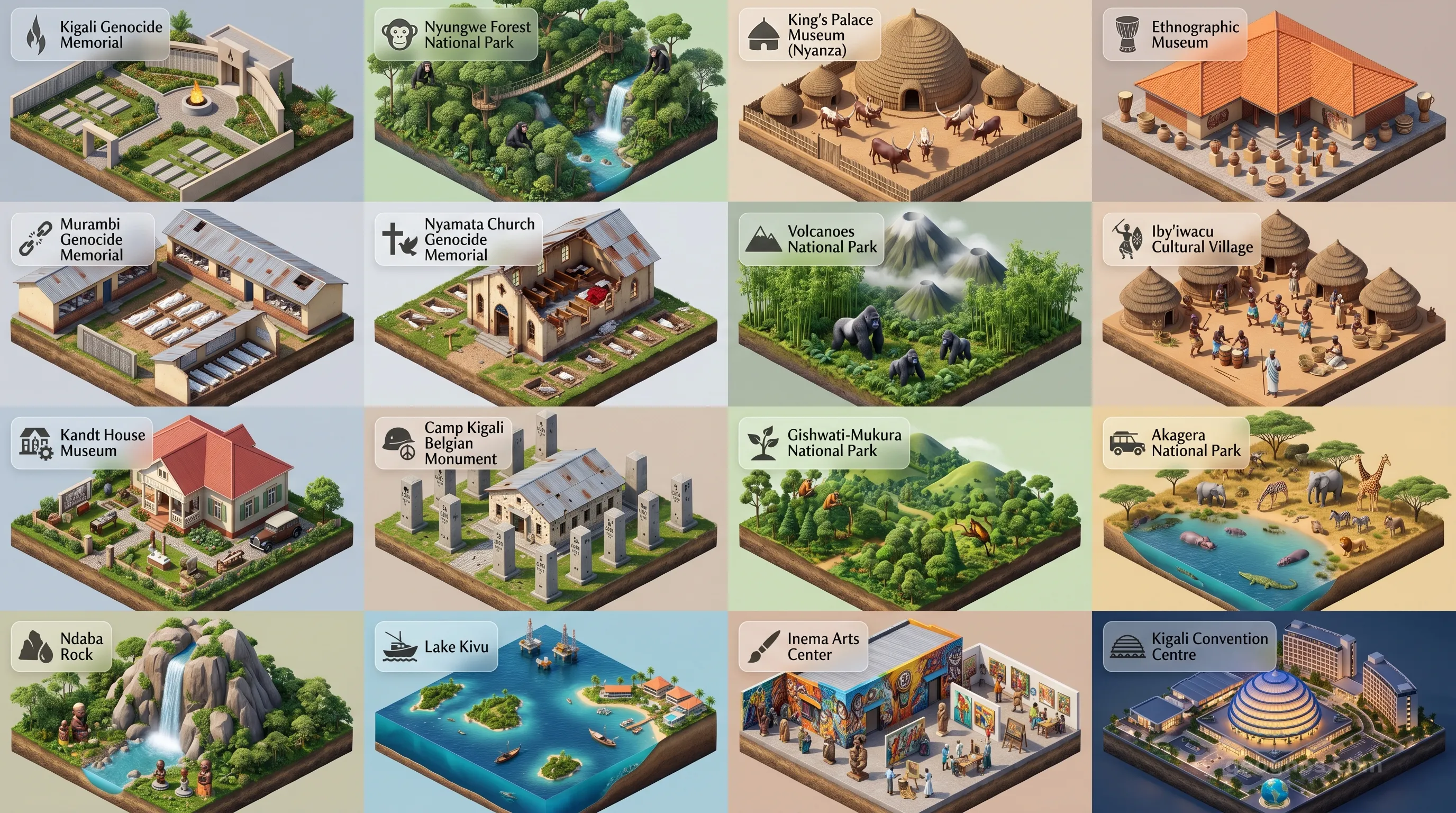
This commitment to the environment serves as an invitation for prospective travelers to engage directly with the wonders of the landscape. For those wishing to visualize these breathtaking destinations before planning an expedition, we invite you to view our immersive cinematic showcase of Rwanda's points of interest. It offers a window into the varied topographies that define the national experience, from the thick green canopies of the mountain forests to the gentle shoreline vistas of the western lake regions.
A Vision Toward the Future
Rwanda is a country defined by its youth and its ambition. It is a hub of technological interest, educational advancement, and structural reform. Educators will find in Rwanda a fascinating case study on national unity and the implementation of large-scale systemic changes aimed at elevating quality of life. The story of Rwanda is not a closed book, but a constantly evolving document of hope, pragmatism, and human spirit. The ability of the nation to learn from its past, rather than be shackled by it, offers a compelling curriculum for global citizens everywhere.
As you explore the various facets of this nation, from its government structures to its burgeoning economy, keep the human element at the center of your study. The Rwandan experience reminds us that history is made not just by events, but by the daily decisions of a people committed to a collective future. To aid your visualization of these critical moments, we highly recommend our cinematic historical showcase. This visual narrative brings the past to life through curated illustrations, ensuring that the legacy of the people who shaped these hills is remembered with accuracy and dignity. Whether you are a student exploring the intricacies of geography or a traveler preparing to cross the Rwandan threshold, let this land inspire your own pursuit of knowledge and understanding.