🇸🇦

Saudi Arabia

Middle East Countries
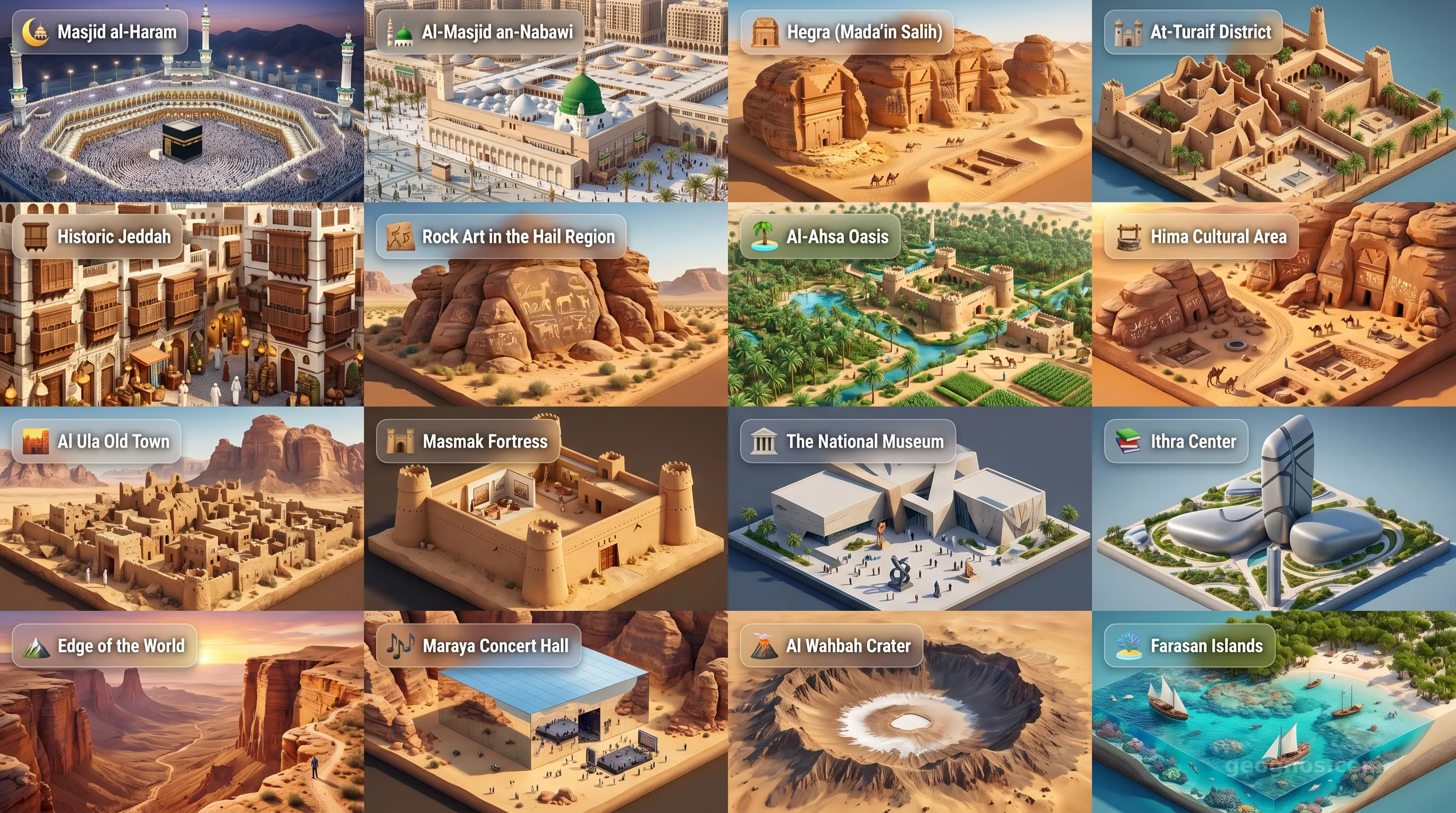
Saudi Arabia - Panoramic Places of Interest Atlas including Masjid al-Haram (Great Mosque of Mecca), Al-Masjid an-Nabawi (The Prophet's Mosque), Hegra (Mada'in Salih), At-Turaif District in ad-Dir'iyah, Historic Jeddah (Al-Balad), Rock Art in the Hail Region, Al-Ahsa Oasis, Hima Cultural Area, Al Ula Old Town, Masmak Fortress, The National Museum of Saudi Arabia, King Abdulaziz Center for World Culture (Ithra), Edge of the World (Jebel Fihrayn), Maraya Concert Hall, Al Wahbah Crater, Farasan Islands

Top Sights & Landmarks

01

Masjid al-Haram (Great Mosque of Mecca)

The Holiest Site in Islam

02

Al-Masjid an-Nabawi (The Prophet's Mosque)

The Prophet's Resting Place

03

Hegra (Mada'in Salih)

Ancient Nabataean Necropolis

04

At-Turaif District in ad-Dir'iyah

Birthplace of the Saudi State

05

Historic Jeddah (Al-Balad)

The Gateway to Makkah

06

Rock Art in the Hail Region

Prehistoric Desert Petroglyphs

07

Al-Ahsa Oasis

The World's Largest Oasis

08

Hima Cultural Area

Ancient Caravan Waystation

09

Al Ula Old Town

Labyrinth of Mudbrick Heritage

10

Masmak Fortress

The Citadel of Riyadh

11

The National Museum of Saudi Arabia

A Journey Through Arabian Time

12

King Abdulaziz Center for World Culture (Ithra)

Architectural Marvel of Knowledge

13

Edge of the World (Jebel Fihrayn)

Dramatic Desert Escarpment

14

Maraya Concert Hall

The World's Largest Mirrored Building

15

Al Wahbah Crater

Volcanic Wonder with a Salt Heart

16

Farasan Islands

Pristine Red Sea Archipelago

The Kingdom of Sands and Stars: An Introduction to Saudi Arabia

To stand upon the sands of the Arabian Peninsula is to stand at the threshold of human civilization. Saudi Arabia, a nation defined by its vast, rolling deserts and its jagged, atmospheric mountain ranges, occupies a unique position in the story of our world. It is a land where the whispers of ancient incense caravans still echo through the canyons, yet it is also a nation firmly planted in the vanguard of the twenty-first century. For centuries, the geography of this peninsula served as an impenetrable barrier, fostering a culture of profound resilience and inward reflection, even as it acted as a vital bridge between East and West.

Understanding this nation requires a shift in perspective. Here, the landscape is not merely a backdrop for history. The harsh beauty of the Empty Quarter (Rub' al Khali), the world's largest contiguous sand desert, has dictated the migration patterns, the survival strategies, and the philosophical outlook of its people for millennia. Yet, beneath the arid dunes and the rugged basalt plateaus lies a rich tapestry of cultural development that predates many of the world's empires. As we explore the history of Saudi Arabia, we find a narrative of transformation, from the tribal origins of the central Najd region to the formation of a unified modern state that anchors the global Islamic community.

A Crossroads of Human Heritage

Saudi Arabia is often perceived as a monolithic expanse, but its character is remarkably diverse. From the turquoise waters of the Red Sea, where coral reefs flourish in untouched marine habitats, to the mist-covered peaks of the Asir Mountains in the southwest, the country is a study in contrasts. These geographic disparities have given rise to regional identities, each contributing to a collective national spirit defined by generous hospitality (known locally as karam) and a deeply ingrained respect for the wisdom of the past.

To truly appreciate how this complex landscape gave rise to a sophisticated society, you might wish to dive deeper into our interactive resources. If you are a student or a visual learner, you can explore the history of Saudi Arabia, which provides a comprehensive, academically curated overview of the major turning points that transformed the peninsula from a cluster of regional entities into a world power. We invite our younger readers and puzzle enthusiasts to challenge their knowledge through our history puzzle, an engaging, gamified platform where you can arrange landmark events in their proper chronological order to earn digital accolades and mastery badges.

The Living History: Seeing the Kingdom

The history of the Kingdom is written in stone and sand. Thousands of petroglyphs and inscriptions, etched into the desert cliffs, tell stories of civilizations that vanished before the written word became common practice elsewhere. The Nabataean influence at Al-Hijr, or Mada'in Salih, reveals a society of architects who carved grandeur directly from the living rock, creating a city that mirrors the famed Petra of Jordan. For those who cannot walk these paths today, we provide a virtual bridge to the past through our history cinematic showcase. This feature utilizes high-resolution digital illustrations and immersive narratives to bring the rise of the desert kingdoms to life, highlighting the pivotal role this region played in the tapestry of global trade routes, including the fabled Incense Road.

Furthermore, Saudi Arabia is a nation in the midst of a spectacular opening, unveiling wonders that have remained largely unseen by the international community for decades. From the ancient oasis of Al-Ula to the bustling, futuristic streetscapes of Riyadh and the burgeoning cultural hubs along the coast, the country is a photographer's dream. You can get a closer look at these incredible locations by browsing our POI cinematic showcase. This interactive carousel takes you on a tour of the country's crown jewels, from heritage sites recognized by UNESCO to the contemporary engineering marvels that are reshaping the horizon of the Saudi landscape.

Geography and the Human Spirit

At its heart, Saudi Arabia is an arid realm that demands respect. With its massive territorial footprint, the Kingdom is home to a staggering array of environments. The central plateau, the Najd, offers a vast, golden solitude, while the eastern coast, fringed by the Persian Gulf, serves as an engine of industry and modern connectivity. The geography here is not a limitation but a foundation; it has shaped the resourcefulness of the Saudi people, fostering an economy that evolved from ancient pastoralism to a center of global energy and innovation.

As we examine the Kingdom through the eyes of a historian and a traveler, it is essential to appreciate how the geography, the traditions, and the modern aspirations of Saudi Arabia exist in a state of harmonious tension. The nation is proud of its heritage, valuing the preservation of its language, arts, and culinary traditions, even as it pivots toward a diversified and technology-driven future. It is a land of great, enduring mysteries and warm, inviting people, all waiting to be discovered by those who take the time to learn the language of its terrain.

As we delve further into the various sections of this page, you will find detailed insights into the demographics that populate this vast land, the environmental policies being implemented to preserve its delicate desert ecosystems, and the robust infrastructure connecting its sprawling urban centers. We invite you to join us on this scholarly and sensory journey across the dunes and through the centuries that define the Kingdom of Saudi Arabia.
Location

Latitude
25° N
Longitude
45° E
N S W E
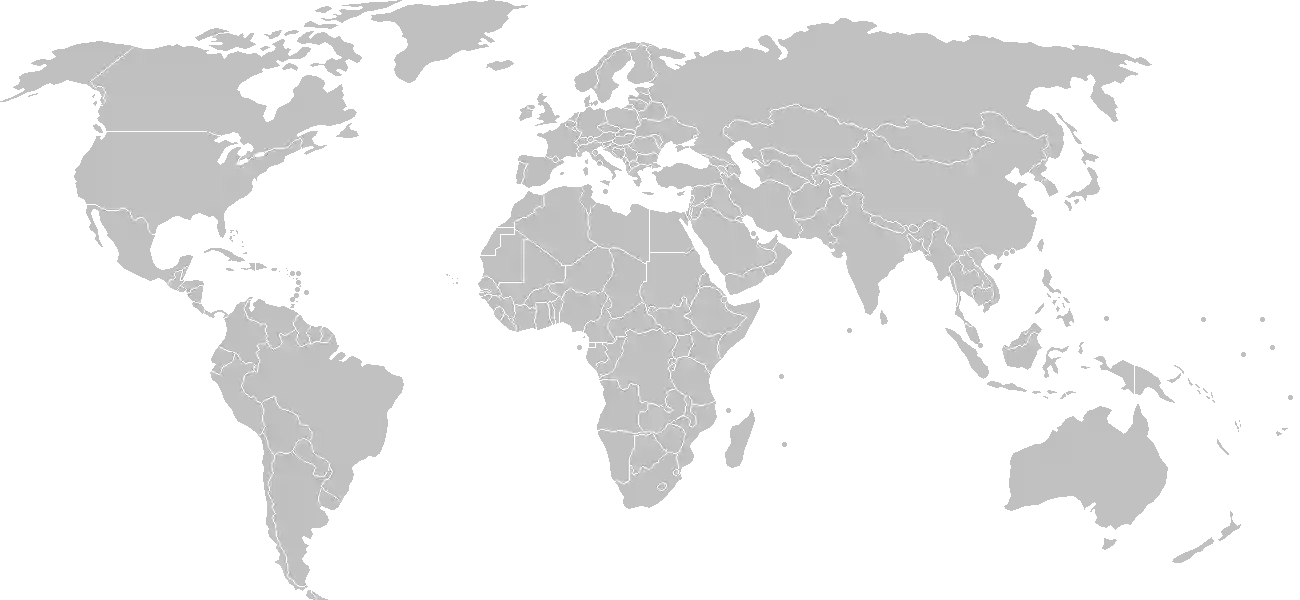
World Map Location
Geographic Location

Middle East, bordering the Persian Gulf and the Red Sea, north of Yemen

Map Reference
Middle East

Area

Total Area
2,149,690 sq km
Land (100%)
Land: 2,149,690 sq km
Water: 0 sq km

Elevation

Highest Point
As Sarawat range,
As Sarawat range, 3,000 m
Lowest Point
Persian Gulf
Persian Gulf 0 m
Mean Elevation
665 m

Detailed Geography Information

Coastline

2,640 km

Geography - note

Saudi Arabia is the largest country in the world without a river; extensive coastlines on the Persian Gulf and Red Sea allow for considerable shipping (especially of crude oil) through the Persian Gulf and Suez Canal

Irrigated land

7,575 sq km (2022)

Land boundaries

Total boundary: 4,272 km
Iraq 811 km
Jordan 731 km
Kuwait 221 km
Oman 658 km
Qatar 87 km
UAE 457 km
Yemen 1307 km

Major aquifers

Arabian Aquifer System

Major watersheds (area sq km)

Indian Ocean drainage: (Persian Gulf) Tigris and Euphrates (918,044 sq km)

Maritime claims

territorial sea: 12 nm contiguous zone: 18 nm continental shelf: not specified

Natural hazards

frequent sand and dust storms volcanism: little activity in the past few centuries, despite many volcanic formations; volcanoes include Harrat Rahat, Harrat Khaybar, Harrat Lunayyir, and Jabal Yar

Natural resources

petroleumnatural gasiron oregoldcopper

Terrain

mostly sandy desert

Population & Growth

+1.70% Growth
37,172,774
Total inhabitants (2025 est.)
Male: 56.7% (21,067,984) Female: 43.3% (16,104,790)

Age Distribution

0-14 years
22.9%
~8,512,565
15-64 years
72.7%
~27,024,607
65 years
4.4%
~1,635,602
Note: 2024 est.

Demographic Longevity

Median Age
32.8 years
Male
34.6 yrs
Female
29.3 yrs
Life Expectancy
77.2 years
Male
75.6 yrs
Female
78.8 yrs

Vital Dynamics

Birth Rate
13.41
births per 1,000 people
Death Rate
3.51
deaths per 1,000 people
Net Migration
+7.35
migrants per 1,000 people
Fertility Rate
1.84
children born per woman

Detailed People & Society Information

Alcohol consumption per capita

0 liters of pure alcohol (2019 est.)

Children under the age of 5 years underweight

3.5% (2020 est.)

Currently married women (ages 15-49)

55.3% (2022 est.)

Dependency ratios

total dependency ratio: 36.9 (2025 est.) youth dependency ratio: 30.5 (2025 est.) elderly dependency ratio: 6.3 (2025 est.) potential support ratio: 15.8 (2025 est.)

Education expenditure

5.1%

5.1% of GDP (2023 est.) 14.8% national budget (2024 est.)

Ethnic groups

Arab
90%
Afro-Asian
10%

Gross reproduction rate

0.9 (2025 est.)

Health expenditure

6%

6% of GDP (2021) 12.8% of national budget (2022 est.)

Hospital bed density

2.2 beds/1,000 population (2021 est.)

Infant mortality rate

total: 11.4 deaths/1,000 live births (2025 est.) male: 12.8 deaths/1,000 live births female: 10.5 deaths/1,000 live births

Languages

Literacy

total population: 97.9% (2024 est.) male: 98.6% (2024 est.) female: 96.7% (2024 est.)

Major urban areas - population

7.682 million RIYADH (capital), 4.863 million Jeddah, 2.150 million Mecca, 1.573 million Medina, 1.329 million Ad Dammam, 872,000 million Hufuf-Mubarraz (2023)

Maternal mortality ratio

7 deaths/100,000 live births (2023 est.)

Nationality

noun: Saudi(s) adjective: Saudi or Saudi Arabian

Obesity - adult prevalence rate

35.4% (2016)

Physician density

3.41 physicians/1,000 population (2023)

Population distribution

historically a population that was mostly nomadic or semi-nomadic, the Saudi population has become more settled since oil was discovered in the 1930s; most of the country's population is now concentrated in a wide area across the middle of the peninsula, from Ad Dammam in the east through Riyadh in the interior to Mecca-Medina in the west near the Red Sea

Refugees and internally displaced persons

Total Displaced & Vulnerable Persons
74,355 individuals
Refugees
5.9%
4,355
4,355 (2024 est.)
Stateless Persons
94.1%
70,000
70,000 (2024 est.)

Religions

Muslim
90%

School life expectancy (primary to tertiary education)

total: 17 years (2022 est.) male: 16 years (2022 est.) female: 18 years (2022 est.)

Sex ratio

at birth: 1.05 male(s)/female 0-14 years: 1.04 male(s)/female 15-64 years: 1.42 male(s)/female 65 years and over: 1.14 male(s)/female total population: 1.31 male(s)/female (2024 est.)

Tobacco use

total: 17.6% (2025 est.) male: 28.3% (2025 est.) female: 2% (2025 est.)

Climate & Issues

Climate Profile

harsh, dry desert with great temperature extremes

Key Environmental Issues
desertification depletion of underground water resources limited freshwater resources coastal pollution from oil spills air pollution waste management

Land Cover

Coverage Distribution
Agri (81%)
Other (18%)
Arable: 1.6%
Crops: 0.1%
Pasture: 79.1%
Forest: 1.3%

Air & Carbon Emissions

Annual CO2 Output 2023 est.
656.511 million
Coal (100%) Oil (0%) Gas (0%)
PM2.5 Exposure 60.7 µg/m³
0 5 (WHO Limit) 15 25 35+
Methane Emissions
energy: 1,743.8 kt (2022-2024 est.)

Water Resources & Use

Renewable Water Resources 2.4 billion cubic meters (2022 est.)
Annual Water Withdrawal
municipal: 3.392 billion cubic meters (2022 est.)
Municipal (13%) Ind (5%) Agri (82%)

Detailed Environmental Information

Geoparks

total global geoparks and regional networks: 2 (2025) global geoparks and regional networks: North Riyadh; Salma (2025)

International environmental agreements

BiodiversityClimate ChangeClimate Change-Kyoto ProtocolClimate Change-Paris AgreementDesertificationEndangered SpeciesHazardous WastesLaw of the SeaMarine Dumping-London ProtocolOzone Layer ProtectionShip Pollution

Urbanization

urban population: 85% of total population (2023) rate of urbanization: 1.69% annual rate of change (2020-25 est.)

Waste and recycling

municipal solid waste generated annually: 16.126 million tons (2024 est.) percent of municipal solid waste recycled: 18.8% (2022 est.)

Capital & State Profile

Capital City
Riyadh
24.65° N, 46.7° E
Timezone UTC+3
Government Type
absolute monarchy
Independence 1932-09-23
National Holiday 09-23

Executive Branch

Chief of State
King SALMAN bin Abd al-Aziz Al Saud (since 23 January 2015)
Head of Government
Crown Prince and Prime Minister MUHAMMAD BIN SALMAN bin Abd al-Aziz Al Saud (since 27 September 2022)
Cabinet Council of Ministers appointed by the monarch every 4 years and includes many royal family members

Legislative Branch

unicameral
Legislature Name Shura Council (Majlis Ash-Shura)
Seats & Term
151 (all appointed) seats / 4 years
Women in Chamber
19.9% Representation
Electoral System N/A

National Identity & Symbols

National Flag Description

green (traditional Islamic color) with the Shahada, or Muslim creed, in large white Arabic script that translates as, "There is no god but God; Muhammad is the messenger of God;" the text is above a white horizontal saber pointing to the left

Symbolic Meaning history: design dates to the early 20th century and is closely associated with the Al Saud family that established the kingdom in 1932; the flag has different sides so that the text reads correctly from right to left and the saber points in the same direction on both sides
National Symbol palm tree over two crossed swords
National Colors green, white
National Anthem Aash Al Maleek (Long Live Our Beloved King)

Detailed Government Information

Administrative divisions

13 regions (manatiq, singular - mintaqah); Al Bahah, Al Hudud ash Shamaliyah (Northern Border), Al Jawf, Al Madinah al Munawwarah (Medina), Al Qasim, Ar Riyad (Riyadh), Ash Sharqiyah (Eastern), 'Asir, Ha'il, Jazan, Makkah al Mukarramah (Mecca), Najran, Tabuk

Citizenship

citizenship by birth: no citizenship by descent only: the father must be a citizen of Saudi Arabia; a child born out of wedlock in Saudi Arabia to a Saudi mother and unknown father dual citizenship recognized: no residency requirement for naturalization: 5 years

Constitution

history: 1 March 1992 -- Basic Law of Government, issued by royal decree, serves as the constitutional framework and is based on the Qur'an and the life and traditions of the Prophet Muhammad amendment process: proposed by the king directly or proposed to the king by the Consultative Assembly or by the Council of Ministers; passage by the king through royal decree

Country name

conventional long form: Kingdom of Saudi Arabia conventional short form: Saudi Arabia local long form: Al Mamlakah al Arabiyah as Suudiyah local short form: Al Arabiyah as Suudiyah etymology: named after the ruling dynasty of the country, the House of Saud; the name Arabia can be traced back at least as far as the ancient Romans, who referred to the peninsula as "Arabia Felix" (Arabia the Fortunate)

International law organization participation

has not submitted an ICJ jurisdiction declaration; non-party state to the ICCt

International organization participation

Judicial branch

highest court(s): High Court (consists of the court chief; organized into circuits with 3-judge panels, except for the criminal circuit, which has a 5-judge panel for cases involving major punishments) judge selection and term of office: High Court chief and chiefs of the High Court Circuits appointed by royal decree on the recommendation of the Supreme Judiciary Council, a 10-member body of high-level judges and other judicial heads; new judges and assistant judges serve 1- and 2-year probations, respectively, before permanent assignment subordinate courts: Court of Appeals; Specialized Criminal Court, first-degree courts composed of general, criminal, personal status, and commercial courts; Labor Court; a hierarchy of administrative courts

Legal system

Islamic (sharia) system with some elements of Egyptian, French, and customary law; commercial disputes handled by special committees

National heritage

total World Heritage Sites: 7 (7 cultural, 1 natural) selected World Heritage Site locales: Hegra Archaeological Site (al-Hijr / Madā ͐ in Ṣāliḥ) (c); At-Turaif District in ad-Dir'iyah (c); Historic Jeddah, the Gate to Makkah (c); Rock Art in the Hail Region of Saudi Arabia (c); Al-Ahsa Oasis, an Evolving Cultural Landscape (c); Ḥimā Cultural Area (c); ‘Uruq Bani Ma’arid (n);The Cultural Landscape of Al-Faw Archaeological Area (c)

Political parties

none

Suffrage

18 years of age; universal for municipal elections

Economic Overview

high-income, oil-based Middle Eastern economy; OPEC founding member; Vision 2030 strategy prioritizing economic diversification, increased private sector involvement, and projects funded by sovereign wealth fund and foreign investment; young labor force; falling but significant poverty rate despite lack of official statistics

Size & Performance

Real GDP (PPP)
$2.213 trillion
Latest available estimate (2024)
2023: $2.173 trillion2022: $2.161 trillion
Real GDP Growth
1.8% (2024 est.)
+1.8%
GDP Per Capita (PPP)
$62,700
2023: $64,5002022: $67,200

GDP Sector Breakdown

Agriculture: 2.5%Industry: 44.8%Services: 47.2%
Origin GDP %
Agriculture 2.5%
Industry 44.8%
Services 47.2%

Trade Balance

Trade Position
Trade Surplus
$43.88 billion
Total Exports
$360.897 billion (2024 est.)
Total Imports
$317.012 billion (2024 est.)
Exports (53%) Imports (47%)

Budget Balance

Budget Position
Budget Deficit
-$10.08 billion
Revenues
$378.413 billion (2023 est.)
Expenditures
$388.489 billion (2023 est.)
Revenues (49%) Expenditures (51%)

Export Profile

Top Export Partners

21.0%
12.0%
12.0%
6.0%
4.0%
Note: 2023; top five export partners based on percentage share of exports

Major Export Commodities

crude petroleumrefined petroleumplasticsalcoholsships

Import Profile

Top Import Partners

21.0%
8.0%
7.0%
6.0%
Note: 2023; top five import partners based on percentage share of imports

Major Import Commodities

carsrefined petroleumgoldbroadcasting equipmentpackaged medicine

Labor & Employment

Total Labor Force 17.168 million (2024 est.)
General Unemployment Rate 3.9%
Youth Unemployment (Ages 15-24) 13.8%

Income Inequality

Detailed Economic Data

Agricultural products

milkdateschickenwheattomatoeswatermelonspotatoesoliveseggsonions

Current account balance

-$5.685 billion (2024 est.) $35.133 billion (2023 est.) $150.353 billion (2022 est.) note: balance of payments - net trade and primary/secondary income in current dollars

Exchange rates

Saudi riyals (SAR) per US dollar - Exchange rates: 3.75 (2024 est.) 3.75 (2023 est.) 3.75 (2022 est.) 3.75 (2021 est.) 3.75 (2020 est.)

GDP - composition, by end use

Industrial production growth rate

-1.3% (2024 est.) note: annual % change in industrial value added based on constant local currency

Industries

crude oil productionpetroleum refiningbasic petrochemicalsammoniaindustrial gasessodium hydroxide (caustic soda)cementfertilizerplasticsmetalscommercial ship repaircommercial aircraft repairconstruction

Inflation rate (consumer prices)

1.7% (2024 est.) 2.3% (2023 est.) 2.5% (2022 est.) note: annual % change based on consumer prices

Remittances

0% of GDP (2024 est.) 0% of GDP (2023 est.) 0% of GDP (2022 est.) note: personal transfers and compensation between resident and non-resident individuals/households/entities

Reserves of foreign exchange and gold

$463.87 billion (2024 est.) $457.949 billion (2023 est.) $478.232 billion (2022 est.) note: holdings of gold (year-end prices)/foreign exchange/special drawing rights in current dollars

Taxes and other revenues

7.8% (of GDP) (2023 est.) note: central government tax revenue as a % of GDP

Grid Infrastructure

Electricity Access 100%
Capacity 119.62 million kW (2023 est.)
Consumption 383.512 billion kWh (2023 est.)
Exports 352 million kWh (2023 est.)
Imports 308 million kWh (2023 est.)
Grid Losses: 38.23 billion kWh (2023 est.)

Generation Mix

Percentage Share of Production
fossil fuels 99.3%
wind 0.4%
solar 0.3%

Fossil Fuels Production

Petroleum
Production 11.174 million bbl/day (2023 est.)
Consumption 3.524 million bbl/day (2023 est.)
Proven Reserves 258.6 billion barrels (2021 est.)
Natural Gas
Production 121.219 billion cubic meters (2023 est.)
Consumption 121.219 billion cubic meters (2023 est.)
Proven Reserves 9.423 trillion cubic meters (2021 est.)
Coal
Consumption 66,000 metric tons (2023 est.)
Exports 500 metric tons (2023 est.)
Imports 223,000 metric tons (2023 est.)

Intensity & Nuclear

Energy Consumption Per Capita 349.692 million Btu/person (2023 est.)
No nuclear energy infrastructure or reactor operations reported in this country dossier.

Digital Access

.sa
Internet Usage 100%

Active internet users as a percentage of the total population.

Fixed Broadband

Penetration Rate 44 / 100
Total Subscriptions 14.5 million (2023 est.)

Mobile Cellular

Penetration Rate 160 / 100
Total Subscriptions 54.2 million (2024 est.)

Broadcast Media

state-controlled broadcast media; state-run TV operates 4 networks; major market for pan-Arab satellite TV broadcasters; state-run radio with several networks; multiple international broadcasters available

Aviation

HZ
Airports
90
As of 2025
Heliports
69
As of 2025

Railways

Total Track Length
5,410 km
National Network Data from 2016

Ports & Harbors

Ports Count 16
Hover for breakdown & key ports As of 2024

Merchant Marine

Commercial Fleet
433 ships
Hover for vessel types breakdown As of 2023

Military Expenditures

GDP Allocation 7.1%
7.1% of GDP (2024 est.) 7% of GDP (2023 est.) 6.5% of GDP (2022 est.) 7% of GDP (2021 est.) 8% of GDP (2020 est.)

Active Duty Strengths

approximately 250,000 active Saudi Armed Forces, including 125,000 under the Ministry of Defense and 125,000 in the National Guard (2025)

Refers to active military personnel.

Service & Defense Details

Military and security forces

the Saudi Arabian Armed Forces (SAAF) are divided into two ministries: Ministry of Defense: Royal Saudi Land Forces, Royal Saudi Naval Forces (includes marines, special forces, naval aviation), Royal Saudi Air Force, Royal Saudi Air Defense Forces, Royal Saudi Strategic Missiles Force; Ministry of the National Guard: Saudi Arabian National Guard (SANG) Other security forces include: Ministry of Interior: Facilities Security Forces, Public Security Forces (police), General Directorate of Border Guard State Security Presidency (SSP): General Directorate of Investigation (Mabahith), Special Security Forces, Special Emergency Forces (2025) note 1: the regular armed forces under the Ministry of Defense are responsible for external defense, although they can be called for domestic security duties if needed note 2: the SANG (also known as the White Army) is a land force comprised of tribal elements loyal to the House of Saud; it is responsible for internal security, protecting the royal family, guarding against military coups, defending strategic facilities and resources, and providing security for the cities of Mecca and Medina; it may also assist the regular armed forces in combat operations note 3: the SAAF includes the Saudi Royal Guard Command, a unit which provides security and protection to the ruling family and other dignitaries

Military equipment inventories and acquisitions

the inventory of the Saudi military forces, including the SANG, is comprised of imported modern armaments; major suppliers include Canada, China, France, Spain, the UK, and the US; Saudi Arabia is one of the world's largest importers of arms (2025) note: the Saudi Navy is in the midst of a multi-year and multi-billion-dollar expansion and modernization program to purchase new frigates, corvettes, and other naval craft from such suppliers as Spain and the US

Military - note

Saudi Arabia's security concerns include border security, cyberattacks, instability in Yemen, international terrorism, maritime security, and regional rivals such as Iran and Turkey Saudi Arabia has close security ties with the US; the SAAF conducts bilateral exercises with the US military and hosts US forces; the US has participated in a cooperative program to equip and train the SANG since 1973, and much of the equipment for both the regular forces and the SANG has been acquired from the US; Saudi Arabia also has defense relationships with China, France, India, Pakistan, the UK, and fellow Gulf Cooperation Council (GCC) members; it is a member of the Peninsula Shield Forces, a joint military force established by the GCC countries with the aim of maintaining security and stability in the region; the force was established in 1982, and its leadership is based in Saudi Arabia (2025)

Military service age and obligation

voluntary military service for men (17-40) and women (typically 21-40, although maximum age may vary by role); no conscription (2025)

Space Agency

Saudi Space Agency (SSA; elevated to agency level from previous Saudi Space Commission or SSC, which was established in 2018); King Abdulaziz City for Science and Technology (KACST; established 1977) (2024)

Program Overview

has a national space strategy (Vision 2030) that seeks to grow its domestic space industry and use the space sector to accelerate economic diversification, enhance scientific research and development, and raise private-sector participation in the global space industry; manufactures and operates communications, remote sensing (RS), and scientific satellites; develops a range of satellite subsystems and payload technologies; is the main founder and financier of the Arab Satellite Communications Organization (Arabsat, launched in 1976 and headquartered in Riyadh); cooperates with the space agencies and industries of a wide range of countries, including those of Belarus, China, Egypt, the ESA and its member states (particularly France, Germany, Greece, and Hungary), India, Kazakhstan, Morocco, Russia, South Africa, South Korea, Ukraine, the UAE, the UK, and the US; member of the Arab Space Cooperation Group (2025)

Program Milestones

1985 first communications satellite (Arabsat-1A) built and launched by European commercial companies; first Saudi astronaut in space on US Space Shuttle
2004 first domestically built, experimental remote sensing (RS) satellite (SaudiSat-2) launched by Russia
2017-2019 contributed to China’s robotic spacecraft mission (Chang’e-4) to the far side of the Moon
2021 domestically built maritime-tracking satellite (Shaheen Sat) launched by Russia; began participating in Russia's astronaut training program
2022 signed US-led Artemis Accords on space and lunar exploration
2023 sent two astronauts, including first Saudi woman, to the International Space Station on a US commercial spacecraft