The Eternal Loom: Syria as the Cradle of Civilizational Threads
To speak of Syria is to speak of the very architecture of human memory. Located at the pivot point of the Afro-Eurasian landmass, this land has never merely been a geographical territory, but rather a profound engine of innovation, belief, and culture. For millennia, the plains between the Euphrates and the Mediterranean have served as a crucible where the threads of Mesopotamian invention, Levantine mercantile spirit, and classical intellectual rigor have been woven into the tapestry of the modern world. It is a land of palimpsests, where every stone layer in a foundation speaks to a different empire, a different language, and a different stage in the evolution of humanity.
Understanding this nation requires shifting one's perspective from the modern borders on a map to the ancient cartography of human transit. Syria was the silent partner in the success of the great empires of the Fertile Crescent. Its strategic depth allowed for the birth of alphabets, the domestication of crops, and the rise of cities that served as the first true urban nodes in the global narrative. When you explore the history of Syria, you are not merely reading a chronicle of the past. You are engaging with a legacy of continuous civilization, where the rise of the Amorites, the grandeur of the Aramaeans, and the golden ages of regional prominence are archived in the very soil beneath one's feet.
The Architecture of Persistence
The soul of Syria is inextricably tied to its geography, a mosaic of harsh arid plateaus, fertile river valleys, and a Mediterranean coastline that beckons toward the horizon. The cities of Damascus and Aleppo stand as testament to the concept of the eternal city. Damascus, frequently cited as one of the oldest continuously inhabited cities on earth, acts as a living laboratory for urban resilience. Here, the narrow alleyways of the Old City are not just passages of stone but conduits of culture that have sustained human society through transitions of power and theology that would have dissolved lesser civilizations.
For students and researchers who wish to master the chronology of this vast timeline, our history puzzle serves as an essential mental exercise. By arranging the defining moments of this nation, from the Neolithic revolution of the northern plains to the height of the Umayyad Caliphate, one gains an intuitive grasp of how Syria bridged the divide between East and West. It is this unique position that allowed Syria to be the gateway for the Silk Road, ensuring that the scent of spice and the weight of silk—along with the exchange of scientific, philosophical, and religious ideas—traversed these roads with rhythmic consistency.
A Sensory Journey Through Time
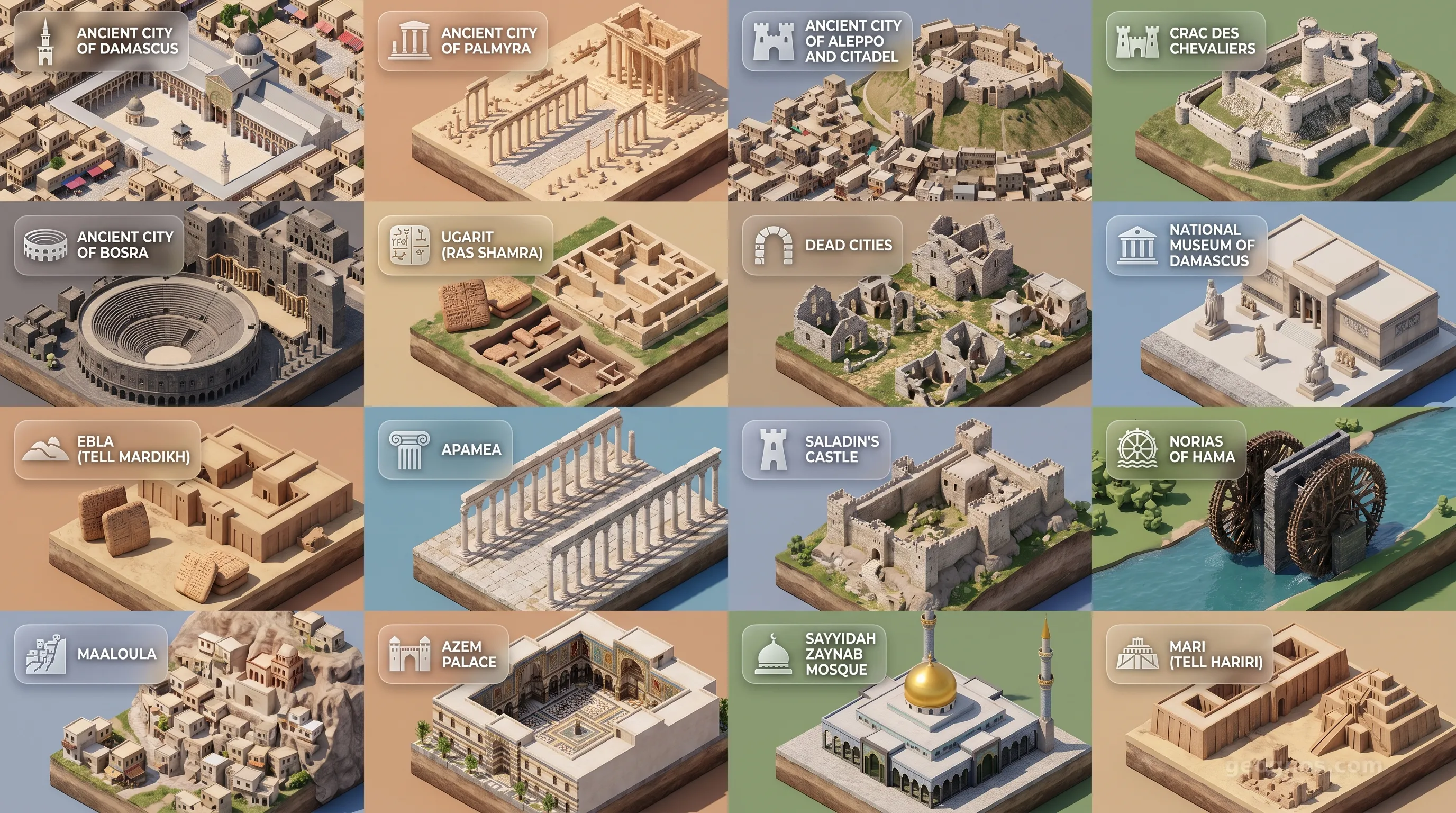
Beyond the analytical study of dates and regimes, Syria demands to be experienced through a lens of aesthetic appreciation. The architectural heritage—spanning from the limestone "Dead Cities" of the Idlib region to the soaring colonnades of Palmyra—represents a unique synthesis of regional artisan traditions and Hellenistic influence. To truly grasp the scale and visual impact of these sites, we invite you to view our history cinematic showcase. This visual exploration provides an immersive window into the grand events that shaped the Levantine identity, set against a backdrop of the majestic geography that allowed these structures to survive for thousands of years.
For the traveler at heart, Syria offers a profound intimacy that few other nations can replicate. The physical landmarks tell stories of triumph, trade, and architectural ingenuity. To better familiarize yourself with the iconic locations that anchor this land in the consciousness of the modern global traveler, our POI cinematic showcase provides a breathtaking survey of these physical treasures. These sites act as witnesses, standing firmly against the erosion of time, marking the spots where human ambition first dreamt of legacy.
The Harmonious Diversity of the Levant
Syria's cultural identity is a vibrant mosaic, reflective of its historical status as a bridge between three continents. The demographic composition is a testament to waves of migration, trade, and exchange that have occurred over the last ten millennia. The people of Syria possess a tradition of hospitality that is rooted in the practical necessities of the caravan route, where the traveler was historically the messenger of news, the carrier of goods, and the vital link to the outside world. This cultural trait of welcoming is perhaps the most defining characteristic of the Syrian landscape, fostering a spirit of community that persists even as the region continues to transform.
As we examine the environmental and economic markers of the nation today, we see a people actively engaged in the stewardship of a challenging but fertile land. From the terraced olive groves that have been harvested since antiquity to the emerging sectors of energy and technology, Syria remains a nation of immense potential. By studying the geography that mandates cooperation and the history that demands resilience, we can appreciate Syria not just as a location on a map, but as a primary author of our shared global story. We encourage every student, educator, and traveler to view this land as a vital participant in the history of all nations, a place that continues to inspire inquiry and evoke wonder at the sheer longevity of the human spirit.