🇹🇯

Tajikistan

Central Asia Countries
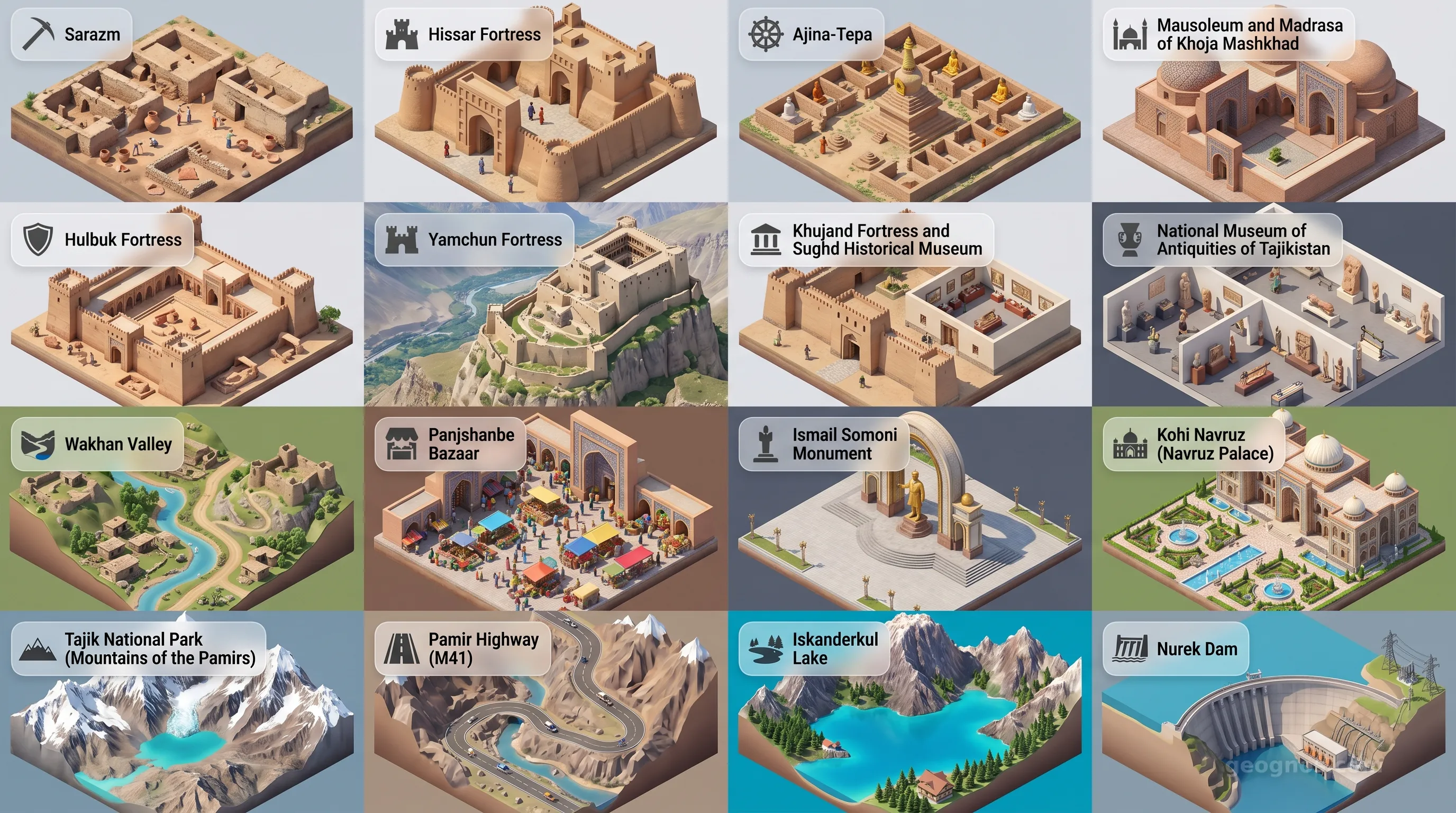
Tajikistan - Panoramic Places of Interest Atlas including Sarazm, Hissar Fortress, Ajina-Tepa, Mausoleum and Madrasa of Khoja Mashkhad, Hulbuk Fortress, Yamchun Fortress, Khujand Fortress and Sughd Historical Museum, National Museum of Antiquities of Tajikistan, Wakhan Valley, Panjshanbe Bazaar, Ismail Somoni Monument, Kohi Navruz (Navruz Palace), Tajik National Park (Mountains of the Pamirs), Pamir Highway (M41), Iskanderkul Lake, Nurek Dam

Top Sights & Landmarks

01

Sarazm

Ancient Proto-Urban Settlement

02

Hissar Fortress

Historical Silk Road Stronghold

03

Ajina-Tepa

Ancient Buddhist Monastery

04

Mausoleum and Madrasa of Khoja Mashkhad

Pioneering Islamic Architecture

05

Hulbuk Fortress

Medieval Capital of Khatlon

06

Yamchun Fortress

Wakhan Corridor's Stone Sentinel

07

Khujand Fortress and Sughd Historical Museum

Legacy of Alexandria Eschate

08

National Museum of Antiquities of Tajikistan

Home of the Sleeping Buddha

09

Wakhan Valley

Crossroads of Empires

10

Panjshanbe Bazaar

The Cultural Heartbeat of Khujand

11

Ismail Somoni Monument

Symbol of the Tajik Nation

12

Kohi Navruz (Navruz Palace)

Masterpiece of Modern Handicraft

13

Tajik National Park (Mountains of the Pamirs)

The Roof of the World

14

Pamir Highway (M41)

Epic High-Altitude Road Trip

15

Iskanderkul Lake

Lake of Alexander the Great

16

Nurek Dam

Soviet Engineering Marvel

The Roof of the World: An Introduction to Tajikistan

To enter Tajikistan is to step into a realm where the Earth rises to meet the heavens. It is a nation defined by verticality, a kingdom of jagged peaks and crystalline glaciers that demand reverence from any who tread upon its rugged soil. Often described as the "Roof of the World," this Central Asian jewel is home to the mighty Pamir Mountains, which dominate over ninety percent of the country’s landscape. Yet, to categorize Tajikistan merely as a high-altitude wilderness would be to overlook the profound depth of its human soul. It is a place where ancient Persian roots entwine with the dramatic histories of the Silk Road, creating a culture as resilient, enduring, and majestic as the mountains themselves.

In this landscape, geography is not just a backdrop; it is the primary architect of the national character. From the turquoise tranquility of Iskanderkul Lake to the dizzying heights of the Fedchenko Glacier, the physical features of this land have dictated the paths of empires, traders, and poets for millennia. To understand this nation fully, one must be prepared to look both at the high-altitude horizon and deep into the annals of its past. For those beginning their intellectual journey, you may want to explore the history of Tajikistan, where the legacy of Sogdian merchants, Timurid architects, and Soviet-era transformations converge into the story of a modern, sovereign state.

The Echoes of Ancient Crossroads

The cultural heartbeat of Tajikistan is deeply melodic, carried through the centuries by the rhythm of the rubab and the poetry of the great Persian masters. Before it became a modern nation, this territory served as an essential artery of the Silk Road. Traders, monks, and emissaries crossed these passes, carrying everything from spices and silk to revolutionary philosophies and artistic techniques. This historical crossroads transformed the valleys into melting pots of wisdom. While the mountains provided isolation and protection, the valleys invited exchange, fostering a civilization that values hospitality as a sacred duty. There is a tangible magic in walking these paths, a sensation that you are walking in the footsteps of figures who once linked the Orient to the Occident.

For students and travelers who enjoy testing their grasp of time, we invite you to engage with our interactive learning tool. You can challenge yourself with our history puzzle, an immersive chronology challenge that rewards your growing expertise with digital badges as you correctly piece together the pivotal milestones that defined this land. It is an excellent way for learners of all ages to visualize the evolution of the Tajik state, from its early tribal roots to its complex regional integration.

Visualizing the Mountain Legacy

Because Tajikistan is a country that resists simplistic description, the best way to capture its spirit is often through the visual arts. The contrasts are staggering. In one moment, you are overlooking the desolate, lunar landscapes of the high Pamir Plateau, and in the next, you are witnessing the emerald embrace of a mountain orchard in the Zeravshan Valley. The aesthetic language of Tajikistan is one of extreme beauty, often humbling the viewer with its vastness. We have curated special digital windows for our users to experience this firsthand.

We invite you to immerse yourself in our history cinematic showcase, where a carefully crafted carousel of illustrations brings the legendary events of the past to life with rich context and pedagogical notes. Furthermore, because geography in this region is inextricable from travel, you can prepare for your own exploration by viewing our POI cinematic showcase. This visual journey traverses the most breathtaking geographical and cultural monuments, from the fortresses guarding the Pyanj River to the urban energy of Dushanbe, giving you a front-row seat to the wonders that await in this magnificent country.

A Future Written in Granite and Spirit

Today, Tajikistan is a nation that looks toward the future with a deep appreciation for the stability and traditional values that kept its people thriving through centuries of nomadic flux and imperial influence. It is a country that offers profound silence to the wanderer and endless data to the scholar. Whether you are trekking through the Fann Mountains, admiring the ancient architecture of the Silk Road, or studying the complex geopolitics of the Central Asian region, Tajikistan proves itself to be a land of surprises. It is a quiet giant of the mountains, harboring a richness of spirit that can only be understood by those willing to make the climb.

As you delve into the remaining sections of our GeoGnos profile, including our 3D diorama maps, environmental climate data, and socio-economic indicators, keep the image of those snow-capped peaks in your mind. They are a testament to the fact that Tajikistan has always stood above the clouds, observing the flow of world history while maintaining its own steady, enduring beat. We welcome you to the journey ahead as we uncover the geography, the people, and the timeless essence of this extraordinary Central Asian marvel.
Location

Latitude
39° N
Longitude
71° E
N S W E
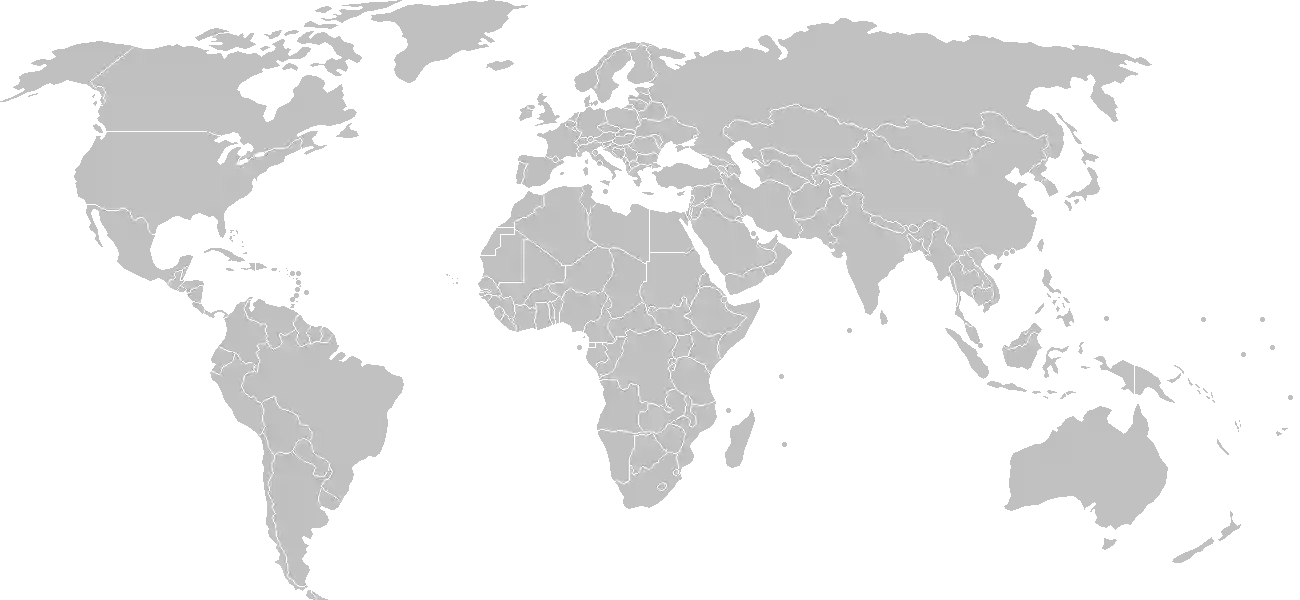
World Map Location
Geographic Location

Central Asia, west of China, south of Kyrgyzstan

Map Reference
Asia

Area

Total Area
144,100 sq km
Land (98%)
Land: 141,510 sq km
Water: 2,590 sq km

Elevation

Highest Point
Qullai Somoniyon
Qullai Somoniyon 7,495 m
Lowest Point
Syr Darya (Sirdaryo)
Syr Darya (Sirdaryo) 300 m
Mean Elevation
3,186 m

Detailed Geography Information

Coastline

0 km (landlocked)

Geography - note

landlocked; highest point, Qullai Ismoili Somoni (formerly Communism Peak), was the tallest mountain in the former USSR

Irrigated land

5,681 sq km (2022)

Land boundaries

Total boundary: 4,130 km
Afghanistan 1357 km
China 477 km
Kyrgyzstan 984 km
Uzbekistan 1312 km

Major rivers (by length in km)

Syr Darya (shared with Kyrgyzstan [s], Uzbekistan, and Kazakhstan [m]) - 3,078 km; Amu Darya river source (shared with Turkmenistan, Afghanistan, and Uzbekistan [m]) - 2,620 km note: [s] after country name indicates river source; [m] after country name indicates river mouth

Major watersheds (area sq km)

Internal (endorheic basin) drainage: Tarim Basin (1,152,448 sq km), (Aral Sea Basin) Amu Darya (534,739 sq km), Syr Darya (782,617 sq km)

Maritime claims

none (landlocked)

Natural hazards

earthquakes; floods

Natural resources

hydropowersome petroleumuraniummercurybrown coalleadzincantimonytungstensilvergold

Terrain

mountainous region dominated by the Alay Mountains in the north and the Pamirs in the southeast; western Fergana Valley in north, Kofirnihon and Vakhsh Valleys in southwest

Population & Growth

+1.90% Growth
10,593,876
Total inhabitants (2025 est.)
Male: 50.2% (5,322,920) Female: 49.8% (5,270,956)

Age Distribution

0-14 years
36.9%
~3,909,140
15-64 years
59.3%
~6,282,168
65 years
3.9%
~413,161
Note: 2024 est.

Demographic Longevity

Median Age
22.8 years
Male
22.3 yrs
Female
23.2 yrs
Life Expectancy
71.9 years
Male
70.1 yrs
Female
73.8 yrs

Vital Dynamics

Birth Rate
25.31
births per 1,000 people
Death Rate
4.45
deaths per 1,000 people
Net Migration
-1.94
migrants per 1,000 people
Fertility Rate
3.52
children born per woman

Detailed People & Society Information

Alcohol consumption per capita

0.85 liters of pure alcohol (2019 est.)

Children under the age of 5 years underweight

5.2% (2023 est.)

Currently married women (ages 15-49)

68% (2020 est.)

Dependency ratios

total dependency ratio: 68.5 (2025 est.) youth dependency ratio: 61.5 (2025 est.) elderly dependency ratio: 6.9 (2025 est.) potential support ratio: 14.5 (2025 est.)

Education expenditure

5.4%

5.4% of GDP (2023 est.) 19.3% national budget (2024 est.)

Ethnic groups

Tajik
84.3%
Uzbek
13.8%
other (includes Kyrgyz
2%

Gross reproduction rate

1.71 (2025 est.)

Health expenditure

8%

8% of GDP (2021) 6.4% of national budget (2022 est.)

Hospital bed density

4.3 beds/1,000 population (2021 est.)

Infant mortality rate

total: 20.3 deaths/1,000 live births (2025 est.) male: 24.3 deaths/1,000 live births female: 18.9 deaths/1,000 live births

Languages

Tajik
84.4%
Uzbek
11.9%
Kyrgyz
0.8%
Russian
0.5%
other
2.4%

Literacy

female: 94.6% (2017 est.)

Major urban areas - population

987,000 DUSHANBE (capital) (2023)

Maternal mortality ratio

14 deaths/100,000 live births (2023 est.)

Mother's mean age at first birth

23.2 years (2017 est.)

Nationality

noun: Tajikistani(s) adjective: Tajikistani

Obesity - adult prevalence rate

14.2% (2016)

Physician density

1.87 physicians/1,000 population (2023)

Population distribution

the population is concentrated at lower elevations, with perhaps as many as 90% living in valleys; overall density increases from east to west

Refugees and internally displaced persons

Total Displaced & Vulnerable Persons
19,895 individuals
Refugees
76.4%
15,191
15,191 (2024 est.)
Internally Displaced Persons (IDPs)
1.2%
238
238 (2024 est.)
Stateless Persons
22.4%
4,466
4,466 (2024 est.)

Religions

Muslim (Sunni
98%
Shia ) other
3%

School life expectancy (primary to tertiary education)

total: 12 years (2024 est.) male: 12 years (2024 est.) female: 11 years (2024 est.)

Sex ratio

at birth: 1.05 male(s)/female 0-14 years: 1.04 male(s)/female 15-64 years: 1 male(s)/female 65 years and over: 0.81 male(s)/female total population: 1.01 male(s)/female (2024 est.)

Climate & Issues

Climate Profile

mid-latitude continental, hot summers, mild winters; semiarid to polar in Pamir Mountains

Key Environmental Issues
air pollution from motor vehicles and industry water pollution from agricultural runoff and untreated industrial waste and sewage poor management of water resources soil erosion increasing levels of soil salinity

Land Cover

Coverage Distribution
Agri (28%)
Other (69%)
Arable: 6.1%
Crops: 1.5%
Pasture: 20.4%
Forest: 3.1%

Air & Carbon Emissions

Annual CO2 Output 2023 est.
8.616 million
Coal (0%) Oil (0%) Gas (100%)
PM2.5 Exposure 53.8 µg/m³
0 5 (WHO Limit) 15 25 35+

Water Resources & Use

Renewable Water Resources 21.91 billion cubic meters (2022 est.)
Annual Water Withdrawal
municipal: 912 million cubic meters (2022 est.)
Municipal (9%) Ind (16%) Agri (75%)

Detailed Environmental Information

International environmental agreements

BiodiversityClimate ChangeClimate Change-Kyoto ProtocolClimate Change-Paris AgreementComprehensive Nuclear Test BanDesertificationEndangered SpeciesEnvironmental ModificationHazardous WastesOzone Layer ProtectionShip PollutionWetlands

Urbanization

urban population: 28.2% of total population (2023) rate of urbanization: 2.73% annual rate of change (2020-25 est.)

Waste and recycling

municipal solid waste generated annually: 1.787 million tons (2024 est.) percent of municipal solid waste recycled: 13.9% (2022 est.)

Capital & State Profile

Capital City
Dushanbe
38.55° N, 68.7667° E
Timezone UTC+5
Government Type
presidential republic
Independence 1991-09-09
National Holiday 09-09

Executive Branch

Chief of State
President Emomali RAHMON (since 16 November 1994; head of state and Supreme Assembly Chairman since 20 November 1992)
Head of Government
Prime Minister Qohir RASULZODA (since 23 November 2013)
Last Election 11 October 2020
Next Election 2027
Cabinet Council of Ministers appointed by the president, approved by the Supreme Assembly

Legislative Branch

bicameral
Legislature Name Supreme Council (Majlisi Oli)
Lower Chamber House of Representatives (Majlisi namoyandogon)
Seats 63 (all directly elected)
Term 5 years
% Women 28.6%
Parties Composition
People's Democratic Party of Tajikistan (PDPT) 49Agrarian Party of Tajikistan (APT) 7Party of Economic Reforms of Tajikistan (PERT) 5Other 2
Upper Chamber National Assembly (Majlisi milli)
Seats 33 (25 indirectly elected; 8 appointed)
Term 5 years
% Women 30.3%

National Identity & Symbols

National Flag Description

three horizontal stripes of red (top), a wider stripe of white, and green; a gold crown under seven five-pointed gold stars is in the center of the white stripe

Symbolic Meaning red stands for the sun, victory, and the unity of the nation; white for purity, cotton, and mountain snows; green for Islam and nature's bounty; the crown symbolizes the Tajik people; the stars represent the number seven, which is considered a symbol of perfection and the embodiment of happiness
National Symbol arc of seven five-pointed stars over a crown, Marco Polo sheep
National Colors red, white, green
National Anthem Surudi milli (National Anthem)

Detailed Government Information

Administrative divisions

2 provinces (viloyatho, singular - viloyat), 1 autonomous province* (viloyati mukhtor), 1 capital region** (viloyati poytakht), and 1 area referred to as Districts Under Republic Administration***; Dushanbe**, Khatlon (Bokhtar), Kuhistoni Badakhshon [Gorno-Badakhshan]* (Khorugh), Nohiyahoi Tobei Jumhuri***, Sughd (Khujand) note: the administrative center name follows in parentheses

Citizenship

citizenship by birth: no citizenship by descent only: at least one parent must be a citizen of Tajikistan dual citizenship recognized: no residency requirement for naturalization: 5 years or 3 years of continuous residence prior to application

Constitution

history: several previous; latest adopted 6 November 1994 amendment process: proposed by the president of the republic or by at least one third of the total membership of both houses of the Supreme Assembly; adoption of any amendment requires a referendum, which includes approval of the president or approval by at least two-thirds majority of the Assembly of Representatives; passage in a referendum requires participation of an absolute majority of eligible voters and an absolute majority of votes; constitutional articles, including Tajikistan’s form of government, its territory, and its democratic nature, cannot be amended

Country name

conventional long form: Republic of Tajikistan conventional short form: Tajikistan local long form: Jumhurii Tojikiston local short form: Tojikiston former: Tajik Soviet Socialist Republic etymology: the Persian suffix -ostan means "land," so the country name means "Land of the Tajik [people];" the name Tajik comes from the Sanskrit tajika, a name originally used to distinguish Arabs from Turks and derived from the Tay, an Arab people

International law organization participation

has not submitted an ICJ jurisdiction declaration; accepts ICCt jurisdiction

International organization participation

Judicial branch

highest court(s): Supreme Court (consists of the chairman, deputy chairmen, and 34 judges organized into civil, family, criminal, administrative offense, and military chambers); Constitutional Court (consists of the court chairman, deputy chairman, and 5 judges); High Economic Court (consists of 16 judicial positions) judge selection and term of office: Supreme Court, Constitutional Court, and High Economic Court judges nominated by the president and approved by the National Assembly; judges of all 3 courts appointed for 10-year renewable terms with no term limits, but the last appointment must occur before the age of 65 subordinate courts: regional and district courts; Dushanbe City Court; viloyat (province-level) courts; Court of Gorno-Badakhshan Autonomous Region

Legal system

civil law system

National heritage

total World Heritage Sites: 5 (3 cultural, 2 natural) selected World Heritage Site locales: Proto-urban Site of Sarazm (c); Tajik National Park (Mountains of the Pamirs) (n); Silk Roads: Zarafshan-Karakum Corridor (c); Tugay forests of the Tigrovaya Balka Nature Reserve (n); Cultural Heritage Sites of Ancient Khuttal (c)

Political parties

Agrarian Party of Tajikistan or APT Democratic Party or DPT Party of Economic Reforms or PERT People's Democratic Party of Tajikistan or PDPT Socialist Party of Tajikistan or SPT

Suffrage

18 years of age; universal

Economic Overview

lower-middle-income Central Asian economy; large infrastructure projects, including Rogun Dam, and a push towards green development and digitalization driving growth; strong metal mining, electricity, and manufacturing industries; challenges include land scarcity, climate vulnerability, and complex bureaucratic processes for investors

Size & Performance

Real GDP (PPP)
$50.37 billion
Latest available estimate (2024)
2023: $46.467 billion2022: $42.905 billion
Real GDP Growth
8.4% (2024 est.)
+8.4%
GDP Per Capita (PPP)
$4,800
2023: $4,5002022: $4,200

GDP Sector Breakdown

Agriculture: 22.9%Industry: 33.6%Services: 34.7%
Origin GDP %
Agriculture 22.9%
Industry 33.6%
Services 34.7%

Trade Balance

Trade Position
Trade Deficit
$5.29 billion
Total Exports
$1.618 billion (2024 est.)
Total Imports
$6.907 billion (2024 est.)
Exports (19%) Imports (81%)

Budget Balance

Budget Position
Budget Deficit
-$125.00 million
Revenues
$2.911 billion (2023 est.)
Expenditures
$3.036 billion (2023 est.)
Revenues (49%) Expenditures (51%)

Export Profile

Top Export Partners

Note: 2023; top five export partners based on percentage share of exports

Major Export Commodities

goldprecious metal orealuminumlead oreantimony

Import Profile

Top Import Partners

Note: 2023; top five import partners based on percentage share of imports

Major Import Commodities

garmentsfootwearcarswheatvehicle parts/accessories

Labor & Employment

Total Labor Force 2.78 million (2024 est.)
General Unemployment Rate 11.7%
Youth Unemployment (Ages 15-24) 27.1%
Population Below Poverty Line 20.4% (2023 est.)

Income Inequality

Gini Coefficient (Family Income) 34
0 (Perfect Equality) Moderate Inequality 100 (Perfect Inequality)

Family Income / Consumption Share

Lowest 10%: 3% (2015 est.) Highest 10%: 26.4% (2015 est.)
Inequality Gap: Top 10% holds 8.8x the share of the bottom 10%.

Detailed Economic Data

Agricultural products

potatoesmilkwheatwatermelonsonionstomatoescarrotscottonvegetablesgrapes

Current account balance

$887.016 million (2024 est.) $584.022 million (2023 est.) $1.635 billion (2022 est.) note: balance of payments - net trade and primary/secondary income in current dollars

Debt - external

$3.024 billion (2023 est.) note: present value of external debt in current US dollars

Exchange rates

Tajikistani somoni (TJS) per US dollar - Exchange rates: 10.799 (2024 est.) 10.845 (2023 est.) 11.031 (2022 est.) 11.309 (2021 est.) 10.322 (2020 est.)

GDP - composition, by end use

Industrial production growth rate

9.9% (2023 est.) note: annual % change in industrial value added based on constant local currency

Industries

aluminumcementcoalgoldsilverantimonytextilevegetable oil

Inflation rate (consumer prices)

7.7% (2019 est.) 3.9% (2018 est.) 7.3% (2017 est.) note: annual % change based on consumer prices

Remittances

47.9% of GDP (2024 est.) 37.8% of GDP (2023 est.) 49.9% of GDP (2022 est.) note: personal transfers and compensation between resident and non-resident individuals/households/entities

Reserves of foreign exchange and gold

$3.304 billion (2023 est.) $3.847 billion (2022 est.) $2.499 billion (2021 est.) note: holdings of gold (year-end prices)/foreign exchange/special drawing rights in current dollars

Taxes and other revenues

10.8% (of GDP) (2023 est.) note: central government tax revenue as a % of GDP

Grid Infrastructure

Electricity Access 100%
Urban: 99% Rural: 100%
Capacity 6.481 million kW (2023 est.)
Consumption 15.275 billion kWh (2023 est.)
Exports 3.101 billion kWh (2023 est.)
Imports 714.025 million kWh (2023 est.)
Grid Losses: 3.94 billion kWh (2023 est.)

Generation Mix

Percentage Share of Production
hydroelectricity 92.6%
fossil fuels 7.4%

Fossil Fuels Production

Petroleum
Production 300 bbl/day (2023 est.)
Consumption 31,000 bbl/day (2023 est.)
Proven Reserves 12 million barrels (2021 est.)
Natural Gas
Production 18.476 million cubic meters (2023 est.)
Consumption 43.767 million cubic meters (2023 est.)
Imports 24.196 million cubic meters (2023 est.)
Proven Reserves 5.663 billion cubic meters (2021 est.)
Coal
Production 2.394 million metric tons (2023 est.)
Consumption 2.297 million metric tons (2023 est.)
Exports 475,000 metric tons (2023 est.)
Imports 147,000 metric tons (2023 est.)
Proven Reserves 4.075 billion metric tons (2023 est.)

Intensity & Nuclear

Energy Consumption Per Capita 16.192 million Btu/person (2023 est.)
No nuclear energy infrastructure or reactor operations reported in this country dossier.

Digital Access

.tj
Internet Usage 57%

Active internet users as a percentage of the total population.

Fixed Broadband

Penetration Rate 0 / 100
Total Subscriptions 6,000 (2022 est.)

Mobile Cellular

Penetration Rate 119 / 100
Total Subscriptions 7.92 million (2023 est.)

Broadcast Media

state-run broadcaster has 9 national TV and 10 radio stations, and 4 regional stations; 31 independent TV and 20 independent radio stations broadcast locally and regionally; Russian and other foreign stations available via cable and satellite (2016)

Aviation

EY
Airports
19
As of 2025
Heliports
1
As of 2025

Railways

Total Track Length
680 km
National Network Data from 2014

Military Expenditures

GDP Allocation 1.8%
1.8% of GDP (2024 est.) 2% of GDP (2023 est.) 1.9% of GDP (2022 est.) 1.2% of GDP (2021 est.) 1.1% of GDP (2020 est.)

Active Duty Strengths

estimated 10,000 active Armed Forces; estimated 5-10,000 active paramilitary National Guard, Border Service, and Internal Troops personnel (2025)

Refers to active military personnel.

Service & Defense Details

Military and security forces

Armed Forces of the Republic of Tajikistan: Ground Forces, Mobile Forces, Air and Air Defense Forces Tajik National Guard (TNG); Ministry of Internal Affairs: Internal Troops of Tajikistan; State Committee on National Security: Border Troops (aka Tajik Border Service) (2025) note 1: the Mobile Forces are the airborne, air assault, mountain, and rapid reaction troops of the Armed Forces note 2: the Tajik National Guard, formerly the Presidential Guard, is a paramilitary force under direct authority of the President; it is tasked with ensuring public safety and security, similar to the tasks of the Internal Troops; it also has ceremonial duties

Military equipment inventories and acquisitions

the military is equipped with mostly older Russian and Soviet-era armaments; it also has smaller amounts of items from suppliers such as China, Türkiye, and the US (2025)

Military - note

the military's primary concerns are terrorism, border security, territorial defense, and regional security, particularly in neighboring Afghanistan; Russia is traditionally Tajikistan’s most important security partner and thousands of Russian troops are stationed in the country, primarily at the 201st military base, which Moscow has leased until at least 2042; Russia and Tajikistan have a joint air defense system, and they conduct periodic joint exercises; Tajikistan has been a member of the Russian-led Collective Security Treaty Organization (CSTO) since 1994 and contributes troops to CSTO's rapid reaction force; Tajikistan also cooperates on security matters with China, including joint military training Tajikistan is the only former Soviet republic that did not form its armed forces from old Soviet Army units following the collapse of the USSR in 1991; rather, Russia retained command of the Soviet units there while the Tajik government raised a military from scratch; the first ground forces were officially created in 1993 from groups that fought for the government during the Tajik Civil War (2025)

Military service age and obligation

18-27 years of age for compulsory (men only) or voluntary (men and women) military service; up to a 24-month service obligation for conscripts based on education level (2025) note 1: in addition to the Armed Forces, conscripts are assigned to Tajikistan's other security agencies note 2: those called up to perform military service can participate in just one month of military training instead of fulfilling the full service obligation for a fee of about the equivalent of $2,200 USD