Turkey
Top Sights & Landmarks
The Zero Point in Time
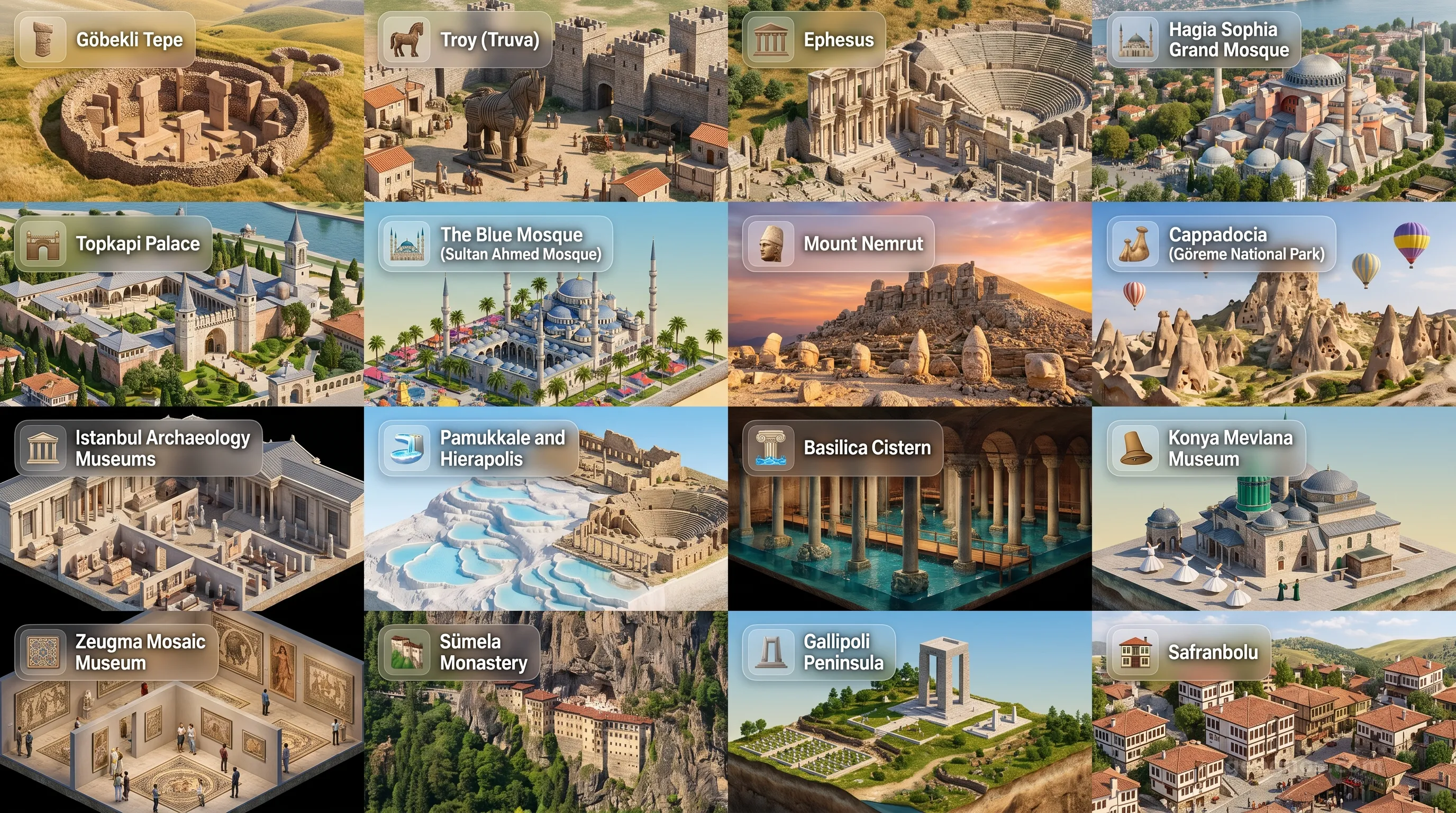
Predating Stonehenge by over 6,000 years, Göbekli Tepe is widely considered the world's oldest temple, drastically altering our understanding of early human religion and the transition to agriculture. It is an unparalleled site for students of archaeology, anthropology, and ancient history. The massive, intricately carved T-shaped pillars reveal a complex hunter-gatherer society capable of monumental architecture. The best time to visit is during the spring or autumn to avoid the intense southeastern heat. Tourist Tip: Visit the Şanlıurfa Archaeology Museum nearby to see artifacts excavated from the site before heading to the ruins for better context.
The Legendary City of the Iliad
Immortalized by Homer's epic poem, the Iliad, Troy boasts over 4,000 years of history as a cultural bridge between East and West. Studying Troy offers invaluable insights into the stratigraphy of ancient civilizations, as the site actually contains the ruins of nine distinct cities built one on top of the other. It is crucial for understanding Bronze Age trade and warfare in the Aegean. Spring and fall offer the most pleasant weather for exploration. Tourist Tip: Take a guided tour to decipher the complex layers of ruins, and do not miss the state-of-the-art Museum of Troy located just outside the site.
Jewel of Classical Antiquity
Once a premier city of the Roman Empire and home to the Temple of Artemis (one of the Seven Wonders of the Ancient World), Ephesus is an extraordinary open-air museum. Students of architecture, theology, and classical history will marvel at the remarkably preserved Library of Celsus, the Great Theatre, and the intricate terraced houses. It also holds profound significance in early Christian history. The best season to visit is spring (April-May) when the surrounding flora is blooming and temperatures are mild. Tourist Tip: Arrive right at opening time to beat the heavy cruise ship crowds and the midday sun.
A Masterpiece of Byzantine Architecture
A crowning architectural achievement of the Byzantine Empire commissioned by Emperor Justinian in 537 AD, the Hagia Sophia has served as an Orthodox cathedral, a Catholic cathedral, an Ottoman mosque, a museum, and once again a mosque. Its massive dome revolutionized architecture, making it a critical study subject for engineers, historians, and art lovers analyzing the blend of Christian mosaics and Islamic calligraphy. Spring and autumn are ideal for visiting Istanbul. Tourist Tip: Since it functions as an active mosque, visitors must dress modestly (headscarves for women, covered knees and shoulders for all) and avoid visiting during prayer times.
The Grand Center of the Ottoman Empire
For nearly 400 years, Topkapi Palace was the administrative and residential heart of the Ottoman Empire. Students of political history, Islamic art, and sociology can explore its labyrinthine courtyards, the opulent Imperial Harem, and the treasury holding the famous Topkapi Dagger and Spoonmaker's Diamond. It offers a deep dive into the lives of sultans, courtiers, and eunuchs. The mild weather of the shoulder seasons (spring and fall) makes exploring the vast palace gardens deeply enjoyable. Tourist Tip: Purchase a separate ticket for the Harem in advance, as it is the most culturally fascinating section of the complex.
An Icon of Ottoman Design
Constructed between 1609 and 1616 under the rule of Ahmed I, the Blue Mosque is a masterpiece of classical Ottoman architecture. It is famed for its six striking minarets and the tens of thousands of hand-painted blue İznik tiles that adorn its interior, flooding the space with a tranquil blue light. It is a premier study location for Islamic architecture and Ottoman decorative arts. Best visited in the cooler, less crowded months of April, May, September, or October. Tourist Tip: It is incredibly busy on Fridays. Plan your visit for a weekday morning, and remember to remove your shoes before entering.
Throne of the Gods
At the summit of Mount Nemrut sits the extraordinary 1st-century BC tomb-sanctuary of King Antiochus I of Commagene. The site is flanked by colossal stone heads of Apollo, Zeus, Hercules, and the King himself, blending Hellenistic, Persian, and Anatolian artistic traditions. It is a vital site for studying the syncretism of ancient religions and monumental funerary art. Summer (June to August) is the most reliable time to visit, as snow blocks the mountain passes in winter. Tourist Tip: Plan your ascent to reach the summit at sunrise or sunset; the way the light hits the colossal statues is breathtaking and unforgettable.
Land of Fairy Chimneys
Cappadocia is an otherworldly landscape characterized by towering volcanic rock formations, known as fairy chimneys, and vast underground cities like Derinkuyu and Kaymaklı. Culturally, it is deeply significant for the Göreme Open-Air Museum, containing rock-hewn sanctuaries adorned with Byzantine frescoes from the early Christian era. It is an exceptional destination for students of geology, theology, and art history. Spring (April to June) and autumn (September to November) offer the best hiking weather. Tourist Tip: A sunrise hot air balloon flight is an absolute must, but book well in advance as flights are highly weather-dependent and frequently sell out.
Guardian of the Ancient Near East
Comprising three museums—the Archaeological Museum, the Museum of the Ancient Orient, and the Museum of Islamic Art—this complex holds over a million objects spanning almost all eras and civilizations in world history. Highlights include the magnificent Alexander Sarcophagus and the world's oldest peace treaty (Treaty of Kadesh). It is an indispensable resource for students of Middle Eastern and Classical antiquity. The museums are excellent year-round indoor destinations. Tourist Tip: Allocate at least a half-day for your visit, and take a break in the museum's peaceful courtyard café, which is dotted with ancient statues.
The Cotton Castle and the Ancient Spa
Pamukkale is a surreal natural wonder featuring terraces of blindingly white travertine created by mineral-rich thermal waters. Sitting immediately atop these terraces are the extensive ruins of Hierapolis, an ancient Greco-Roman spa city. It provides a unique opportunity to study both geological limestone deposition processes and ancient Roman urban planning and health practices, including a remarkably preserved theater and a sprawling necropolis. Spring and fall are ideal to avoid the scorching summer heat. Tourist Tip: You must walk barefoot on the travertine terraces to protect them, so bring a bag to carry your shoes.
The Subterranean Palace
Constructed in 532 AD during the reign of Justinian I, the Basilica Cistern is the largest of several hundred ancient cisterns lying beneath Istanbul. Supported by 336 marble columns, many repurposed from older ruined temples (including the famous Medusa-head column bases), it is a marvel of Byzantine engineering and water management. It is a brilliant study in ancient civic infrastructure. The subterranean nature makes it a great year-round site, offering a cool respite from the summer heat. Tourist Tip: The atmospheric lighting and shallow water make it perfect for photography; look out for the contemporary art installations periodically hosted inside.
Spiritual Heart of Sufism
The Mevlana Museum is the mausoleum of Jalal ad-Din Muhammad Rumi, the 13th-century Persian poet, Islamic scholar, and Sufi mystic. It is the birthplace of the Mevlevi Order, widely known as the Whirling Dervishes. For students of comparative religion, philosophy, and Islamic mysticism, this site is a profound cultural touchstone. The museum houses important manuscripts, textiles, and artifacts of the order. Best visited in spring or autumn. Tourist Tip: If you visit in mid-December, you can witness the mesmerizing Şeb-i Arus ceremonies commemorating Rumi's death, though accommodations must be booked months in advance.
The World's Largest Mosaic Collection
Located in Gaziantep, this state-of-the-art museum houses incredible Roman mosaics rescued from the ancient city of Zeugma before it was flooded by the Birecik Dam. It offers an unprecedented look into the opulent domestic lives, mythology, and artistic sophistication of Roman border towns. The hauntingly beautiful 'Gypsy Girl' mosaic is the centerpiece. It is a vital institution for classical art students. The museum can be comfortably visited year-round. Tourist Tip: Gaziantep is recognized as a UNESCO Creative City of Gastronomy; be sure to try the world-famous local baklava after your museum visit.
The Cliff-Hanging Byzantine Sanctuary
Clinging to a sheer rock face 1,200 meters above the Altındere Valley, Sümela Monastery is a spectacular Greek Orthodox monastery dedicated to the Virgin Mary. Founded in the 4th century, it features stunning rock-hewn churches covered in vibrant, albeit weathered, frescoes. It is a critical site for studying Pontic Greek history, Eastern Orthodox monasticism, and Byzantine art. Summer (June to September) provides the safest and most accessible weather conditions in the rainy Black Sea region. Tourist Tip: Reaching the monastery requires a steep, winding hike through the forest; wear sturdy shoes and take advantage of the local shuttle vans to skip the hardest part.
A Solemn Monument to Bravery
The Gallipoli Peninsula was the site of the pivotal 1915 WWI campaign. Today, it is a profoundly moving historical national park dotted with memorials, trenches, and cemeteries honoring Turkish, Australian, New Zealand, British, and French soldiers. It is a crucial site for students of modern military history and understanding the forging of the modern Turkish Republic under Mustafa Kemal Atatürk, as well as the national identities of ANZAC nations. Spring is the most poignant and temperate time to visit. Tourist Tip: Hire a local historical guide; the landscape is expansive, and expert context is vital to truly understand the scale and strategy of the battles.
A Living Ottoman Town
Safranbolu is one of the most perfectly preserved Ottoman cities in the world, once a key stop on the East-West trade route. It is characterized by hundreds of traditional half-timbered mansions (konaks) with red-tiled roofs and cobbled streets. It is an exceptional living laboratory for architecture students and historians studying Ottoman urban planning, civic architecture, and guild systems. Spring and autumn are beautiful, highlighting the surrounding nature and the town's namesake saffron harvests. Tourist Tip: Stay overnight in a restored traditional Ottoman mansion and purchase authentic saffron-infused Turkish Delight from the historic bazaar.