🇾🇪

Yemen

Middle East • Countries
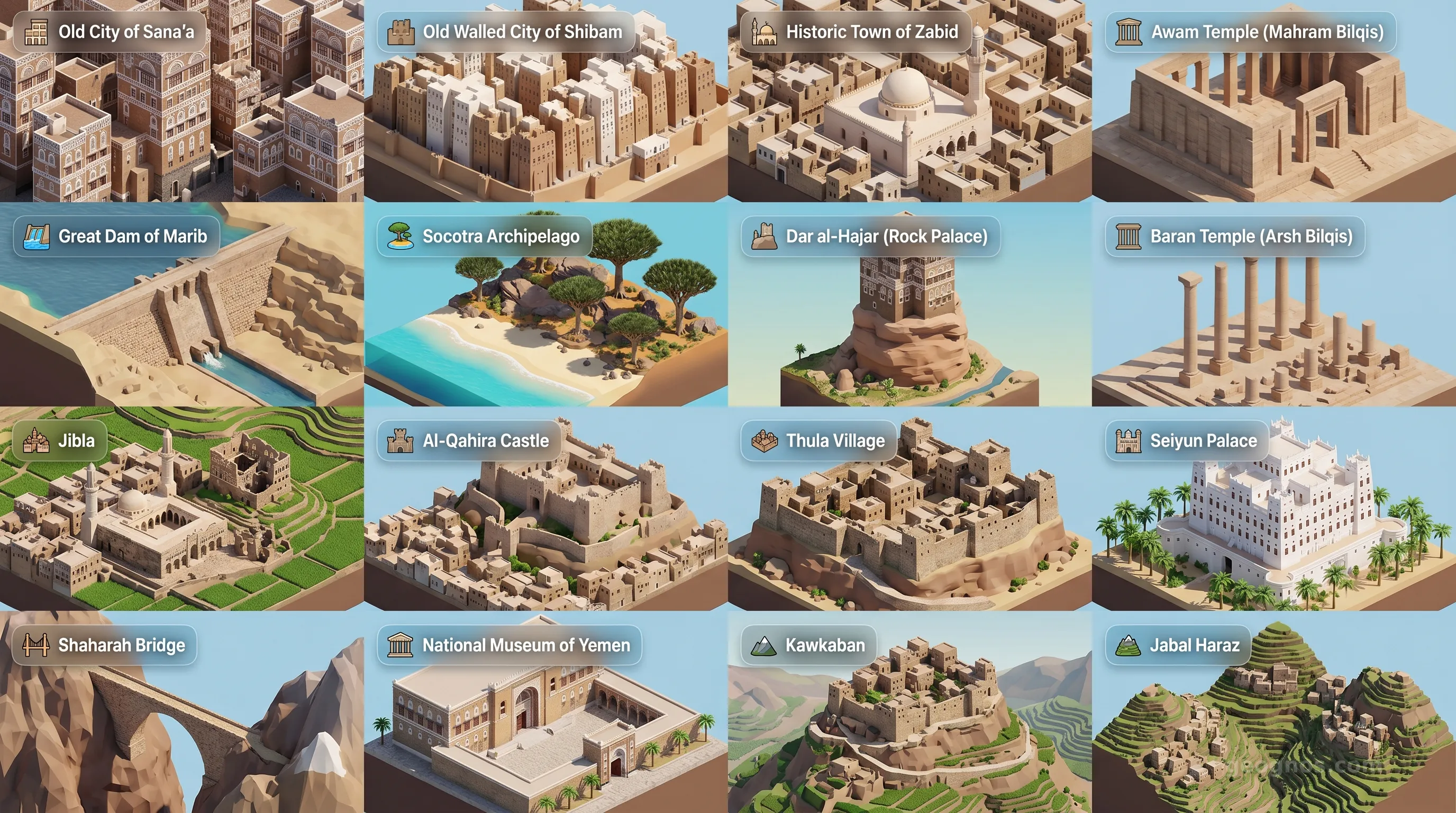
Yemen - Panoramic Places of Interest Atlas including Old City of Sana'a, Old Walled City of Shibam, Historic Town of Zabid, Awam Temple (Mahram Bilqis), Great Dam of Marib, Socotra Archipelago, Dar al-Hajar (Rock Palace), Baran Temple (Arsh Bilqis), Jibla, Al-Qahira Castle, Thula Village, Seiyun Palace, Shaharah Bridge, National Museum of Yemen, Kawkaban, Jabal Haraz

Top Sights & Landmarks

01

Old City of Sana'a

Ancient Rammed-Earth Metropolis

02

Old Walled City of Shibam

The Manhattan of the Desert

03

Historic Town of Zabid

Cradle of Islamic Scholarship

04

Awam Temple (Mahram Bilqis)

Sanctuary of the Sabaean Kingdom

05

Great Dam of Marib

Engineering Marvel of Antiquity

06

Socotra Archipelago

The Galapagos of the Indian Ocean

07

Dar al-Hajar (Rock Palace)

Iconic Palace Atop a Rock

08

Baran Temple (Arsh Bilqis)

The Throne of Bilqis

09

Jibla

Capital of the Queen Arwa

10

Al-Qahira Castle

Fortress Overlooking Taiz

11

Thula Village

Preserved Stone Fortress Town

12

Seiyun Palace

The Sultan's Mudbrick Marvel

13

Shaharah Bridge

A Leap Across the Abyss

14

National Museum of Yemen

Custodian of Yemeni Antiquity

15

Kawkaban

Fortress in the Clouds

16

Jabal Haraz

Terraced Mountains and Ismaili Heritage

The Cradle of Clouds and Commerce: Understanding the Essence of Yemen

To step into Yemen is to step into a living archive of human civilization. It is a land where geography acts as a sculptor, carving out vertical cities from sheer cliff faces and creating hidden garden oases within some of the world's most formidable deserts. As you traverse this storied peninsula, you find yourself walking the same paths that once carried frankincense, myrrh, and gold to the far reaches of the ancient world. Yemen is not merely a country on a map. It is a testament to human resilience, ingenuity, and an aesthetic soul that expresses itself in intricate lattice windows, mud-brick skyscrapers, and terraced mountainsides that seem to touch the very heavens.

For those eager to understand how this land evolved through the ages, we invite you to explore the comprehensive history of Yemen. This collection offers a deep dive into the kingdoms of Saba and Himyar, the rise of maritime trade, and the lasting legacies that define the nation today. For students and lifelong learners, you may also test your grasp of the past by completing our interactive history puzzle, a challenging chronology that puts your knowledge of Yemini heritage to the ultimate test.

Architecture as a Dialogue with the Landscape

Yemen possesses a visual language entirely its own. The most striking characteristic of the nation is its traditional architecture, which functions as an extension of the terrain itself. In the highlands, cities like Sana'a seem to rise organically from the earth. The "skyscrapers of the desert," constructed from baked mud and adorned with white geometric plasterwork, have stood for centuries, their designs perfected to catch the cool mountain breezes and repel the intensity of the sun. These structures are not merely houses, they are ancestral memory etched into the facade of the world.

If you wish to see how these structural wonders manifest across the different provinces, from the labyrinthine alleys of the old city to the cliff-clinging villages of the Haraz Mountains, take a moment to enjoy our POI cinematic showcase. These vignettes offer a high-fidelity look at the landmarks that have shaped Yemen’s architectural identity and global cultural footprint.

The Vertical Geography of the Highlands

The geography of Yemen is defined by its dramatic elevation. The western highlands serve as a mountainous fortress, shielding the fertile inland valleys from the moisture of the Red Sea and the arid winds of the Rub al Khali. This extreme topography has fostered a localized, village-centric culture that remains one of the most unique on Earth. Agriculture in these regions is an art form. For generations, farmers have carved elaborate terrace systems into the mountains, turning vertical rock slopes into lush gardens that yield coffee, fruits, and grains. This is the "Arabia Felix" or "Happy Arabia" described by the ancients, a land of water, harvest, and enduring vitality.

Maritime Crossroads and Ancient Connections

Beyond the mountain peaks, Yemen looks toward the sea. As a crucial pivot point connecting the Mediterranean with the Indian Ocean, the coastline of Yemen has served as a crucible of cultural exchange for millennia. Ancient ports and coastal settlements became the meeting places of traders from Rome, India, and Africa. This history is perhaps best experienced through our digital archives. You can experience the visual evolution of this region by viewing our history cinematic showcase, which synthesizes centuries of architectural and cultural transition into a compelling, immersive narrative.

A Heritage Defined by Endurance

What truly sets Yemen apart is the spirit of its people. The societal structure of the nation is deeply rooted in strong familial and tribal bonds, fostering a sense of community that acts as the primary support system for the population. This social fabric, combined with a deep reverence for the arts of storytelling, poetry, and craftsmanship, makes Yemen a uniquely vibrant country. Education here is held in high esteem, and the oral tradition continues to bridge the gap between ancient sagas and modern understanding.

The natural environment, while demanding, rewards those who learn its rhythms. The monsoon rains that feed the wadis and the unique flora of the Socotra Archipelago, an ecosystem so alien and diverse that it is often called the Galapagos of the Indian Ocean, emphasize that Yemen is a treasure chest of biodiversity. By studying the nation's climate patterns, agricultural practices, and the ways in which its citizens have harmonized with their environment, students gain a valuable lesson in sustainable living and environmental stewardship.

Connecting the Future to the Past

GeoGnos.com is dedicated to mapping these stories in ways that provide clarity and inspiration. Yemen is not a closed book, but an evolving dialogue between its legendary geography and its resilient people. Whether you are conducting academic research on the socio-economic evolution of the Arabian Peninsula or simply discovering the immense beauty of a land where high-altitude civilizations meet tropical seas, our collection serves as a portal into the soul of Yemen.

As you proceed through the following sections of our atlas, we encourage you to reflect on how each element of Yemeni society, from its robust trade history to its distinct environmental landscape, fits into the broader mosaic of the human experience. Through the combination of our interactive maps, detailed socio-political data, and curated visual journeys, you are invited to broaden your perspective and deepen your appreciation for this magnificent corner of the world.
Location

Latitude
15° N
Longitude
48° E
N S W E
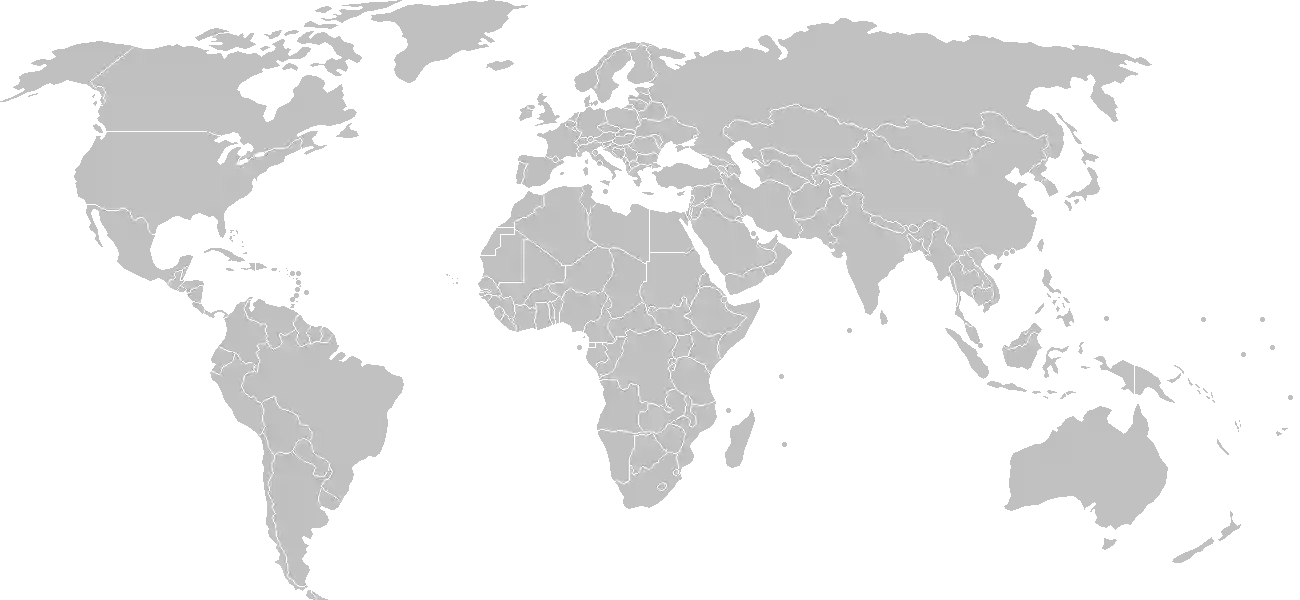
World Map Location
Geographic Location

Middle East, bordering the Arabian Sea, Gulf of Aden, and Red Sea, between Oman and Saudi Arabia

Map Reference
Middle East

Area

Total Area
527,968 sq km
Land (100%)
Land: 527,968 sq km
Water: 0 sq km

Elevation

Highest Point
Jabal an Nabi Shu'ayb
Jabal an Nabi Shu'ayb 3,666 m
Lowest Point
Arabian Sea
Arabian Sea 0 m
Mean Elevation
999 m

Detailed Geography Information

Coastline

1,906 km

Geography - note

strategic location on Bab el Mandeb, the strait linking the Red Sea and the Gulf of Aden and one of world's most active shipping lanes

Irrigated land

6,800 sq km (2012)

Land boundaries

Total boundary: 1,601 km
Oman 294 km
Saudi Arabia 1307 km

Maritime claims

territorial sea: 12 nm contiguous zone: 24 nm exclusive economic zone: 200 nm continental shelf: 200 nm or to the edge of the continental margin

Natural hazards

sandstorms and dust storms in summer volcanism: limited volcanic activity; Jebel at Tair (Jabal al-Tair, Jebel Teir, Jabal al-Tayr, Jazirat at-Tair) (244 m), which forms an island in the Red Sea, became active in 2007; other historically active volcanoes include Harra of Arhab, Harras of Dhamar, Harra es-Sawad, and Jebel Zubair, although many of these have not erupted in over a century

Natural resources

petroleumfishrock saltmarble; small deposits of coalgoldleadnickeland copper; fertile soil in west

Terrain

narrow coastal plain backed by flat-topped hills and rugged mountains; dissected upland desert plains in center slope into the desert interior of the Arabian Peninsula

Population & Growth

+2.20% Growth
34,505,496
Total inhabitants (2025 est.)
Male: 50.1% (17,275,539) Female: 49.9% (17,229,957)

Age Distribution

0-14 years
34.4%
~11,869,891
15-64 years
62.2%
~21,462,419
65 years
3.4%
~1,173,187
Note: 2024 est.

Demographic Longevity

Median Age
20.5 years
Male
21.9 yrs
Female
22.2 yrs
Life Expectancy
68.2 years
Male
65.8 yrs
Female
70.6 yrs

Vital Dynamics

Birth Rate
29.07
births per 1,000 people
Death Rate
6.21
deaths per 1,000 people
Net Migration
-0.65
migrants per 1,000 people
Fertility Rate
3.65
children born per woman

Detailed People & Society Information

Alcohol consumption per capita

0.02 liters of pure alcohol (2019 est.)

Children under the age of 5 years underweight

40.7% (2022 est.)

Currently married women (ages 15-49)

63.9% (2023 est.)

Dependency ratios

total dependency ratio: 70.2 (2025 est.) youth dependency ratio: 64.8 (2025 est.) elderly dependency ratio: 5.4 (2025 est.) potential support ratio: 18.4 (2025 est.)

Ethnic groups

Gross reproduction rate

1.78 (2025 est.)

Health expenditure

4.3%

4.3% of GDP (2015) 2.5% of national budget (2022 est.)

Infant mortality rate

total: 42.4 deaths/1,000 live births (2025 est.) male: 49.9 deaths/1,000 live births female: 39 deaths/1,000 live births

Languages

Literacy

female: 54.1% (2023 est.)

Major urban areas - population

3.292 million SANAA (capital), 1.080 million Aden, 941,000 Taiz, 772,000 Ibb (2023)

Maternal mortality ratio

118 deaths/100,000 live births (2023 est.)

Mother's mean age at first birth

20.8 years (2013 est.) note: data represents median age at first birth among women 25-49

Nationality

noun: Yemeni(s) adjective: Yemeni

Obesity - adult prevalence rate

17.1% (2016)

Physician density

0.1 physicians/1,000 population (2023)

Population distribution

the vast majority of the population is found in the Asir Mountains (part of the larger Sarawat Mountain system), located in the far western region of the country

Refugees and internally displaced persons

Total Displaced & Vulnerable Persons
4,856,904 individuals
Refugees
1.3%
60,921
60,921 (2024 est.)
Internally Displaced Persons (IDPs)
98.7%
4,795,983
4,795,983 (2024 est.)

Religions

Muslim (; virtually all are citizens
99.1%
an estimated are Sunni and are Shia
65%
other (includes Jewish
0.9%

Sex ratio

at birth: 1.05 male(s)/female 0-14 years: 1.04 male(s)/female 15-64 years: 1.03 male(s)/female 65 years and over: 0.78 male(s)/female total population: 1.02 male(s)/female (2024 est.)

Tobacco use

total: 20.2% (2025 est.) male: 33.1% (2025 est.) female: 7.3% (2025 est.)

Climate & Issues

Climate Profile

mostly desert; hot and humid along west coast; temperate in western mountains affected by seasonal monsoon; extraordinarily hot, dry, harsh desert in east

Key Environmental Issues
limited natural freshwater resources inadequate supplies of potable water overgrazing soil erosion desertification

Land Cover

Coverage Distribution
Agri (44%)
Other (55%)
Arable: 2.2%
Crops: 0.6%
Pasture: 41.7%
Forest: 1.0%

Air & Carbon Emissions

Annual CO2 Output 2023 est.
8.193 million
Coal (82%) Oil (0%) Gas (18%)
PM2.5 Exposure 43.9 µg/m³
0 5 (WHO Limit) 15 25 35+
Methane Emissions
energy: 190.5 kt (2022-2024 est.)

Water Resources & Use

Renewable Water Resources 2.1 billion cubic meters (2022 est.)
Annual Water Withdrawal
municipal: 265 million cubic meters (2022 est.)
Municipal (7%) Ind (2%) Agri (91%)

Detailed Environmental Information

International environmental agreements

BiodiversityClimate ChangeClimate Change-Kyoto ProtocolDesertificationEndangered SpeciesEnvironmental ModificationHazardous WastesLaw of the SeaMarine Dumping-London ProtocolNuclear Test BanOzone Layer ProtectionWetlands

Urbanization

urban population: 39.8% of total population (2023) rate of urbanization: 3.71% annual rate of change (2015-20 est.)

Waste and recycling

municipal solid waste generated annually: 4.837 million tons (2024 est.) percent of municipal solid waste recycled: 8% (2016 est.)

Capital & State Profile

Capital City
Sanaa
15.35° N, 44.2° E
Timezone UTC+3
Government Type
in transition
Independence 1990-05-22
National Holiday 05-22

Executive Branch

Chief of State
Presidential Leadership Council Chairperson Dr. Rashad Muhammad al-ALIMI (since 19 April 2022)
Head of Government
Prime Minister Salim Salih BIN BURAYK (since 9 May 2025)
Last Election 21 February 2012
Cabinet 24 members from northern and southern Yemen, with representatives from Yemen's major political parties

Legislative Branch

bicameral
Legislature Name Parliament (Majlis)
Lower Chamber House of Representatives (Majlis Annowab)
Seats 301 (all directly elected)
Term 6 years
% Women 0%
Parties Composition
General People's Congress (GPC) 238Yemeni Congregation for Reform (Islah) 46Other 17
Upper Chamber Shura Council (Majlis Alshoora)
Seats 111 (all appointed)
Term N/A
% Women 1.1%

National Identity & Symbols

National Flag Description

three equal horizontal bands of red (top), white, and black

Symbolic Meaning the band colors come from the Arab Liberation flag and represent oppression (black) overcome through bloody struggle (red), to be replaced by a bright future (white)
National Symbol golden eagle
National Colors red, white, black
National Anthem Al-qumhuriyatu l-muttahida (United Republic)

Detailed Government Information

Administrative divisions

22 governorates (muhafazat, singular - muhafazah); Abyan, 'Adan (Aden), Ad Dali', Al Bayda', Al Hudaydah, Al Jawf, Al Mahrah, Al Mahwit, Amanat al 'Asimah (Sanaa City), 'Amran, Arkhabil Suqutra (Socotra Archipelago), Dhamar, Hadramawt, Hajjah, Ibb, Lahij, Ma'rib, Raymah, Sa'dah, San'a' (Sanaa), Shabwah, Ta'izz

Citizenship

citizenship by birth: no citizenship by descent only: the father must be a citizen of Yemen; if the father is unknown, the mother must be a citizen dual citizenship recognized: no residency requirement for naturalization: 10 years

Constitution

history: adopted by referendum 16 May 1991 (following unification)

Country name

conventional long form: Republic of Yemen conventional short form: Yemen local long form: Al Jumhuriyah al Yamaniyah local short form: Al Yaman former: Yemen Arab Republic [Yemen (Sanaa) or North Yemen] and People's Democratic Republic of Yemen [Yemen (Aden) or South Yemen] etymology: the name origin is unclear but may come from the Arabic word al-yamin, meaning "the right," as a reference to its geographic position in relation to Mecca

International law organization participation

has not submitted an ICJ jurisdiction declaration; non-party state to the ICCt

International organization participation

Judicial branch

highest court(s): Supreme Court (consists of the court president, 2 deputies, and nearly 50 judges; court organized into constitutional, civil, commercial, family, administrative, criminal, military, and appeals scrutiny divisions) judge selection and term of office: judges appointed by the Supreme Judicial Council, which is chaired by the president of the republic and includes 10 high-ranking judicial officers; judges serve for life with mandatory retirement at age 65 subordinate courts: appeal courts; district or first instance courts; commercial courts

Legal system

mixed system of Islamic (sharia) law, Napoleonic law, English common law, and customary law

National heritage

total World Heritage Sites: 5 (4 cultural, 1 natural) selected World Heritage Site locales: Old Walled City of Shibam (c); Old City of Sana'a (c); Historic Town of Zabid (c); Socotra Archipelago (n); Landmarks of the Ancient Kingdom of Saba, Marib (c)

Political parties

General People’s Congress or GPC (3 factions: pro-Hadi, pro-Houthi, pro-Salih) Nasserist Unionist People's Organization National Arab Socialist Ba'ath Party Southern Transitional Council or STC Yemeni Reform Grouping or Islah Yemeni Socialist Party or YSP

Suffrage

18 years of age; universal

Economic Overview

low-income Middle Eastern economy; infrastructure, trade, and economic institutions devastated by civil war; oil/gas-dependent but decreasing reserves; massive poverty, food insecurity, and unemployment; high inflation

Size & Performance

Real GDP (PPP)
$18.719 billion
Latest available estimate (2024)
2023: $18.908 billion2022: $19.294 billion
Real GDP Growth
0.8% (2018 est.)
+0.8%
GDP Per Capita (PPP)
$200
2023: $2002022: $300

GDP Sector Breakdown

Agriculture: 28.7%Industry: 25.4%Services: 41.8%
Origin GDP %
Agriculture 28.7%
Industry 25.4%
Services 41.8%

Trade Balance

Trade Position
Trade Deficit
$3.69 billion
Total Exports
$384.5 million (2017 est.)
Total Imports
$4.079 billion (2017 est.)
Exports (9%) Imports (91%)

Budget Balance

Budget Position
Budget Deficit
-$1.38 billion
Revenues
$2.207 billion (2019 est.)
Expenditures
$3.585 billion (2019 est.)
Revenues (38%) Expenditures (62%)

Export Profile

Top Export Partners

Note: 2023; top five export partners based on percentage share of exports

Major Export Commodities

goldfishscrap ironshellfishindustrial acids/oils/alcohols

Import Profile

Top Import Partners

Note: 2023; top five import partners based on percentage share of imports

Major Import Commodities

wheatraw sugarriceiron barsplastic products

Labor & Employment

Total Labor Force 7.848 million (2024 est.)
General Unemployment Rate 17.1%
Youth Unemployment (Ages 15-24) 32.4%

Income Inequality

Detailed Economic Data

Agricultural products

mangoespotatoesmilkonionsspiceschickensorghumwatermelonstomatoesgrapes

Current account balance

-$2.419 billion (2016 est.) -$3.026 billion (2015 est.) -$1.488 billion (2014 est.) note: balance of payments - net trade and primary/secondary income in current dollars

Debt - external

$6.492 billion (2023 est.) note: present value of external debt in current US dollars

Exchange rates

Yemeni rials (YER) per US dollar - Exchange rates: 1,355.116 (2023 est.) 1,115.002 (2022 est.) 1,028.108 (2021 est.) 743.006 (2020 est.) 486.731 (2019 est.)

Industrial production growth rate

-1.1% (2018 est.) note: annual % change in industrial value added based on constant local currency

Industries

crude oil production and petroleum refiningsmall-scale production of cotton textilesleather goodsfood processinghandicraftsaluminum productscementcommercial ship repairnatural gas production

Inflation rate (consumer prices)

29.1% (2022 est.) 26% (2021 est.) 19.6% (2020 est.) note: annual % change based on consumer prices

Remittances

20.05% of GDP (2023 est.) 16.02% of GDP (2022 est.) 19.44% of GDP (2021 est.) note: personal transfers and compensation between resident and non-resident individuals/households/entities

Reserves of foreign exchange and gold

$1.251 billion (2022 est.) $1.688 billion (2021 est.) $969.613 million (2020 est.) note: holdings of gold (year-end prices)/foreign exchange/special drawing rights in current dollars

Grid Infrastructure

Electricity Access 76%
Urban: 96.1% Rural: 65%
Capacity 1.79 million kW (2023 est.)
Consumption 2.579 billion kWh (2023 est.)
Grid Losses: 486.24 million kWh (2023 est.)

Generation Mix

Percentage Share of Production
fossil fuels 83%
solar 17%

Fossil Fuels Production

Petroleum
Production 15,000 bbl/day (2023 est.)
Consumption 58,000 bbl/day (2023 est.)
Proven Reserves 3 billion barrels (2021 est.)
Natural Gas
Production 10.286 million cubic meters (2023 est.)
Consumption 10.286 million cubic meters (2023 est.)
Proven Reserves 478.555 billion cubic meters (2021 est.)
Coal
Consumption 27,000 metric tons (2023 est.)
Imports 36,000 metric tons (2023 est.)

Intensity & Nuclear

Energy Consumption Per Capita 2.987 million Btu/person (2023 est.)
No nuclear energy infrastructure or reactor operations reported in this country dossier.

Digital Access

.ye
Internet Usage 14%

Active internet users as a percentage of the total population.

Fixed Broadband

Penetration Rate 1 / 100
Total Subscriptions 486,000 (2022 est.)

Mobile Cellular

Penetration Rate 51 / 100
Total Subscriptions 20 million (2023 est.)

Broadcast Media

state-run TV with 2 stations; state-run radio with 2 national radio stations and 5 local stations; stations from Oman and Saudi Arabia can be accessed

Aviation

7O
Airports
37
As of 2025
Heliports
6
As of 2025

Ports & Harbors

Ports Count 10
Hover for breakdown & key ports As of 2024

Merchant Marine

Commercial Fleet
30 ships
Hover for vessel types breakdown As of 2023

Active Duty Strengths

not available

Refers to active military personnel.

Service & Defense Details

Military and security forces

Yemeni Armed Forces: Yemeni National Army, Air Force and Air Defense, Navy and Coastal Defense Forces, Border Guard, Strategic Reserve Forces (includes Special Forces and Presidential Protection Brigades, which are under the Ministry of Defense but responsible to the president), Popular Committee Forces (aka Popular Resistance Forces; government-backed tribal militia) Ministry of Interior: Security Forces, Emergency Forces, Counterterrorism Units (2025) note 1: both Saudi Arabia and the United Arab Emirates have raised and continue to back tribal and regionally based irregular forces in Yemen note 2: Houthi (alt Huthi; aka Ansarallah) forces include land, aerospace (air, missile), naval/coastal defense, presidential protection, special operations, internal security, and militia/tribal auxiliary components; a considerable portion--up to 70 percent by some estimates--of Yemen’s military and security forces defected in whole or in part to former president SALAH and the Houthi opposition in 2011-2015

Military equipment inventories and acquisitions

the Yemeni Government forces have an inventory consisting primarily of older foreign-supplied weapons systems, mostly of Russian or Soviet origin (2025) note: Houthi rebel forces are armed largely with weapons seized from the Yemeni Government stockpiles, smuggled in from Iran, and manufactured copies of Iranian designs and pre-war Yemeni Government weapons

Military - note

government forces under the Yemeni Ministry of Defense are responsible for both external and internal defense; their priorities are the Houthi separatists (aka Ansarallah), the terrorist groups al-Qa’ida in the Arabian Peninsula (AQAP) and the Islamic State of Iraq and ash-Sham in Yemen (ISIS-Yemen), and maritime security, particularly against arms smuggling; in 2022, the Yemeni Government and the Houthis signed a truce, halting most fighting and establishing humanitarian measures; the former front lines of conflict, in some areas mirroring Yemen’s pre-unification borders, remain static; AQAP and ISIS-Yemen continue to be active in remote areas (2025)

Military service age and obligation

limited available information; 18 is the legal minimum age for military service under the Yemeni Government (2025) note: there is widespread recruitment of fighters by numerous armed groups operating in Yemen; all parties to the civil war have been implicated in child soldier recruitment and use; in 2022, the Houthis signed a plan with the UN to end the recruitment and use of child soldiers; Houthi leaders previously pledged to end the use of child soldiers in 2012, as did the Government of Yemen in 2014; in 2019, the Saudi and UAE-led coalition committed to protect children in a memorandum of understanding signed with the UN