🇲🇨

Monaco

Europe • Countries
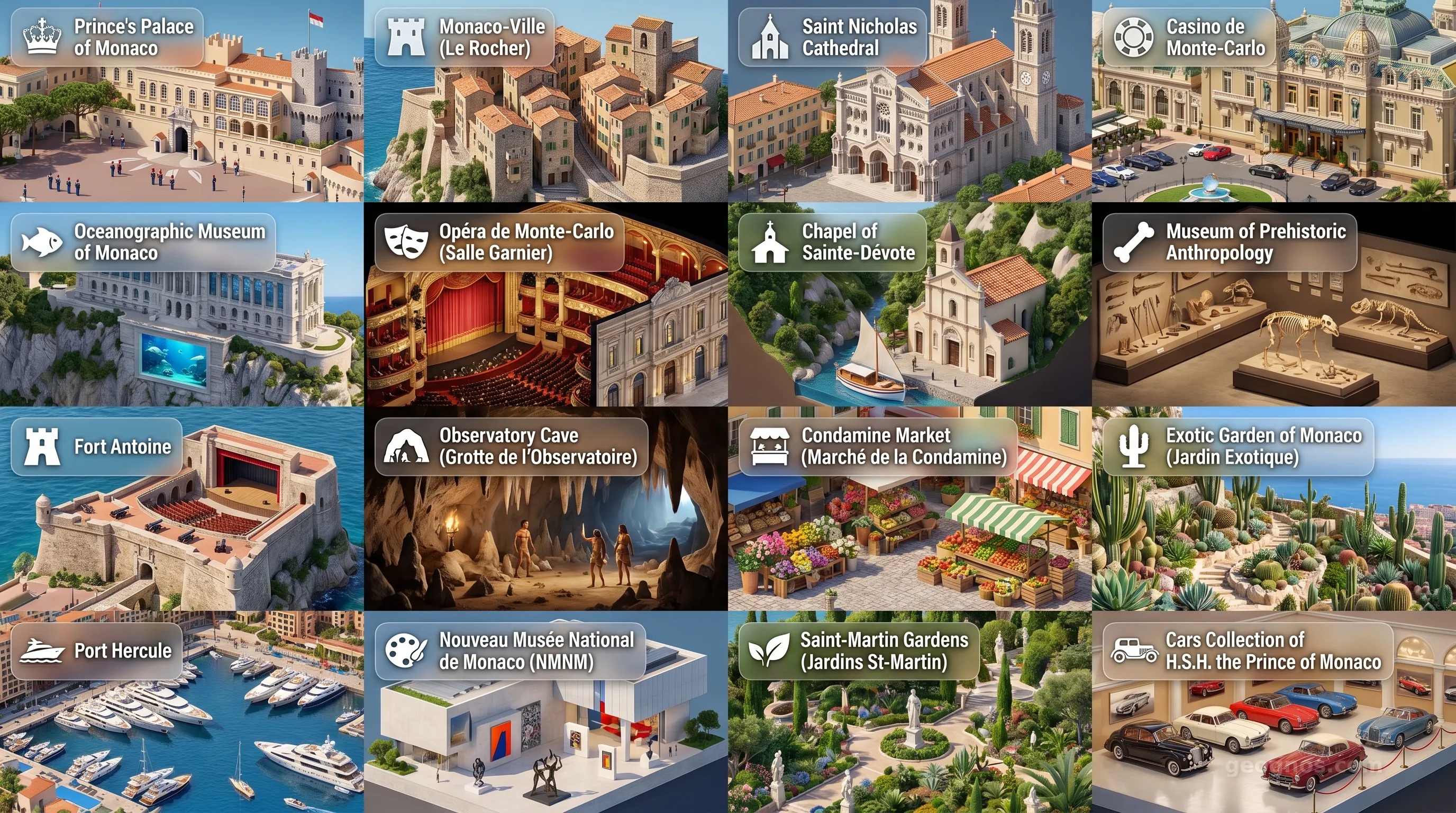
Monaco - Panoramic Places of Interest Atlas including Prince's Palace of Monaco, Monaco-Ville (Le Rocher), Saint Nicholas Cathedral, Casino de Monte-Carlo, Oceanographic Museum of Monaco, Opéra de Monte-Carlo (Salle Garnier), Chapel of Sainte-Dévote, Museum of Prehistoric Anthropology, Fort Antoine, Observatory Cave (Grotte de l'Observatoire), Condamine Market (Marché de la Condamine), Exotic Garden of Monaco (Jardin Exotique), Port Hercule, Nouveau Musée National de Monaco (NMNM), Saint-Martin Gardens (Jardins St-Martin), Cars Collection of H.S.H. the Prince of Monaco

Top Sights & Landmarks

01

Prince's Palace of Monaco

Seat of the Grimaldi Dynasty

02

Monaco-Ville (Le Rocher)

The Ancient Fortified City

03

Saint Nicholas Cathedral

The Royal Resting Place

04

Casino de Monte-Carlo

Belle Époque Masterpiece

05

Oceanographic Museum of Monaco

Temple of the Sea

06

Opéra de Monte-Carlo (Salle Garnier)

The Jewel of the Casino

07

Chapel of Sainte-Dévote

Shrine of Monaco's Patron Saint

08

Museum of Prehistoric Anthropology

Monaco's Ancient Origins

09

Fort Antoine

Military Fortress Turned Theatre

10

Observatory Cave (Grotte de l'Observatoire)

Subterranean Prehistory

11

Condamine Market (Marché de la Condamine)

Authentic Monegasque Heritage

12

Exotic Garden of Monaco (Jardin Exotique)

Cliffside Botanical Marvel

13

Port Hercule

The Historic Deep-Water Port

14

Nouveau Musée National de Monaco (NMNM)

Contemporary Art in Historic Villas

15

Saint-Martin Gardens (Jardins St-Martin)

Monaco's First Public Green Space

16

Cars Collection of H.S.H. the Prince of Monaco

A Royal Automotive Journey

The Vertical Jewel of the Mediterranean

To understand Monaco is to abandon the traditional concepts of scale. In a world where nationhood is typically measured in vast, sweeping territories, Monaco defines itself through verticality, ambition, and an unrelenting refusal to yield to its limited geography. Clinging to the jagged, sun-drenched limestone cliffs of the French Riviera, this sovereign city-state is a testament to the idea that greatness is not a product of landmass, but of vision. It is a tiny theater of human achievement where the Mediterranean Sea meets a dense, golden architecture, creating a landscape that feels less like a country and more like a carefully curated masterpiece.

For the traveler, student, or historian, Monaco presents a fascinating contradiction. It is one of the oldest sovereign states in the world, anchored by a deep lineage of the Grimaldi dynasty, yet it remains on the cutting edge of global finance and modern luxury. Every inch of its 2.02 square kilometers carries a narrative weight. As you wander through the labyrinthine streets of the Rock (Le Rocher), you are not just walking through a modern tourist destination, but tracing the layers of a civilization that has weathered the storms of centuries. To truly grasp how this strategic outcrop transformed into a global icon, we invite you to explore the comprehensive history of Monaco, which documents the enduring resilience and ingenuity of its people across the ages.

A Fortress Transformed: From Siege to Spectacle

Monaco’s physical geography has dictated its path since the dawn of recorded time. Because of its precarious perch above the sea, the area became an early focal point for empires seeking dominance over the Mediterranean trade routes. From the prehistoric inhabitants who sheltered in its limestone caves to the Greeks who established a harbor here and the Romans who recognized its strategic value, the "Rock" has always been a coveted prize. Yet, it was the arrival of the Grimaldis in the 13th century that began the long, winding chapter of sovereign statehood.

For those interested in the milestones of this progression, you can test your knowledge and engage with the temporal flow of the nation through our interactive history data chronology puzzle. By arranging the critical events of the Principality's development, you gain a sense of the complex diplomatic maneuvering and internal governance that preserved this small patch of land as a beacon of independence while neighbors expanded and consolidated around it.

This history is not static, nor is it relegated to dusty archives. The visual evolution of the nation is nothing short of breathtaking, as traditional fortresses have given way to architectural marvels of the modern era. If you wish to witness how these pivotal moments manifest visually, our cinematic history showcase provides a gallery of illustrations that bring the foundational stories of the Principality to life, offering a window into the past through the eyes of those who witnessed its steady, focused growth.

The Architecture of Elegance and Engineering

Walking through Monaco is a study in density and aesthetics. You are as likely to notice the meticulously maintained public gardens as you are the world-famous harbor. This is a country that has learned to master its constraints. Where other nations might seek horizontal expansion, Monaco utilizes its dramatic elevation changes. Elevators, public walkways, and subterranean engineering are the veins that power this vibrant urban environment. The result is a seamless flow of activity that bridges the gap between the historic charm of the Old Town and the opulent, contemporary glamour of Monte-Carlo.

Beyond the built environment, the Principality serves as a lighthouse for cultural and sporting excellence. It is a place where tradition, such as the colorful Changing of the Guard at the Prince’s Palace, sits comfortably alongside the cutting-edge technology of global industry and high-profile events. The sheer density of landmarks—from the Oceanographic Museum that perches on the very edge of the precipice to the cathedral where history remains etched in stone—creates an atmosphere of constant discovery. To experience these sites through a lens that emphasizes their unique place in the Mediterranean tapestry, we highly recommend viewing our comprehensive points of interest cinematic showcase.

The Sustainable Horizon

As we move deeper into the 21st century, Monaco’s geography provides yet another narrative: that of environmental stewardship. Living on such a compressed, resource-precious plot of land has necessitated a forward-thinking approach to urban planning. The nation’s current leadership places an immense value on the protection of the surrounding marine environment and the pursuit of a sustainable economy. It is an interesting study for students and scholars alike to witness how a nation that relies so heavily on external connections can focus with such intensity on preserving its local climate and delicate ecological footprint.

Ultimately, Monaco acts as a living laboratory for the concept of sovereignty in a globalized world. It is a community that embraces its size while projecting an influence that reaches far beyond its borders. It shows that even in an age of globalization, local identity—cultivated with patience and pride—remains a powerful and enduring force. Whether you are coming to study its unique governmental structure, to witness its spectacular geography, or to learn about the lineage that has kept a nation alive against all odds, Monaco offers a lesson in depth, persistence, and the undeniable charm of a place that knows exactly who it is.

As you move through this resource, we encourage you to look at the intersection of our educational materials and your own intellectual curiosity. Monaco is more than a dot on a map or a high-end destination; it is a profound realization of the human capacity to craft a distinct, meaningful, and resilient world within the most challenging of canvases. Welcome to GeoGnos's dedicated portal for the Principality, where geography, history, and human ingenuity converge.
Location

Latitude
43.7333° N
Longitude
7.4° E
N S W E
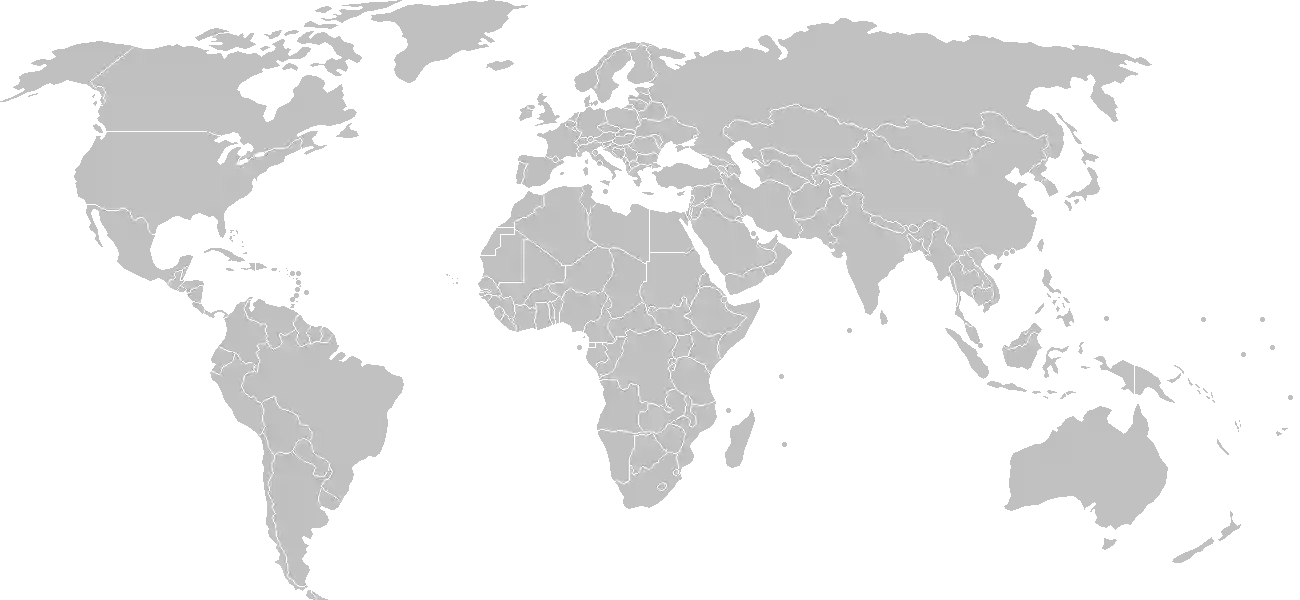
World Map Location
Geographic Location

Western Europe, bordering the Mediterranean Sea on the southern coast of France, near the border with Italy

Map Reference
Europe

Area

Total Area
2 sq km
Land (100%)
Land: 2 sq km
Water: 0 sq km

Elevation

Highest Point
Chemin des Revoires on Mont Agel
Chemin des Revoires on Mont Agel 162 m
Lowest Point
Mediterranean Sea
Mediterranean Sea 0 m

Detailed Geography Information

Coastline

4.1 km

Geography - note

second-smallest independent state in the world (after the Holy See); smallest country with a coastline; almost entirely urban

Irrigated land

0 sq km (2022)

Land boundaries

Total boundary: 6 km
France 6 km

Maritime claims

territorial sea: 12 nm exclusive economic zone: 12 nm

Natural hazards

none

Natural resources

none

Terrain

hilly, rugged, rocky

Population & Growth

+0.80% Growth
32,047
Total inhabitants (2025 est.)
Male: 48.3% (15,467) Female: 51.7% (16,580)

Age Distribution

0-14 years
9.1%
~2,916
15-64 years
53.8%
~17,241
65 years
37.1%
~11,889
Note: 2024 est.

Demographic Longevity

Median Age
57.5 years
Male
55 yrs
Female
58.4 yrs
Life Expectancy
89.8 years
Male
86 yrs
Female
93.7 yrs

Vital Dynamics

Birth Rate
6.46
births per 1,000 people
Death Rate
11.36
deaths per 1,000 people
Net Migration
+12.48
migrants per 1,000 people
Fertility Rate
1.55
children born per woman

Detailed People & Society Information

Dependency ratios

total dependency ratio: 88.7 (2025 est.) youth dependency ratio: 16.6 (2025 est.) elderly dependency ratio: 72.1 (2025 est.) potential support ratio: 1.4 (2025 est.)

Education expenditure

1.7%

1.7% of GDP (2023 est.) 7.7% national budget (2023 est.)

Ethnic groups

Monegasque
32.1%
French
19.9%
Italian
15.3%
British
5%
Belgian
2.3%
Swiss
2%
German
1.9%
Russian
1.8%
American
1.1%
Dutch
1.1%
Moroccan
1%
other
16.6%

Gross reproduction rate

0.76 (2025 est.)

Health expenditure

3.7%

3.7% of GDP (2021) 12% of national budget (2022 est.)

Infant mortality rate

total: 1.7 deaths/1,000 live births (2025 est.) male: 2 deaths/1,000 live births female: 1.4 deaths/1,000 live births

Languages

Major urban areas - population

39,000 MONACO (capital) (2018)

Maternal mortality ratio

5 deaths/100,000 live births (2023 est.)

Nationality

noun: Monegasque(s) or Monacan(s) adjective: Monegasque or Monacan

Physician density

8.61 physicians/1,000 population (2020)

Population distribution

the second most densely populated country in the world (after Macau); its entire population lives on 2 sq km (0.8 sq mi)

Refugees and internally displaced persons

Total Displaced & Vulnerable Persons
17 individuals
Refugees
100.0%
17
17 (2024 est.)

Religions

Roman Catholic
90%
other
10%

School life expectancy (primary to tertiary education)

total: 21 years (2024 est.) male: 20 years (2024 est.) female: 22 years (2024 est.)

Sex ratio

at birth: 1.04 male(s)/female 0-14 years: 1.05 male(s)/female 15-64 years: 1.02 male(s)/female 65 years and over: 0.8 male(s)/female total population: 0.93 male(s)/female (2024 est.)

Climate & Issues

Climate Profile

Mediterranean with mild, wet winters and hot, dry summers

Land Cover

Coverage Distribution
Other (100%)
Arable: 0.0%
Crops: 1.0%
Pasture: 0.0%
Forest: 0.0%

Air & Carbon Emissions

PM2.5 Exposure 9.2 µg/m³
0 5 (WHO Limit) 15 25 35+

Water Resources & Use

Annual Water Withdrawal
municipal: 10 million cubic meters (2020 est.)
Municipal (100%) Ind (0%) Agri (0%)

Detailed Environmental Information

International environmental agreements

Air PollutionAir Pollution-Heavy MetalsAir Pollution-Sulphur 94Air Pollution-Volatile Organic CompoundsAntarctic-Environmental ProtectionAntarctic TreatyBiodiversityClimate ChangeClimate Change-Kyoto ProtocolClimate Change-Paris AgreementComprehensive Nuclear Test BanDesertificationEndangered SpeciesHazardous WastesLaw of the SeaMarine Dumping-London ConventionOzone Layer ProtectionShip PollutionWetlandsWhaling

Urbanization

urban population: 100% of total population (2023) rate of urbanization: 0.5% annual rate of change (2020-25 est.)

Waste and recycling

municipal solid waste generated annually: 46,000 tons (2024 est.) percent of municipal solid waste recycled: 5.4% (2012 est.)

Capital & State Profile

Capital City
Monaco
43.7333° N, 7.4167° E
Timezone UTC+1
Daylight Saving +1hr
Government Type
constitutional monarchy
Independence 1419
National Holiday 11-19

Executive Branch

Chief of State
Prince ALBERT II (since 6 April 2005)
Head of Government
Minister of State Christophe MIRMAND (since 21 July 2025)
Cabinet Council of Government under the authority of the monarch

Legislative Branch

unicameral
Legislature Name National Council (Conseil national)
Seats & Term
24 (all directly elected) seats / 5 years
Women in Chamber
45.8% Representation
Electoral System proportional representation
Parties Composition
Monegasque National Union - l’Union 24

National Identity & Symbols

National Flag Description

two equal horizontal bands of red (top) and white

Symbolic Meaning history: uses the colors of the ruling House of Grimaldi; colors have been in use since 1339, making it one of the world's oldest national flags
National Symbol red and white lozenges (diamond shapes)
National Colors red, white
National Anthem A Marcia de Muneghu (The March of Monaco)

Detailed Government Information

Administrative divisions

no first-order administrative divisions as defined by the US government, but 4 quarters (quartiers, singular - quartier); Fontvieille, La Condamine, Monaco-Ville, Monte-Carlo note: Moneghetti, part of La Condamine, is sometimes called the fifth quarter of Monaco

Citizenship

citizenship by birth: no citizenship by descent only: the father must be a citizen of Monaco; in the case of a child born out of wedlock, the mother must be a citizen and father unknown dual citizenship recognized: no residency requirement for naturalization: 10 years

Constitution

history: previous 1911 (suspended 1959); latest adopted 17 December 1962 amendment process: proposed by joint agreement of the chief of state (the prince) and the National Council; passage requires two-thirds majority vote of National Council members

Country name

conventional long form: Principality of Monaco conventional short form: Monaco local long form: Principauté de Monaco local short form: Monaco etymology: founded as a Greek colony in the 6th century B.C., the name's origin is unclear; it could derive from the Greek term monoikos (solitary), the Ligurian word monegu (rock), or the Basque word muno (mountain)

International law organization participation

has not submitted an ICJ jurisdiction declaration; non-party state to the ICCt

International organization participation

Judicial branch

highest court(s): Supreme Court (consists of 5 permanent members and 2 substitutes) judge selection and term of office: Supreme Court members appointed by the monarch upon the proposals of the National Council, State Council, Crown Council, Court of Appeal, and Trial Court subordinate courts: Court of Appeal; Civil Court of First Instance

Legal system

civil law system influenced by French legal tradition

Political parties

Monegasque National Union (includes Horizon Monaco, Primo!, Union Monegasque) Horizon Monaco Priorite Monaco or Primo! Union Monegasque

Suffrage

18 years of age; universal

Economic Overview

high-income European economy; non-EU euro user; considered a tax haven; tourism and banking are largest sectors; negatively impacted by COVID-19; major oceanographic museum; among most expensive real estate; major state-owned enterprises

Size & Performance

Real GDP (PPP)
$8.924 billion
Latest available estimate (2024)
2023: $8.749 billion2022: $8.329 billion
Real GDP Growth
5% (2023 est.)
+5%
GDP Per Capita (PPP)
$270,100
2023: $256,6002022: $226,100

GDP Sector Breakdown

Industry: 11.5%Services: 88.5%
Origin GDP %
Industry 11.5%
Services 88.5%

Trade Balance

Trade flow data not available.

Budget Balance

Budget data not available.

Export Profile

Top Export Partners

Note: 2021

Major Export Commodities

jewelryperfumeswatchespackaged medicinescarstop five export commodities based on value in dollars

Import Profile

Top Import Partners

Note: 2021

Major Import Commodities

jewelrycars and vehicle partsrecreational boatsplastic productsartwork

Detailed Economic Data

Agricultural products

none

Exchange rates

euros (EUR) per US dollar - Exchange rates: 0.924 (2024 est.) 0.925 (2023 est.) 0.95 (2022 est.) 0.845 (2021 est.) 0.876 (2020 est.) note: while not an EU member state, Monaco, due to its preexisting monetary and banking agreements with France, has a 1998 monetary agreement with the EU to produce limited euro coinage—but not banknotes—that began enforcement in January 2002 and superseded by a new EU agreement in 2012

Industries

bankinginsurancetourismconstructionsmall-scale industrial and consumer products

Inflation rate (consumer prices)

5.9% (2022 est.) 2.1% (2021 est.) 0.5% (2020 est.) note: annual % change based on consumer prices

Grid Infrastructure

Electricity Access 100%

Digital Access

.mc
Internet Usage 99%

Active internet users as a percentage of the total population.

Fixed Broadband

Penetration Rate 56 / 100
Total Subscriptions 22,000 (2023 est.)

Mobile Cellular

Penetration Rate 107 / 100
Total Subscriptions 41,500 (2024 est.)

Broadcast Media

TV Monte-Carlo operates a TV network; cable TV available; Radio Monte-Carlo has extensive radio networks in France and Italy, with French-language broadcasts to France beginning in the 1960s and Italian-language broadcasts to Italy beginning in the 1970s; other radio stations include Riviera Radio and Radio Monaco

Aviation

3A
Heliports
3
As of 2025

Railways

Total Track Length
0 km
National Network

Ports & Harbors

Ports Count 1
Hover for breakdown & key ports As of 2024

Merchant Marine

Commercial Fleet
1 ships
Hover for vessel types breakdown

Service & Defense Details

Military and security forces

no regular military forces; Prince’s Company of Carabiniers (Compagnie des Carabiniers du Prince, Police Department (Direction de la Sûreté Publique), Fire and Emergency Service (Corps des Sapeurs-pompiers de Monaco) (2025) note: the primary responsibility for the Compagnie des Carabiniers du Prince is guarding the palace; the Police maintain public order

Military - note

by treaty, France is responsible for defending the independence and sovereignty of Monaco