The Island Continent: Australia’s Deep Time and Modern Horizon
Australia is not merely a country. It is a geological island of vast, ancient proportions, a place where the physical reality of the Earth dictates the human experience in ways found nowhere else on the globe. Floating in isolation between the Indian and Pacific Oceans, this landmass is a repository of deep geological memory. Its red-ochre heart, scarred by tectonic history and weathered by eons of wind, stands in stark contrast to the verdant fringes where the vast majority of its population resides. To understand Australia is to understand a dialogue between a fierce, unforgiving environment and a civilization that has sought to harmonize its aspirations with the contours of a unique, resilient landscape.
For tens of thousands of years, the First Nations people—the world’s oldest continuous living culture—nurtured a deep, spiritual, and physical relationship with "Country." This connection predates the modern geopolitical borders that we map today and offers a lens through which we must view the continent's development. As global travelers and students of geography, we are invited to look beyond the surface of popular tourism and delve into the complexities of this massive, rugged nation. You can explore the history of Australia to better understand how ancient traditions and colonial shifts wove together to form the social fabric of the current era.
A Laboratory of Evolution and Endurance
Geographically, Australia is a land of extremes. Its center, often called the Outback, is an expansive desert region that challenges the boundaries of life, forcing both flora and fauna to evolve with remarkable ingenuity. The isolation of the continent served as a biological laboratory. Here, marsupials thrived in the absence of placental mammals, creating a unique evolutionary lineage that continues to fascinate scientists and naturalists globally. From the tropical rainforests of the north to the rugged Alpine regions in the southeast, the sheer environmental diversity requires a careful, localized approach to governance and habitation.
For those looking to deepen their chronological knowledge of how the continent transitioned through the eras, we offer an interactive way to engage with the past. You can sharpen your timeline skills and test your understanding through our History Puzzle, where you arrange major historical events in their proper order to earn recognition badges. Whether you are a student preparing for a class or a curious soul mapping out the arc of time, this interactive tool brings a new layer of engagement to the study of the Southern Hemisphere.
The Architecture of the Landscape
The human history of Australia is as multifaceted as its terrain. It is a narrative of arrival, resilience, and the constant navigation of a shifting frontier. Through a visual medium, one can grasp the gravity of key moments that transformed a remote wilderness into a modern federation. We invite you to view our History Cinematic Showcase. This feature utilizes an elegant carousel of illustrations and event summaries to provide a high-end look at the milestones that define the Australian spirit. By witnessing the convergence of maritime exploration, internal migration, and the maturation of social systems, viewers can appreciate the immense scale of human progress within such a vast, dry cradle.
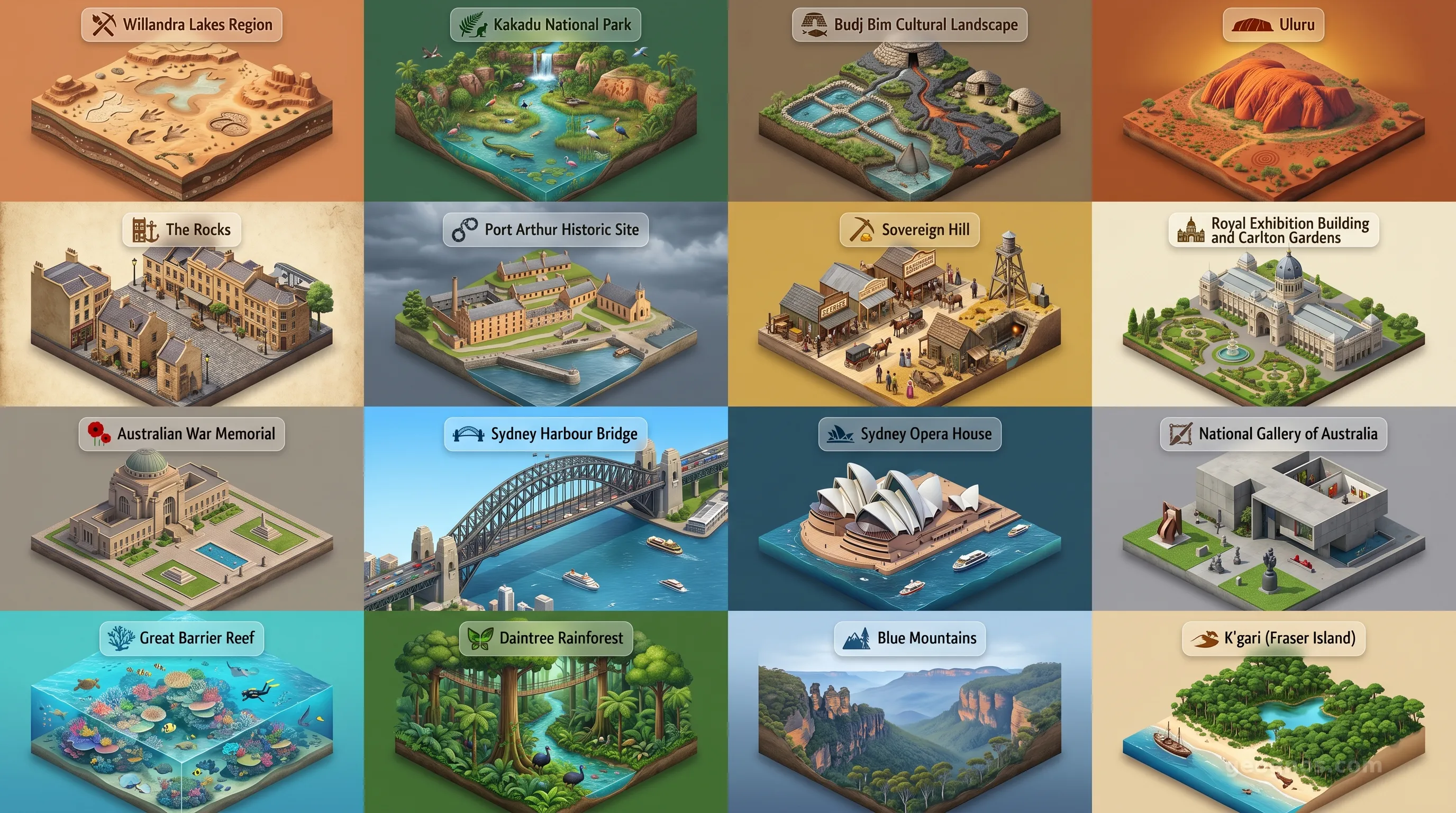
Beyond the pages of history books, the physical allure of Australia remains its strongest magnetic force. Whether it is the world heritage grandeur of the Great Barrier Reef, the spiritual majesty of Uluru, or the urban sophistication of Sydney’s harbor, the sights are world-renowned for a reason. To assist prospective travelers and educators in identifying the most iconic locations, we have compiled a digital collection of the continent's greatest landmarks. Immerse yourself in the geography through our POI Cinematic Showcase, which captures the visual essence of Australia’s most vital points of interest.
Towards a Sustainable Future
The contemporary Australian story is increasingly defined by its commitment to the future. As a nation surrounded by water and sensitive ecosystems, the inhabitants are acutely aware of the global impacts on their climate and biodiversity. Innovations in renewable energy, resource management, and water conservation serve as a roadmap for how modern nations can exist in harmony with dry, arid climates. Educators and researchers are increasingly looking toward the Australian model to understand sustainable land stewardship, ensuring that the legacy of this ancient land remains protected for future generations.
In this digital Atlas, you will find exhaustive details spanning from the structural mechanics of the government to the intricacies of the national economy. We provide this knowledge not just as static facts, but as building blocks for a deeper worldview. By studying Australia, we study our own planet's capacity for endurance, change, and renewal. Let the following sections—our maps, demographic analyses, and environmental reports—serve as your guide to understanding how this singular, vast nation contributes to the interconnected story of our shared world.