The Vast Canvas of the American Experiment
The United States of America is less a country and more an expansive, living experiment carved across a continent. To view it on a map is to observe a geographical titan, a nation of staggering diversity that bridges the frigid tundras of the north to the sun-drenched subtropical palms of the Florida coast. It is a land where the geography is as much a character as its people, defined by the soaring granite cathedrals of the Sierra Nevada, the ancient, rolling spine of the Appalachians, and the vast, horizon-blurring plains that serve as the world's breadbasket. Here, the landscape does not just support human endeavor; it has dictated the trajectory of human ambition for centuries.
To truly understand the "soul" of this nation, one must recognize that its identity is built upon the synthesis of movement and opportunity. It is a mosaic stitched together by thousands of miles of winding rivers, tectonic shifts, and the restless migrations of generations who looked at the horizon and saw not an edge, but a beginning. Whether you are a student tracing the formation of its institutions or a traveler preparing to wander its expansive highways, it is essential to first understand the foundation. For a comprehensive look at the events that shaped this republic, we invite you to explore the history of United States, which covers the pivotal milestones that transformed a colonial foothold into a global intersection of culture and innovation.
A Geographical Tapestry: From Shore to Shining Shore
Geography in the United States is characterized by its remarkable "center." The Great Plains provide a geographical heart that connects the industrial rust belts to the wild frontiers of the West. This interior connectivity allowed for the rapid expansion of commerce and cultural exchange, forming a domestic market the likes of which the world had never seen. Waterways, most notably the mighty Mississippi, act as the continent's circulatory system, while the Great Lakes provide a massive inland reservoir that has sustained industry and settlement for centuries. It is within this diverse environmental framework that the American character was forged, favoring resilience, practicality, and an innate sense of wonder at the sheer scale of the landscape.
For those interested in the milestones of human achievement and struggle within this theater of mountains and plains, you can engage with our interactive learning tool to test your knowledge with our history puzzle, a chronological challenge designed to reward those who can master the timeline of this complex nation. This experience provides not only an educational edge but a deeper appreciation for how the nation grew from thirteen original outposts to a continental superpower.
The Architecture of Memory
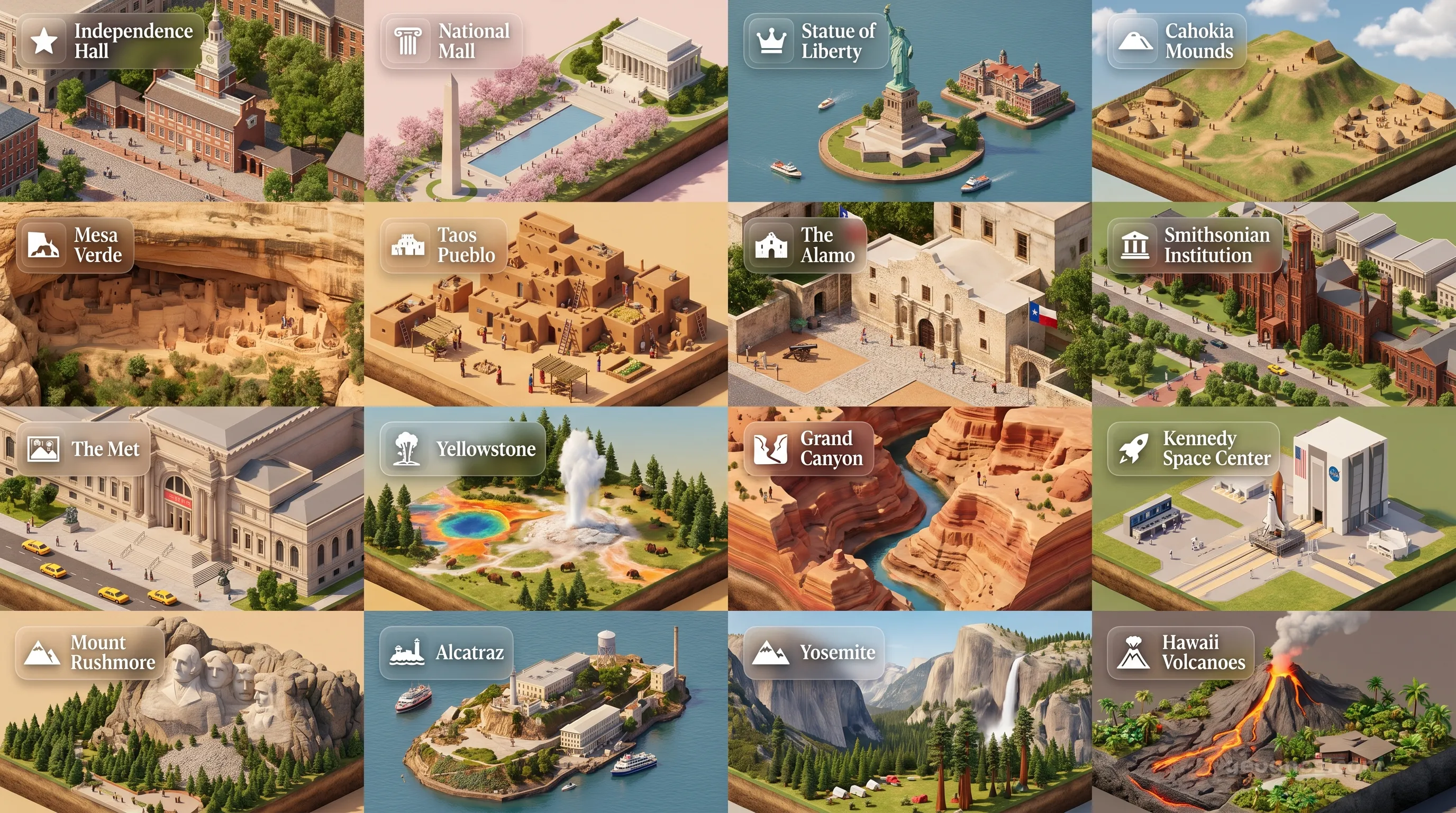
What remains after the march of time are the stories we preserve. The United States is defined by its ability to constantly reinterpret its past while pushing toward a future of technical and cultural change. From the bustling urban canyons of Manhattan to the quiet, red-rock silence of the Utah desert, every location tells a part of the American story. When we examine these historical moments in tandem, we see a recurring theme of reinvention. To bring this history to life, we recommend you view our history cinematic showcase, which features vivid illustrations of top historical events paired with expert summaries, providing a visual narrative that bridges the gap between static history and living experience.
Education is at the heart of the GeoGnos mission, and we encourage students and educators alike to utilize these narratives as starting points for classroom discussions. By situating yourself within the geography of the nation, you begin to see that the buildings, monuments, and wilderness areas are all markers of specific cultural values—liberty, invention, and communal growth. Each location serves as an open-air classroom for anyone curious enough to investigate.
Landscapes of Discovery
While history is written in books, it is experienced in the landscapes. The American system of national parks and public lands represents one of the most generous inheritances any nation has gifted its people, preserving the natural majesty of places like Yellowstone, the Grand Canyon, and Yosemite. These regions represent the biological and geological diversity that makes the United States an unparalleled destination for explorers. Each of these sites tells a story of the Earth, from the deep-time record preserved in geological layers to the delicate ecosystems currently supported by massive environmental conservation efforts.
If you are planning your own voyage, or if you simply wish to traverse the country through your screen, you can discover our POI cinematic showcase, where you will be guided through the most significant points of interest across the country. Each entry is curated to provide you with the sensory experience of being there, offering descriptions that capture the majesty, the quiet power, and the cultural relevance of these landmarks. As we navigate the complex identity of this nation, we find that the United States is, above all, a place that invites you to participate. Whether you are learning about its foundational struggles, its economic power, or its sprawling wilderness, you are engaging with an ongoing human endeavor that is as vast, bold, and ever-changing as the landscape itself.