Aotearoa: The Long White Cloud and the Edge of the Earth
There is a silence in the deep valleys of Fiordland that feels as old as the earth itself. It is a place where tectonic forces continue their restless dialogue, lifting jagged peaks toward the clouds while the Tasman Sea carves deep, glacial veins into the island’s southern flank. New Zealand, or Aotearoa as it is known in the Māori language, is not merely a country located at the bottom of the globe. It is an evolutionary experiment, a remote archipelago where nature has spent millions of years refining forms that exist nowhere else in the biosphere. For the voyager, the historian, and the curious student, this nation offers a profound study in isolation, adaptation, and the persistent human spirit.
To understand the soul of New Zealand, one must look past the picturesque postcards. This is a landscape of violent geological beauty, defined by the collision of the Pacific and Australian plates. It is this fiery foundation that created the Southern Alps, the steaming thermal vents of Rotorua, and the rolling green hills that serve as the stage for a unique national identity. As you delve into the narrative of these islands, I invite you to explore the history of New Zealand, a complex tapestry woven from Polynesian exploration, colonial transformation, and a modern dedication to cultural preservation.
The Architecture of Isolation
Before the arrival of humans, New Zealand was a land of wings, not paws. Because it drifted away from the supercontinent Gondwana eighty million years ago, it lacked terrestrial mammals, allowing birds to claim the ecological niches usually occupied by beasts. This led to the evolution of the iconic flightless kiwi, the formidable moa, and the ancient tuatara reptile. When the first human navigators steered their waka across the vast Pacific Ocean to settle these shores around the thirteenth century, they encountered a realm that defied their previous experiences. The resulting interaction between the Māori and the unique environmental landscape shaped a worldview deeply rooted in kaitiakitanga, or guardianship of the land.
The progression of time in these islands is often a challenge to reconstruct, as oral histories mingle with empirical records. For those who wish to test their understanding of the timeline that transformed these islands from a pristine wilderness into a sovereign bicultural nation, our history puzzle provides a stimulating way to organize the major events that shaped the national character. From the signing of the Treaty of Waitangi to the rise of modern industries, each milestone is a tile in the mosaic of New Zealand’s emergence on the global stage.
A Bicultural Tapestry
The story of New Zealand is perhaps best appreciated as an ongoing conversation between traditions. It is a nation that honors its Polynesian roots through the preservation of the Māori language, art, and protocol, while simultaneously participating as a vibrant democracy within the Commonwealth. This duality creates a unique cultural energy that visitors feel the moment they arrive. Whether watching a traditional kapa haka performance or exploring the contemporary urban design of Wellington and Auckland, one realizes that the "soul" of the nation is found in the synthesis of disparate worlds.
To truly visualize the shifting tides of the New Zealand narrative, we encourage you to engage with the history cinematic showcase. This visual journey brings the past to life through curated illustrations, connecting the early voyages of Polynesian wayfinders to the explorers like Abel Tasman and James Cook who bridged the gap between Europe and the Pacific. It serves as a digital bridge, ensuring that the legacy of this island nation remains accessible and resonant for educators and students alike.
The Land That Breathes
Geographically, New Zealand is divided into two primary landmasses, the North and South Islands, each with a distinct temperament. The North Island is marked by its geothermal vitality, where bubbling mud pools and volcanic cones tell the story of a land that is literally alive. The South Island, conversely, is defined by the grandeur of the Southern Alps, pristine glacial lakes like Tekapo and Pukaki, and the oceanic majesty of the fjords. It is a playground for the world, yet it remains intensely local in its devotion to the natural world.
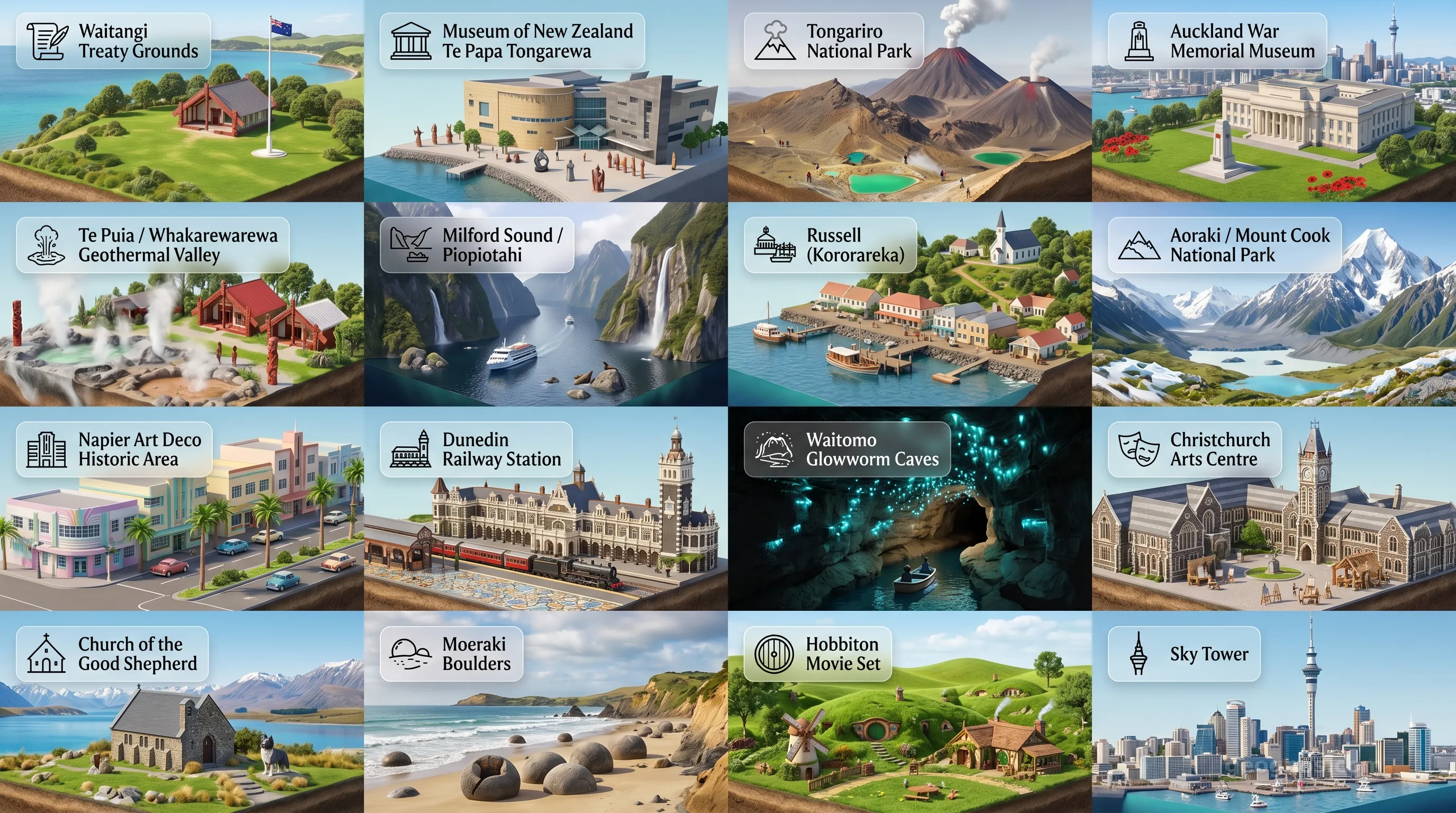
The diversity of these landscapes is best captured through a bird’s-eye perspective. If you are preparing for a journey or looking to enrich a classroom geography module, the POI cinematic showcase acts as a gateway to the most breathtaking corners of the archipelago. From the glow-worm caves of Waitomo to the golden beaches of Abel Tasman National Park, this resource allows users to navigate the diverse terrains that define the New Zealand experience. It highlights the importance of the land not just as a location, but as a vital partner in the national identity.
A Global Perspective on a Local Scale
In our modern era, New Zealand stands as a beacon of sustainable innovation and thoughtful diplomacy. It is a country that understands its vulnerability in a changing climate and works with a sense of urgency to preserve its biological treasures. As students of geography and history, looking at New Zealand teaches us about the fragility of ecosystems and the power of culture to unify. By examining its government, economy, and environmental strategies, one learns that a small population in a remote location can indeed exert a significant influence on global dialogues regarding sustainability and human rights.
We invite you to treat this page as more than a summary. Use the links to traverse the history of the land, engage with the visuals of its beauty, and challenge your mind with our interactive tools. New Zealand is a masterpiece of the Pacific, and it awaits those ready to look closer, learn deeper, and walk softly upon its vibrant, storied ground.