The Pulsing Heart of Mesoamerica
To set foot in Mexico is to stand at the intersection of deep time and vibrant modernity. It is a nation that refuses to be categorized simply by its geography, although that geography is breathtakingly diverse. From the jagged peaks of the Sierra Madre that pierce the clouds to the turquoise cradle of the Caribbean Sea and the raw, sun-baked beauty of the Sonoran Desert, Mexico is a living testament to the power of environmental theater. Yet, the true soul of Mexico lies in how its people have acted upon this stage for thousands of years, weaving a tapestry that is as intricate as it is resilient. This is a land where ancient stone pyramids remain perfectly aligned with the cosmos while contemporary cities thrive with an electric, fast-paced energy that defines the future of North America.
Understanding Mexico requires more than just a map; it requires a willingness to listen to the whispers of its past and the cacophony of its present. The story of Mexico is not a linear progression but a cyclical, multifaceted evolution where the spirits of the Olmec, Maya, and Mexica (Aztec) cultures are not confined to museums. Instead, they remain profoundly woven into the daily rituals, the vibrant culinary traditions, and the deeply rooted sense of community that characterize Mexican life today. To begin your journey through this storied landscape, you may want to explore the comprehensive history of Mexico, which chronicles the epic rise and fall of civilizations, the impact of colonial encounters, and the forging of the modern nation state.
The Geography of Paradox
Mexico occupies a unique position as a geographic and cultural bridge. Stretching from the temperate reaches of the north down to the tropical forests of the Yucatán Peninsula and the rugged southern mountains, the nation experiences virtually every major climatic zone. This diversity is not merely decorative. It has dictated the movement of civilizations, the development of trade routes, and the distribution of natural resources. The great central plateau, ringed by dormant and active volcanoes, provided the fertile heartland that nurtured the massive empires of the ancient world. Even today, the way the people have adapted to this varied terrain reflects an ingenuity that has been refined over centuries.
To fully grasp the magnitude of these historical narratives, educators and students often look for immersive ways to synthesize the timeline of events. If you wish to challenge your understanding and engage with the temporal layers of the nation, consider trying the interactive history puzzle of Mexico. This tool allows you to organize major societal shifts and pivotal movements in the correct order, helping you visualize the heartbeat of a nation that has navigated millennia of change.
A Mosaic of Visual Heritage
Because Mexico is so visually arresting, it can be difficult to translate the experience of being there into words. The deep greens of the jungle canopy contrasting with the brilliant, bleached white of limestone cenotes, or the warm hues of adobe villages against the stark desert landscape, evoke a profound emotional response. To bridge the gap between academic study and visceral appreciation, one must turn to the artistic record of the country. For a curated look at the legacy left behind by architects, builders, and cultural masters, you can view the history cinematic showcase of Mexico, which brings historical narratives to life through vivid illustrations and narrative summaries.
Beyond the Horizon: The Eternal Allure
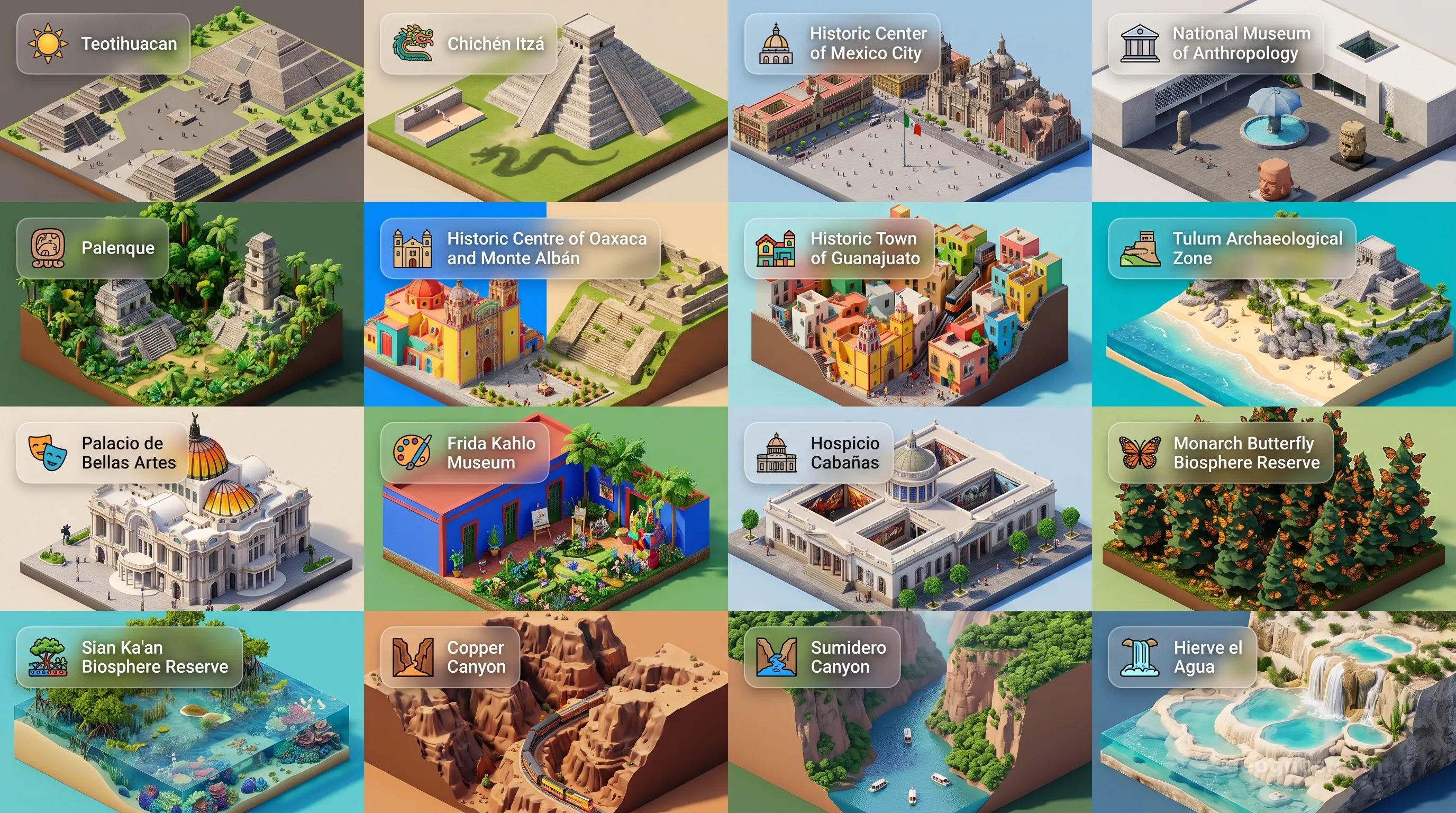
There is an irresistible quality to the Mexican landscape that beckons travelers, scholars, and dreamers alike. Perhaps it is the sense of belonging that visitors report feeling upon arrival, or perhaps it is the overwhelming beauty of its architectural landmarks, ranging from the delicate intricacies of baroque churches to the imposing majesty of pre-Columbian temple complexes. These sites are not mere static points of interest. They are living galleries that tell the story of a culture that honors both the roots of the past and the possibilities of the future. You are invited to discover these iconic landscapes and monuments through our POI cinematic showcase of Mexico, which provides a sweeping tour of the nation's most celebrated sites.
Ultimately, Mexico is a nation defined by its capacity to harmonize contradictions. It manages to hold the weight of its antiquity with grace while accelerating toward a global future. It is a place where every valley, canyon, and coastline holds a story that contributes to the grand, ongoing saga of humanity. As you delve further into the specific pages of this atlas, remember that Mexico is not just a place on a map. It is an invitation to witness one of the world's most enduring and soulful experiments in community, artistry, and environmental endurance.