The Kingdom of the Clouds: Defining the Soul of Bhutan
To enter Bhutan is to step away from the measured cadence of the modern world and into a landscape where time itself seems to fold against the sharp, snow-dusted edges of the Himalayas. Known to its people as Druk Yul, or the Land of the Thunder Dragon, this small, landlocked kingdom acts as a sanctuary for ancient traditions. It is a place where deep-rooted Buddhist philosophy informs the rhythm of daily life and where the verticality of the terrain—stretching from subtropical lowlands to jagged, unreachable peaks—has carved out a unique, protected identity. Unlike many nations that have undergone rapid, chaotic homogenization, Bhutan has charted a quiet, intentional course, prioritizing the sanctity of its heritage and the preservation of its pristine wilderness.
The geography of Bhutan is not merely a setting for its culture; it is the very architect of its isolation and its enduring strength. Deep valleys act as natural amphitheatres for culture, preserving distinctive linguistic and social customs that have remained relatively sheltered for centuries. As we begin our exploration, you might be curious to understand the foundational currents that led this nation to prioritize Gross National Happiness over the more conventional markers of industrial growth. We invite you to explore the history of Bhutan, a compelling narrative of survival, spiritual devotion, and the cautious embrace of global connectivity.
Guardians of the High Frontier: Geography and Philosophy
At the heart of the Bhutanese experience is the concept of interdependence. From the glaciers of the Great Himalayas that feed the nation’s lifeblood of glacial rivers to the verdant, dense forests of the south, the environment is treated as a sentient partner in governance. Bhutan is famously the world’s first carbon-negative country, a distinction made possible by a constitutional mandate to maintain forest cover over at least sixty percent of its land mass. This is not a policy dictated by convenience, but by a cultural reverence for the spirit of the mountains and the living world.
For students and researchers who wish to engage with these historical developments in an immersive way, we offer a specialized tool designed to test your knowledge of how the past shapes the present. You can challenge your comprehension of this timeline by testing your skill in our interactive history puzzle. By arranging the formative moments of the Bhutanese state in their correct order, you will gain a deeper understanding of the monarchs and spiritual leaders who navigated the Kingdom through the storms of history.
A Living Museum: The Preservation of Heritage
Bhutan is often described as a kingdom where the past is present in every glance. Whether it is the soaring dzongs—fortified monastic structures that dominate the valley skylines—or the fluttering prayer flags that mark mountain passes, the physical markers of the country are saturated with meaning. Architecture in Bhutan follows strict traditional guidelines, ensuring that modern structures honor the aesthetic integrity of their predecessors. This visual consistency transforms a walk through towns like Paro or Thimphu into an aesthetic journey through architectural resilience.
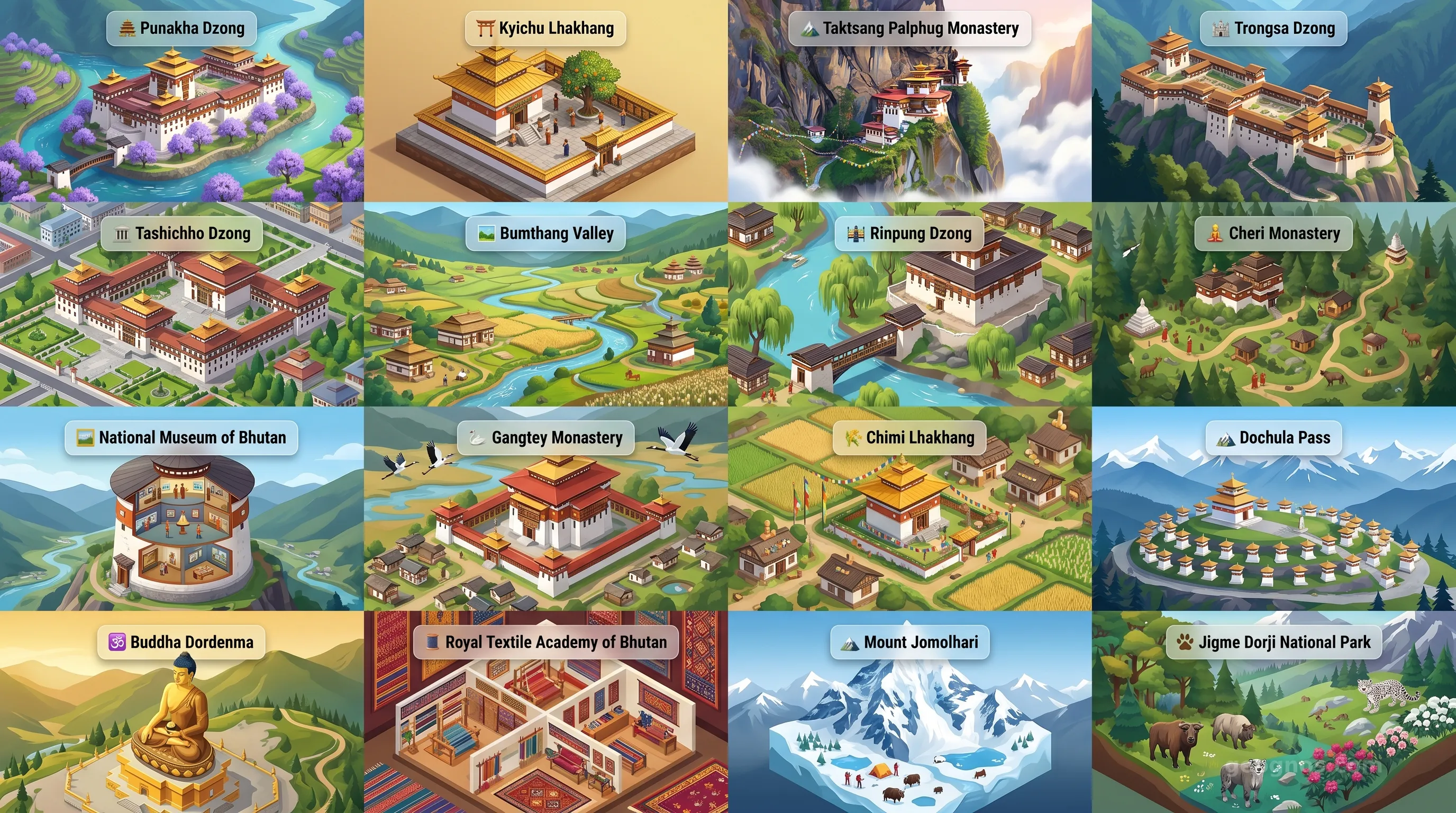
To truly grasp the scale and grandeur of these cultural landmarks, one must view them through the lens of those who live and work among them. We have curated a collection of visual stories that bring these architectural wonders to life. You may view our history cinematic showcase, which weaves together archival records and masterful illustrations to highlight the defining eras of the Kingdom. Similarly, for a broader perspective on the geography of human accomplishment, you can engage with our POI cinematic showcase. This carousel takes you on a high-definition journey from the tiger-nest cliffs of Taktsang to the sprawling courtyards of the Punakha Dzong, allowing you to witness the visual symphony that defines this Himalayan bastion.
The Road Ahead: Continuity in a Changing World
As we delve further into the specific segments of this GeoGnos profile, including the demographic patterns of the Bhutanese people, the specifics of their legislative environment, and the technological landscape of the 21st century, it is essential to remember that Bhutan is not stagnant. It is a nation in transition, carefully calibrating the balance between traditional societal values and the educational, technological, and environmental challenges of the current era. The nation approaches the global stage with a sense of guarded optimism, confident in the wisdom that it has guarded in its mountain fastness for centuries.
Through our comprehensive analysis of the Kingdom, we hope to foster an appreciation for how Bhutan navigates its global role as a guardian of heritage and environmental wisdom. As you explore the following sections of our atlas, consider how the spirit of the Thunder Dragon remains a powerful, gentle, and essential voice in our modern, fast-paced world. Welcome to our deep dive into the extraordinary, enduring life of Bhutan.