The Peninsula of Perpetual Echoes
To speak of Italy is to speak of the geography of the human soul, a land where every stone feels like an artifact and every horizon whispers of antiquity. Often described as a boot kicking a football, the Italian peninsula is defined by the rigid, jagged backbone of the Apennine Mountains and the protective crescent of the Alps in the north. This is not merely a country in the cartographic sense, but a stage upon which the most profound dramas of Western civilization have unfolded. From the silent, dust-covered lanes of Pompeii to the soaring, sunlight-drenched marble of Florence, Italy serves as a global cultural crossroads where the tension between human ingenuity and natural grandeur has existed for millennia.
Italy does not merely hold history; it breathes it. To truly understand this nation, one must dive deep into its complex past. We invite you to explore the comprehensive history of Italy, where the rise and fall of empires, the turbulence of the city-states, and the birth of the Renaissance are detailed through scholarly resources, interactive maps, and foundational pedagogical guides.
The Geography of Grandeur
The Italian landscape is a masterwork of environmental diversity. It is a land shaped by the fiery temperament of active volcanoes like Vesuvius and Etna, which have both destroyed and immortalized the civilizations resting at their feet. The fertile Po Valley in the north feeds a nation of artisans, while the sun-scorched hills of the south offer up the olives and grapes that have become synonymous with the Italian way of life. The geography of Italy is a study in contrasts: the frigid peaks of the Dolomites juxtaposed against the temperate, sapphire waters of the Tyrrhenian and Adriatic seas. These barriers and bridges have, in turn, dictated the path of history, commerce, and migration for thousands of years.
A Chronology Built on Stone
Because Italy is composed of layers upon layers of civilization, organizing the progression of time here is an exercise in enlightenment. Education is central to our mission at GeoGnos, and we believe that history should be as tactile as it is informative. You can test your mastery of these epochal shifts by engaging with our interactive history puzzle, a challenge designed to sharpen your chronological perspective of Italian milestones and reward your expertise with digital badges.
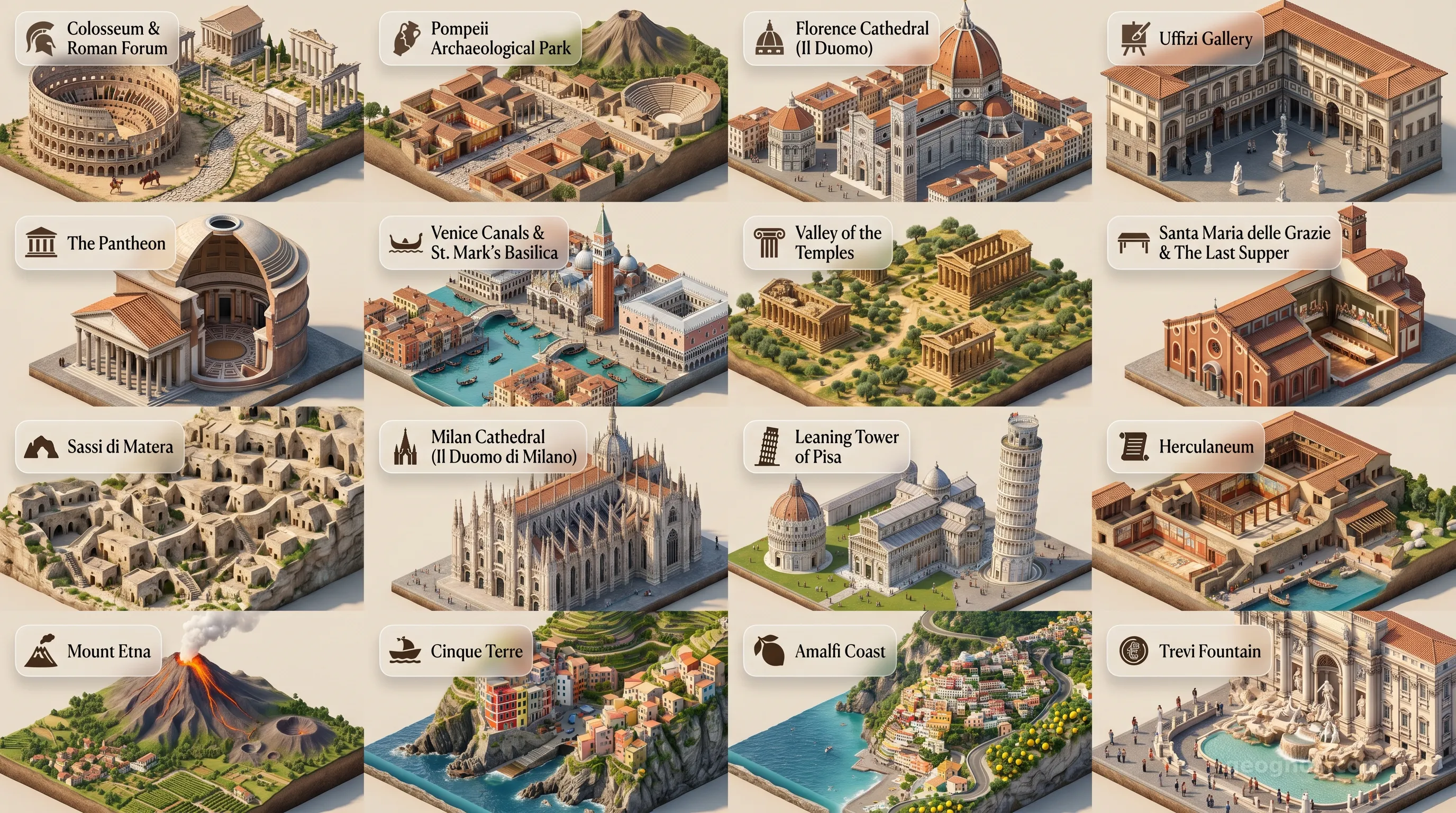
The visual impact of Italy is perhaps its most intoxicating feature. Visitors are often overwhelmed by the density of beauty, finding themselves paralyzed by the choice between a visit to a medieval piazza or a trek through a remote alpine forest. To help visualize this dense aesthetic experience, we have curated a specialized cinematic showcase of Italy’s major points of interest. Through this carousel of high-resolution imagery and contextual narration, you can traverse the Colosseum, the canals of Venice, and the coastal cliffs of Amalfi without leaving your study.
The Soul of the Mediterranean
What makes Italy unique in the modern context is its stubborn refusal to relinquish the past to the sake of the new. While the nation sits firmly within the global economy as an industrial power and a leader in luxury manufacturing, its heart remains tied to the *piazza*—the physical and social center of community life. Here, the preservation of the local craft, the rhythm of the seasonal meal, and the architectural sanctity of public spaces are not just relics of history. They are the living pulse of a country that prioritizes the quality of life over the rapid acceleration of the digital age.
The narrative of Italy is a collective story of art, philosophy, conflict, and rebirth. It is a story told in the brushstrokes of Caravaggio, the inventions of da Vinci, and the structural integrity of Roman aqueducts that still stand as silent witnesses to history. For students and educators, understanding this timeline is key to understanding the foundation of European identity.
If you wish to experience these grand historical moments with heightened dramatic clarity, our history cinematic showcase provides a gallery of illustrated narrative sequences. These visuals pull together the critical events of Italy’s trajectory, bridging the gap between textbook information and the emotional reality of those who built this magnificent civilization. Italy continues to be a pilgrimage site, not just for the faithful or the holidaymaker, but for any individual who wishes to witness how a people can exist within the beautiful, overlapping layers of a global heritage that never truly fades away.