Belgium
Top Sights & Landmarks
The Majestic Heart of Brussels
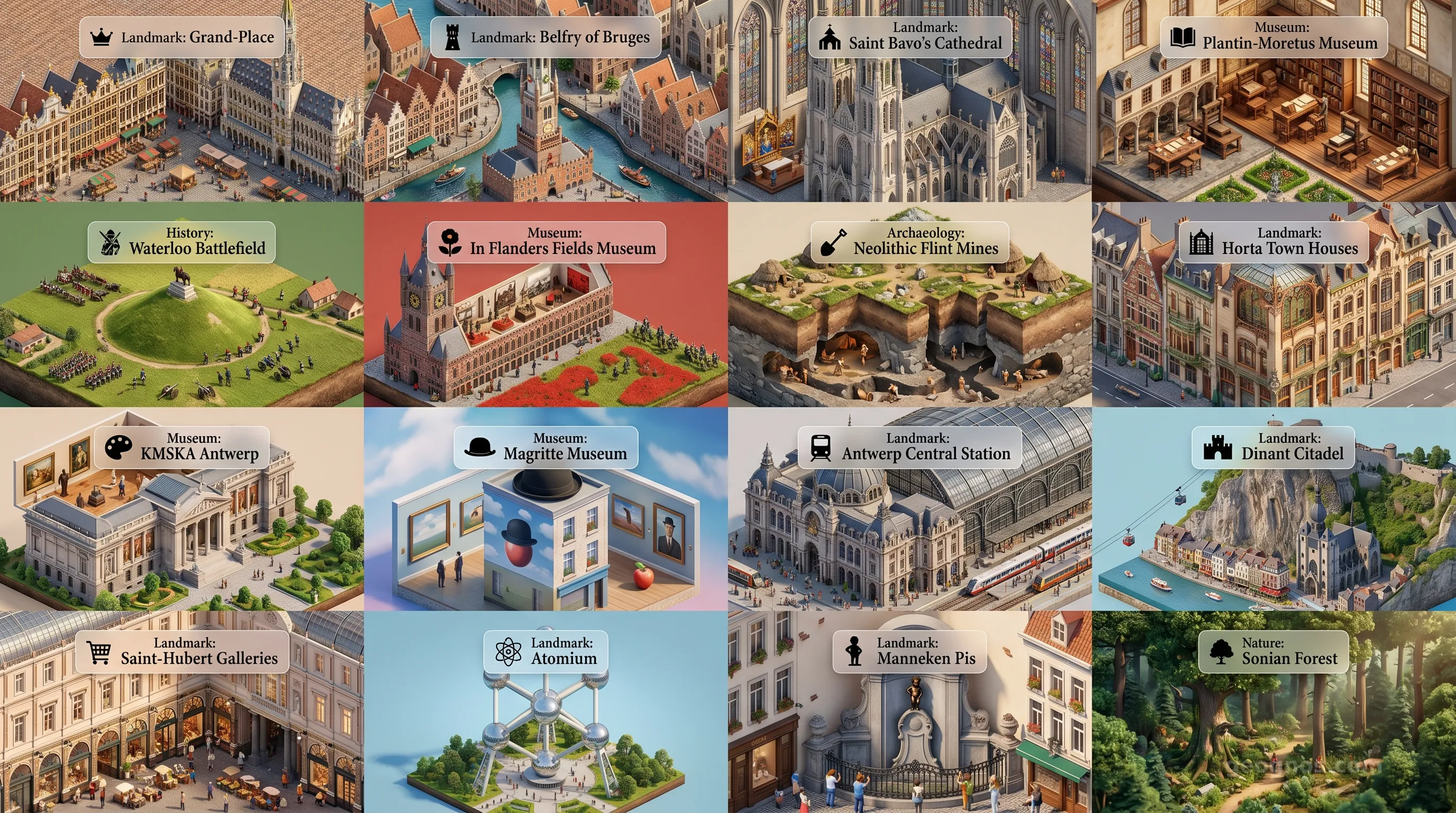
Considered one of the most beautiful town squares in the world, the Grand-Place is a spectacular showcase of 17th-century architecture. Students of architecture and history must visit to study its opulent guildhalls, the spectacular Gothic Town Hall, and the King's House. Historically, it symbolizes the success of mercantile Brussels, having been magnificently rebuilt after a devastating French bombardment in 1695. The best season to visit is mid-August (every two years) to witness the famous Flower Carpet, or winter for its magical Christmas market. Tourist tip: Arrive at dawn to avoid heavy crowds and experience the striking gold-leaf facades glowing in the morning light.
Medieval Masterpiece of Flanders
Towering 83 meters over the Markt square, the Belfry of Bruges is an iconic symbol of the city's medieval wealth and independence. It is an essential site for studying the economic dominance of the Flemish cloth trade during the Middle Ages. The historic center perfectly preserves the layout and gothic architecture of a prosperous medieval European city. Spring and early autumn are the best seasons to visit, offering mild weather and fewer tourists than peak summer. Tourist tip: Climb the 366 narrow, winding steps of the Belfry for panoramic views of Bruges, but book tickets in advance as daily entry is strictly capped.
Home of the Mystic Lamb
Located in the historic core of Ghent, Saint Bavo's Cathedral is a staggering architectural achievement blending Romanesque, Gothic, and Baroque styles. It is immensely significant culturally and historically because it houses the 'Adoration of the Mystic Lamb' (the Ghent Altarpiece) by the Van Eyck brothers, widely considered one of the most important and frequently stolen artworks in European history. Art and history students will find the newly restored altarpiece profoundly insightful. The best time to visit is during the spring. Tourist tip: Utilize the augmented reality headsets offered at the visitor center for an incredibly immersive dive into the altarpiece's dramatic history.
Renaissance Printing Pioneer
This museum in Antwerp is the only museum in the world to be inscribed on the UNESCO World Heritage list. It preserves the home and printing establishment of the Plantin-Moretus family, who operated one of Europe's most prolific printing presses in the 16th century. It is a goldmine for students studying the Renaissance, typography, and the spread of knowledge in Europe, featuring the world's two oldest surviving printing presses. Year-round visits are highly rewarding. Tourist tip: Pay special attention to the original Gutenberg Bible on display and take time to wander the beautifully manicured 17th-century courtyard.
Where Napoleon Fell
The site of the famous 1815 Battle of Waterloo marks the definitive end of the Napoleonic Wars and a turning point in European history. For military history buffs and students of European geopolitics, the battlefield and its modern underground memorial offer a comprehensive look into 19th-century warfare. The artificial Lion's Mound provides a commanding view of the battle lines. The best season to visit is June, specifically around the anniversary of the battle (June 18), when massive historical reenactments take place. Tourist tip: Buy a combined ticket to access the Panorama, the Memorial Museum, and the Lion's Mound to get the full historical context.
WWI Memorial and Museum
Located in the reconstructed Cloth Hall of Ypres, this interactive museum is dedicated to the study and remembrance of the First World War in the West Flanders front region. It holds deep historical significance, detailing the harrowing realities of trench warfare, the first use of chemical weapons, and the human cost of the Ypres Salient. It is essential for history students seeking an empathetic, human-focused perspective on WWI. Autumn, particularly around Armistice Day (November 11), offers a highly poignant atmosphere. Tourist tip: Stay in Ypres until 8:00 PM to witness the daily, deeply moving Last Post ceremony at the nearby Menin Gate.
Ancient Underground Mines
Covering more than 100 hectares near Mons, these are the largest and earliest concentrations of ancient flint mines in Europe, dating back to 4300 to 2200 BC. They are crucial for archaeology students studying Neolithic technology, early human settlement, and the transition from hunter-gatherer to agricultural societies. The site showcases remarkable human ingenuity in shaft mining. Summer is the best season to visit due to the availability of guided tours. Tourist tip: Access to the actual underground shafts is heavily restricted to protect the site; you must book an underground tour well in advance, though the surface museum (SILEX'S) is highly informative on its own.
Birthplace of Art Nouveau
These four townhouses in Brussels—Hôtel Tassel, Hôtel Solvay, Hôtel van Eetvelde, and Maison & Atelier Horta—were designed by the pioneer of Art Nouveau, Victor Horta. They represent a radical architectural revolution from the late 19th century, abandoning classical forms for organic curves, open light-filled spaces, and innovative use of iron and glass. Architecture and design students must visit the Horta Museum (his former home and studio) to understand the birth of modern architecture. Any season is suitable for a visit. Tourist tip: Only the Horta Museum has regular public hours; the others are private or require special appointments, so focus your itinerary on the Horta Museum in the Saint-Gilles district.
Treasury of Flemish Masters
After a massive eleven-year renovation, the KMSKA reopened as a cutting-edge gallery housed within a magnificent neoclassical building. It contains unparalleled collections of Flemish Primitives, masterpieces by Peter Paul Rubens, and the world's largest collection of James Ensor. Art history students will find the juxtaposition of classical and contemporary exhibition spaces inspiring for studying curatorial evolution. Winter and late autumn are great for indoor cultural exploration. Tourist tip: Don't miss the Ensor wing, and keep an eye out for the museum's quirky contemporary art interventions hidden among the classical masterpieces.
Surrealist Art Collection
Situated in the heart of Brussels, the Magritte Museum houses the world's largest collection of works by the renowned Belgian Surrealist, René Magritte. It is a vital destination for understanding 20th-century avant-garde art, philosophy, and visual culture. The chronological layout guides students through Magritte's conceptual evolution, making it highly educational. It is a perfect year-round destination. Tourist tip: Combine this with a visit to the adjacent Old Masters Museum using a combi-ticket, and visit early in the morning to enjoy the mind-bending artworks without the crowds.
The Railway Cathedral
Consistently ranked as one of the most beautiful train stations in the world, Antwerp Central Station is an architectural marvel completed in 1905. It seamlessly blends stone, glass, and iron into an eclectic style that celebrates the Golden Age of railways and Belgian industrial might. Engineering and architecture students will marvel at the monumental iron-and-glass vaulted ceiling and the modern multi-level track integration beneath the historic structure. It is beautiful to visit at any time. Tourist tip: Head to the top level for a breathtaking symmetrical photograph of the main hall, and check out the historic diamond district right outside.
Fortress on the Meuse
Perched dramatically on a sheer rocky outcrop above the Meuse River, the Dinant Citadel offers a gripping glimpse into centuries of European conflicts. Initially built in the 11th century and heavily fortified by the Dutch in 1815, it holds immense historical significance as a strategic military stronghold. History students will appreciate the detailed exhibits on the brutal 1914 WWI Battle of Dinant. The best season to visit is summer when you can combine the trip with a river cruise. Tourist tip: Skip the grueling 408 steps by taking the cable car up, but consider walking down for spectacular photo opportunities of the onion-domed Collegiate Church below.
Elegant 19th-Century Arcade
Predating the famous Galleria Vittorio Emanuele II in Milan, the Royal Saint-Hubert Galleries in Brussels is one of the first glazed shopping arcades in Europe, opened in 1847. It was designed to bring the elite out of the muddy streets and into an elegant, luminous space. It is a superb case study for urban planning students tracking the development of modern consumer spaces and bourgeois culture. The glass roof makes it a perfect rainy-day attraction. Tourist tip: Stop by Neuhaus, the exact shop where the Belgian praline was invented in 1912, for a historic chocolate tasting.
Icon of Post-War Optimism
Originally built for the 1958 Brussels World's Fair (Expo 58), the Atomium represents an iron crystal magnified 165 billion times. It was intended to be a temporary structure but became a permanent symbol of scientific progress and the peaceful use of atomic energy. Engineering and history students will find it a fascinating monument to Cold War-era optimism and mid-century modern design. Spring and summer offer clear skies for the panoramic views from the top sphere. Tourist tip: Ride the surreal, retro-futuristic escalators through the tubes connecting the spheres, which feature light shows reminiscent of science fiction movies.
The Rebellious Mascot of Brussels
This diminutive 17th-century bronze statue of a little boy urinating into a fountain basin embodies the rebellious, self-deprecating spirit (known as 'zwanze') of Brussels. Historically, it served as a public water source, but over centuries it evolved into a powerful cultural mascot. Folklore and cultural studies students will enjoy exploring the sheer volume of traditions surrounding him, including his wardrobe of over 1,000 costumes. Any time of year is fine to visit. Tourist tip: Check the official city schedule to see if he is wearing a costume on the day of your visit, and head to the nearby GardeRobe MannekenPis museum to see his extensive outfits.
Ancient Beech Cathedral
The Sonian Forest is a remnant of the vast Silva Carbonaria that once covered much of Europe from the Iron Age. Large parts of it are recognized by UNESCO as ancient primeval beech forests. For biology and environmental science students, it represents a crucial study in conservation, biodiversity, and historical ecology, showcasing trees over 200 years old. Autumn is spectacularly colorful and visually stunning for hiking. Tourist tip: Stick to the designated paths to protect the delicate flora, and start your trek from the Groenendaal arboretum for the best variety of ancient trees.
Background
Belgium became independent from the Netherlands in 1830; it was occupied by Germany during World Wars I and II. The country prospered as a modern, technologically advanced European state and member of NATO and the EU. In recent years, longstanding tensions between the Dutch-speaking Flemish of the north and the French-speaking Walloons of the south have led to constitutional amendments granting these regions formal recognition and autonomy. The capital city of Brussels is home to numerous international organizations, including the EU and NATO.