The Art of the Infinite Horizon
There is a specific geometry to the Netherlands, a sense of design that hums beneath the surface of its landscape. It is not a country merely found; it is a country curated. When travelers arrive, they are greeted by a horizon that seems stretched wide by the weight of shifting clouds and the reflection of infinite waterways. This is a land where the dialogue between humanity and the sea is not merely a metaphor, but the primary architectural blueprint. To understand the soul of the Dutch nation, one must first recognize the sheer audacity required to claim a country from the depths of the North Sea.
In this low-lying realm, the ground is an act of engineering. The Netherlands exists because its people, over centuries, mastered the patience of dikes and the precision of the windmill. Here, the landscape itself is a living witness to a legacy of cooperation, ingenuity, and a defiance of natural limits. Every polder, the fertile agricultural land reclaimed from the sea, tells a story of survival and prosperity. This delicate equilibrium forms the bedrock of a society that prizes pragmatism, tolerance, and the beauty of a well-organized life.
A Crucible of Progress: Tracing the Dutch Narrative
To walk the streets of Amsterdam, Leiden, or Utrecht is to walk through an outdoor museum of global trade, artistic mastery, and intellectual rebellion. Throughout the centuries, the Dutch became the world’s quintessential explorers and bankers, connecting disparate continents while nurturing a culture of domestic comfort known as "gezelligheid." For those eager to deepen their understanding of how a small delta nation became a colonial and maritime powerhouse, you may explore the comprehensive history of the Netherlands. This resource bridges the gap between early tribal alliances and the golden age of Dutch international dominance.
History here is not stagnant. It is a puzzle that, when solved, reveals the blueprints of modern democracy and market capitalism. Teachers and students looking for a more interactive challenge can test their mastery with our history chronology puzzle, which asks users to organize pivotal turning points in the Dutch story to earn digital achievement badges. Whether it is the rise of the Dutch Republic or the resilience shown during the industrial age, these events shaped the very identity of Europe.
Reframing the Past: From Canvas to Coastline
The story of the Netherlands is also intensely visual. From the stark, dramatic chiaroscuro of Rembrandt and the vibrant light of Vermeer to the mechanical brilliance of the Delta Works, Dutch visual culture is as defining as its land policy. For those who wish to visualize the temporal layers of the nation, we have curated a multimedia experience where you can view our history cinematic showcase. This carousel transports you through time, mapping the top historical events onto a modern timeline with detailed illustrations and academic context.
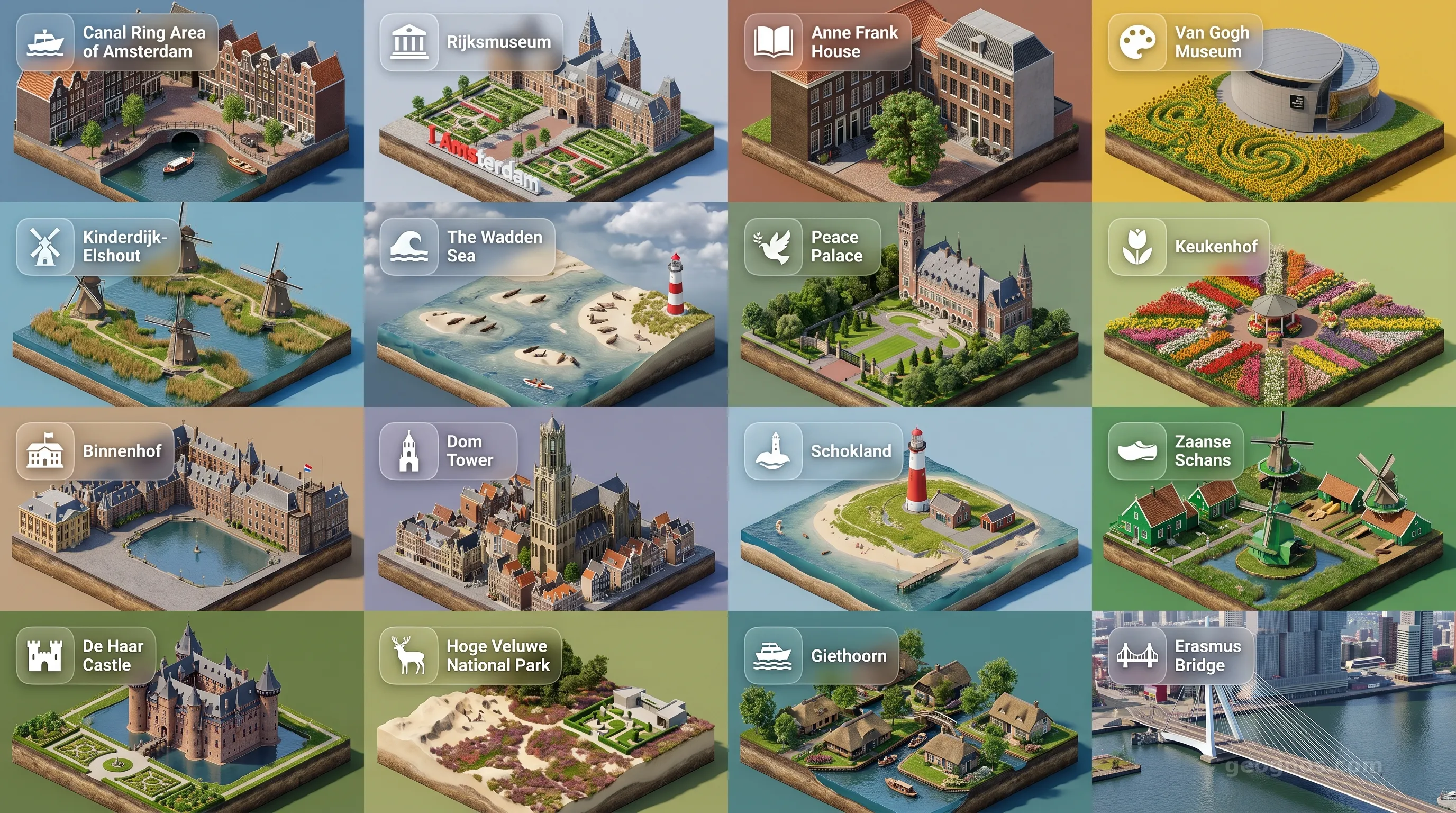
Beyond the pages of history books, the Netherlands offers a physical topography that delights the wandering soul. From the historic fortifications of Bourtange to the iconic colorful windmills of Kinderdijk, the nation is an aesthetic dream. We invite you to survey these wonders in our POI cinematic showcase, which highlights the most captivating landmarks that every student and traveler should recognize. Each location is presented with pedagogical summaries, allowing for a deep dive into the heritage of every provincial border.
The Soul of the Polder: Pragmatism and Innovation
Perhaps the most defining quality of the Dutch people is their legendary resilience. The phrase "God created the world, but the Dutch created the Netherlands" is a source of immense national pride. This ethos manifests in a culture that remains laser-focused on efficiency and environmental harmony. With large swaths of the country situated below sea level, water management is not a hobby; it is a sacred duty that has elevated the Dutch to world leaders in civil engineering and climate adaptation.
This commitment to the future extends to their societal architecture. The Netherlands serves as a global hub for innovation, where academic rigorousness meets a creative, artistic flair. Whether it is the world-renowned research universities or the avant-garde design houses in Rotterdam, the nation continuously reinterprets its identity. The Dutch have mastered the art of maximizing small spaces, whether that means a crowded city grid that flows perfectly via bicycle paths or the efficient, world-leading sustainable agriculture that feeds far beyond the national borders.
Living in the Dutch Landscape
For the student or the traveler, the Netherlands is a classroom of infinite potential. Its flat, green fields and structured urban centers are more than just transit points; they are the result of thousands of years of human ingenuity. The air here tastes different, sharpened by the nearby sea, and the light reflects a nation that has spent centuries learning to observe, adapt, and refine. It is a place that invites you to question what is possible when a civilization learns to cooperate with the environment rather than merely occupy it.
As you delve into the technical sections that follow, remember that each figure regarding population demographics, energy systems, or economic output is supported by this enduring cultural foundation. The Netherlands is a masterpiece of collaborative work, and your journey through these pages will provide the insight required to appreciate why this small nation casts such a long, brilliant shadow upon the global map.