The Balcony of Europe: An Invitation to Georgia
To speak of Georgia is to speak of a place where the earth itself rises in defiance of the heavens. Situated at the precarious and breathtaking intersection of the Greater Caucasus mountains and the Black Sea, this nation is more than a mere geographical entity. It is a sentinel of time, a rugged fortress of culture, and a cradle of civilization that has weathered the storms of empires while nurturing a spirit of unparalleled hospitality. Here, the sheer verticality of the landscape dictates the flow of history, forcing a path through deep gorges and high passes that have, for millennia, funneled the migrations, merchants, and conquerors of both Asia and Europe into a crucible of singular human expression.
For those who wish to understand the resilience and profound depth of the Georgian identity, it is essential to first trace the echoes of the past. You can delve into the layers of this ancient tapestry by reading our comprehensive history essay, which chronicles the saga of a kingdom that claims, quite rightfully, to be the birthplace of wine and one of the world's first Christian states. The resilience required to maintain such an identity is best understood by engaging with the timeline of events; if you are feeling bold, you can test your knowledge and organizational mastery with our history puzzle, an interactive challenge that asks you to arrange the defining moments of this nation in their true, chronological order.
The Vertical Landscape: Where Earth Meets Sky
The geography of Georgia is its destiny. To travel through this land is to move through a vertical kaleidoscope. To the north, the Greater Caucasus range forms a formidable, jagged wall of granite and ice, featuring peaks such as Mount Shkhara, which stands as a silent guardian over the high-altitude villages of Svaneti. These are not merely mountains. They are defensive barriers that protected a unique language and a distinct alphabet, both of which survive to this day as artifacts of a culture that refused to be assimilated.
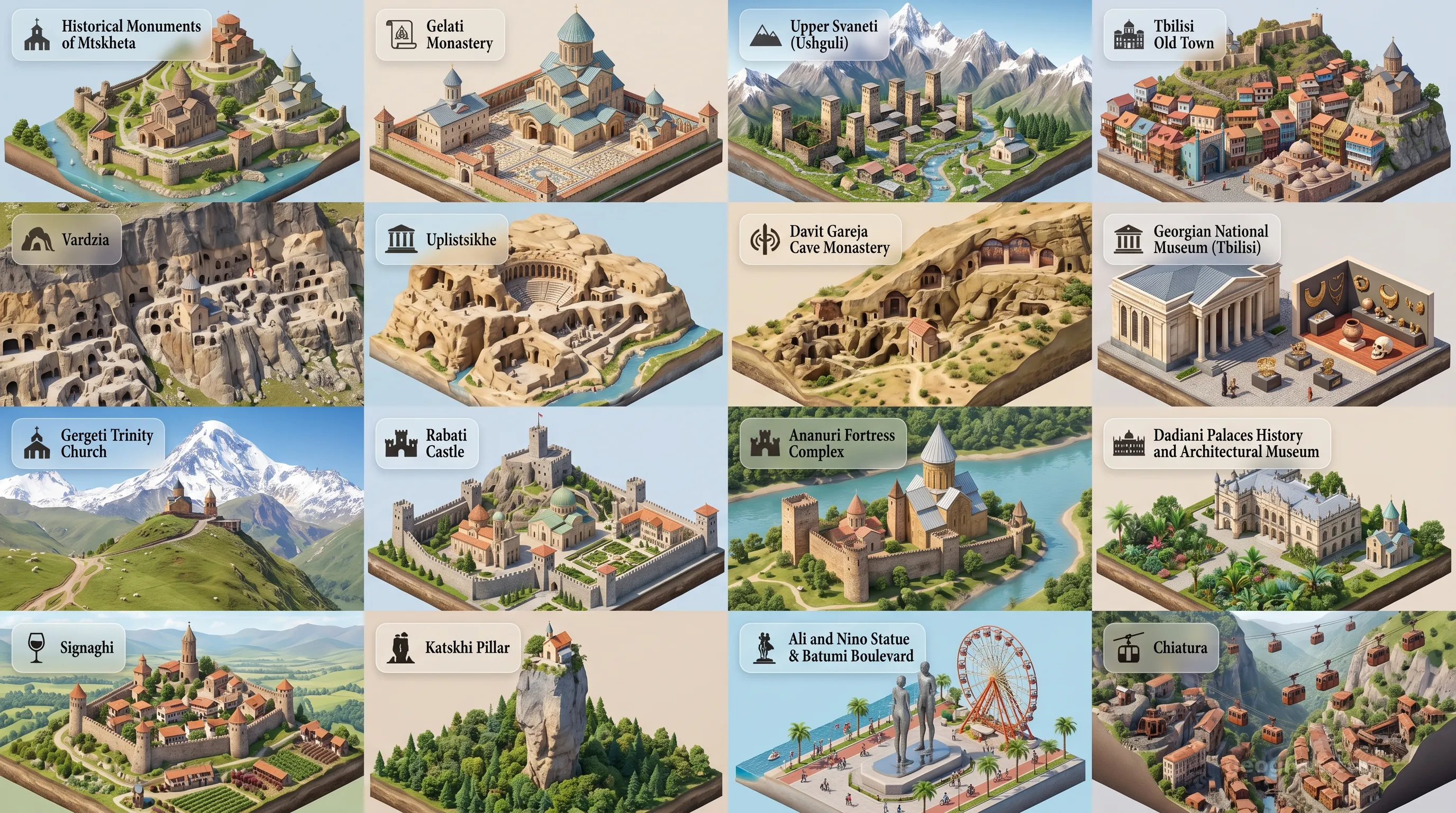
The climate is as diverse as the topography. Descending from the permafrost of the alpine summits, the air thickens with the humidity of the subtropical Kolkhida Lowlands, leading toward the balmy, azure shores of the Black Sea. This dramatic transition creates a biological treasure trove, where glaciers exist in sight of citrus groves. To witness this transition of landscapes, we invite you to view our POI cinematic showcase, which offers a vivid carousel tour of the iconic towers, remote monasteries, and lush valleys that define the visual soul of Georgia.
A Crossroad of Empires and Ideas
Throughout the centuries, Georgia has acted as a bridge between civilizations. From the legendary quest for the Golden Fleece, which the ancient Greeks situated in the land of Colchis, to the strategic movements of the Silk Road, Georgia has always been a place where the world met. The architectural remains tell this story better than any textbook. One can find Byzantine influence, Persian decorative motifs, and Ottoman architectural silhouettes existing alongside a vernacular style that is unmistakably, profoundly Georgian.
The endurance of this identity is a feat of collective memory. Whether it is through the haunting polyphonic singing that echoes in the stone vaults of a village church, or the intricate art of the supra (the traditional Georgian feast), the culture serves as a vibrant, living archive. For those seeking to visualize this chronological endurance in a moving, visual format, our history cinematic showcase provides a gallery of the events and epochs that transformed a collection of ancient tribes into a modern, sophisticated nation-state. This medium serves to ground the student and the traveler alike in the sheer weight of what has passed.
The Spirit of Hospitality: The "Guest is a Gift from God"
Beyond the monuments and the high mountain passes, the true geography of Georgia is the geography of the heart. There is an ancient, fundamental rule of life in this region, which states that a guest is a gift from God. This is not merely a social courtesy but a foundational pillar of the nation's ethos. In every corner of the country, from the bustling cafes of Tbilisi to the humble kitchen tables of the rural highlands, this belief shapes every interaction.
It is in this spirit of sharing—be it bread, local khinkali, or the amber-colored wine fermented in subterranean clay vessels known as qvevri—that Georgia extends its hand to the global community. It is a nation that asks not to be merely observed, but to be felt, tasted, and experienced. By connecting the threads of history with the vibrant life of the present, Georgia remains a luminous, enduring landmark on the world stage, a destination that offers every visitor a chance to witness the endurance of the human spirit against the backdrop of the most breathtaking mountain theater on Earth.