The Celestial Fortress of the Silk Road
To stand in Kyrgyzstan is to stand at the literal roof of the world. Here, the tectonic tension of the Earth has pushed the crust upward into a jagged, mesmerizing assembly of the Tian Shan range, mountains whose name translates appropriately to the Celestial Mountains. For the traveler, the scholar, or the student of geography, this nation serves as a living laboratory of how topography dictates the flow of human culture. Kyrgyzstan is not merely a landlocked territory in Central Asia, but a vast, windswept high-altitude stronghold that has guarded, challenged, and nurtured travelers for millennia.
In this rugged interior, life is defined by the vertical. From the turquoise depths of Issyk-Kul, one of the world's largest high-altitude lakes, to the snow-dusted ridges of the Pamir-Alay, the landscape refuses to be ignored. It is an environment that fostered the nomadic spirit, a way of life that prizes hospitality as a survival mechanism and resilience as a virtue. To understand this nation, one must explore the history of Kyrgyzstan, a chronicle that stretches from the movements of ancient Scythian tribes to the complex legacy of the Silk Road and the subsequent shifts of the modern era.
An Archive Written in Stone and Silk
History in Kyrgyzstan is rarely confined to the dusty pages of a library. It is etched into the very granite of the mountain passes and whispered through the petroglyphs of Cholpon-Ata. The Silk Road was not just a conduit for spices and silk; it was an information superhighway where philosophies, religions, and technological innovations crossed the passes between the East and the West. This historical cross-pollination created a unique cultural tapestry that feels both deeply ancient and remarkably open to the future.
For those looking to engage with this legacy on a deeper level, we invite you to participate in an interactive history puzzle. By arranging the defining moments of this region's past in their correct sequence, you will gain a clearer picture of how diverse empires, khanates, and cultural shifts synthesized into the vibrant identity of modern Kyrgyzstan. Whether you are a student preparing for a class or a curious traveler seeking to earn your honorary historian badge, this tool brings a sense of logic and timeline to the epic scale of the region's events.
Visualizing the Tides of Time
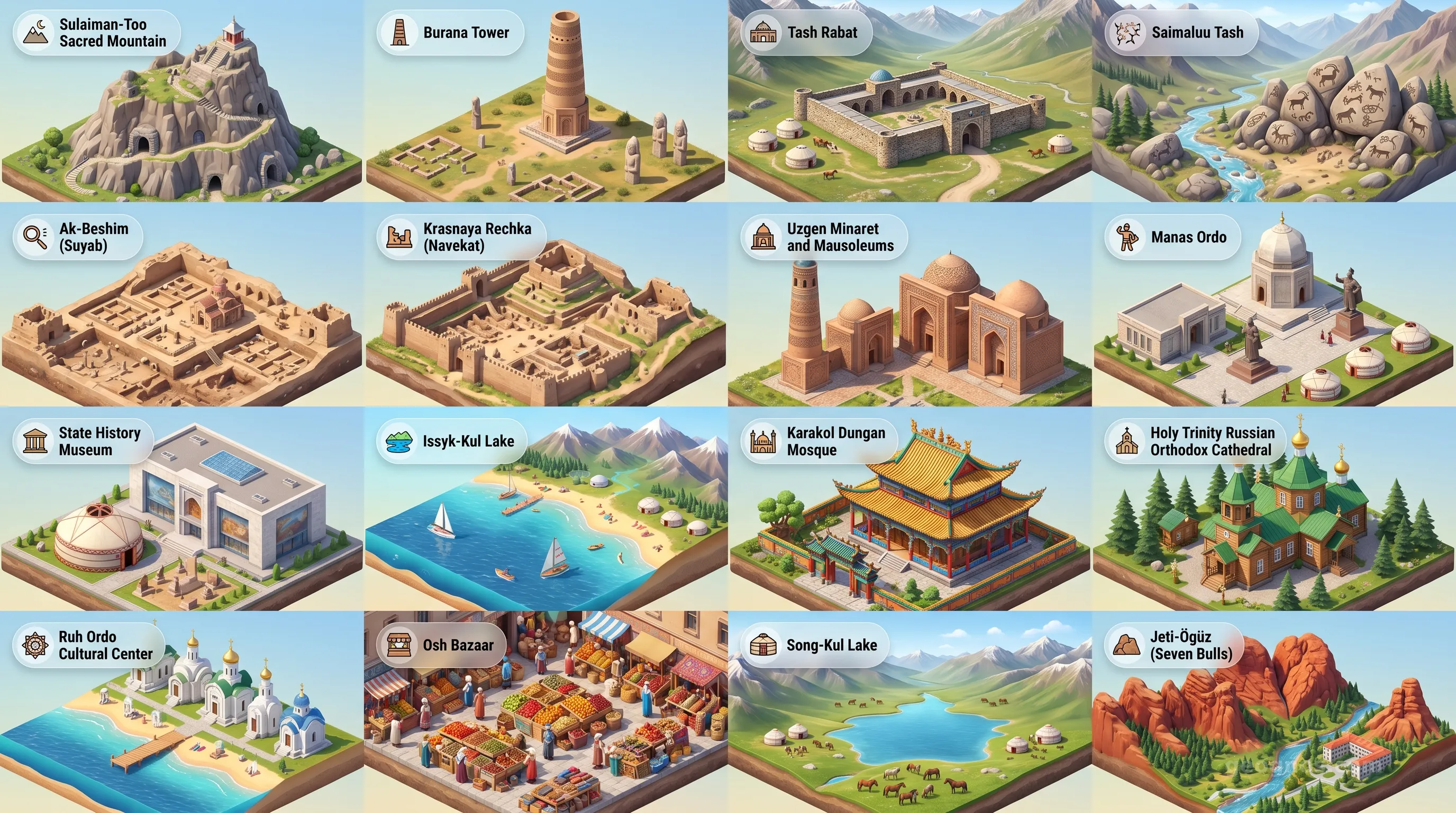
While the written word offers detail, there is a specific beauty in the visual documentation of historical change. Often, the weight of a narrative is best carried by an image that captures the grandeur of a nomadic yurt at dawn or the solemnity of a caravanserai stone archway. Through our history cinematic showcase, you can immerse yourself in these moments, watching as the saga of the Kyrgyz people unfolds through a carefully curated selection of illustrations and expert summaries. It is our hope that these visuals will serve as a foundational guide for those seeking to appreciate the continuity of life in these high valleys.
Beyond the Horizon: The Geography of the Sublime
Kyrgyzstan’s geography is its destiny. It is a nation of immense dramatic contrast. Nearly ninety percent of its land mass exceeds 1,500 meters in altitude. This immense elevation has gifted the country with a pristine water supply that feeds the valleys below, turning glacial melt into the lifeblood of Central Asian agriculture. It is a terrain that demands awe, and for those planning a journey or mapping out a research project, it is essential to visualize the iconic landmarks that define the region's silhouette.
You can begin your journey through these natural cathedrals by viewing our POI cinematic showcase. This collection highlights the diverse landscapes, from the Walnut forests of Arslanbob, which are among the largest on Earth, to the solitary, wind-blown heights of the Son-Kul plateau. Each location tells a story of adaptation, beauty, and the profound silence that can only be found in a world so far removed from the clutter of urban life.
A Spirit of Hospitality in the High Pastures
What truly sets Kyrgyzstan apart is the warmth of its people, a trait famously preserved through the tradition of yurt living and high-mountain herding. In the summer months, families still move their herds to the jailoo, the high-altitude pastures where the grass is richest and the air is clearest. This connection to the land is not merely an economic pursuit; it is a profound cultural statement. It is a reminder that even in the age of global technology, there is great value in the rhythm of the seasons and the cycle of migration.
As we delve deeper into this atlas page, we invite you to consider Kyrgyzstan as a pivot point of human experience. It is a place that challenges the student, rewards the seeker of beauty, and welcomes the wanderer with an open heart. Whether you are investigating the intricate balance of its modern government, the mechanics of its economy, or the environmental conditions that keep its glaciers vibrant, we hope this site serves as your definitive guide to one of the most compelling nations on our planet.