The Land of Eternal Fire: An Introduction to Azerbaijan
To set foot in Azerbaijan is to stand at the hinge of history. Nestled at the meeting point of Eastern Europe and Western Asia, this nation serves as a living bridge between the jagged peaks of the Greater Caucasus Mountains and the tranquil, salt-rich depths of the Caspian Sea. Known since antiquity as the Land of Eternal Fire, Azerbaijan has long held a mystique that captured the imagination of poets, traders, and empire-builders alike. From the natural gas flames that erupt from its earth to the soaring glass skyline of its capital, the country is a vibrant testament to the resilience of human culture at the edge of the Orient.
The identity of Azerbaijan is not merely found in its geography, but in the layers of civilization that have paved its soil. It is a land where ancient petroglyphs whisper tales of the Stone Age, and where the rhythmic flow of the Silk Road once brought merchants to its bustling caravanserais. To truly understand this crossroads of the world, one must dive deep into its complex past, which you can explore the comprehensive history of Azerbaijan. Through this exploration, readers gain access to visual timelines and scholarly perspectives that detail how this nation navigated the shifting tides of the Persian, Ottoman, and Russian empires to emerge as the sovereign republic it is today.
A Geological Crossroads
Azerbaijan’s geography is an extraordinary tapestry of climates. Despite its relatively compact size, the nation holds nine out of the eleven climate zones found on Earth. This radical biodiversity ranges from the subtropical lushness of the southern Lankaran lowlands to the alpine meadows of the high Caucasus and the arid, lunar-like landscapes of the Gobustan mud volcanoes. This physical diversity has naturally shaped a distinct way of life for its people, creating a culture as varied as the land itself.
For students and researchers who wish to master the chronology of this diverse region, the learning experience is enriched by interactive tools. If you feel ready to test your knowledge of how various dynasties and movements influenced the nation, you are invited to solve our interactive history timeline puzzle. By arranging critical milestones in the correct sequence, users gain a deeper intuition for the ebbs and flows of Caucasian geopolitics.
The Synthesis of Ancient Heritage and Modern Vision
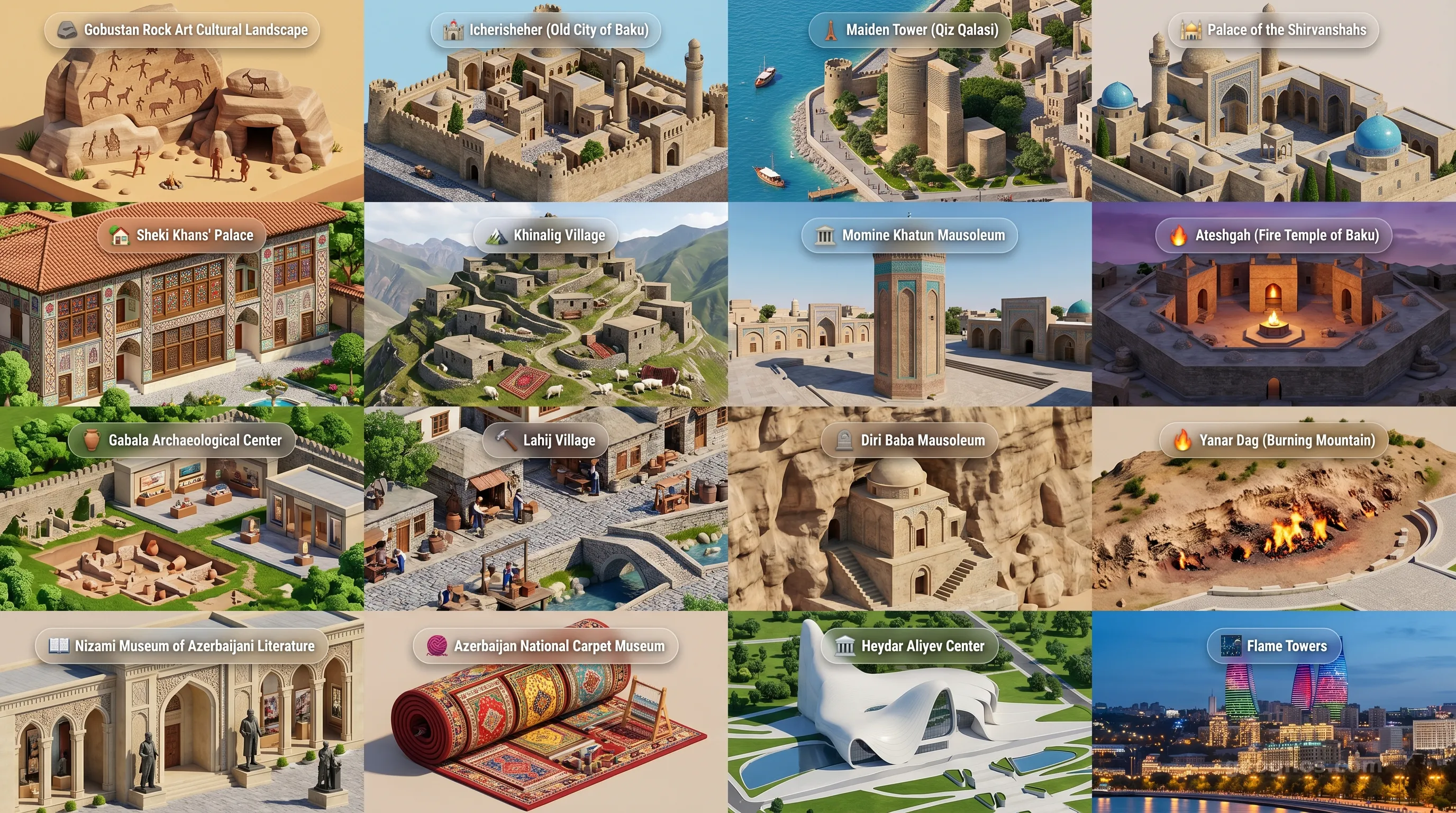
In the capital city of Baku, the past and the future coexist in a dialogue of stone and steel. The UNESCO-listed Old City (Icherisheher), with its labyrinthine alleys and the storied Maiden Tower, stands in stark contrast to the gleaming, flame-shaped skyscrapers that define the modern skyline. This visual dichotomy is not accidental. It reflects an Azerbaijani society that prides itself on deep-rooted traditions while sprinting toward global innovation. Whether it is the ancient art of carpet weaving or the contemporary architectural marvels designed by world-renowned architects, the aesthetic of Azerbaijan is defined by elegance and grand scale.
Those who wish to witness the narrative arc of this nation in a more sensory format will appreciate our visual resources. You can browse our history cinematic showcase, which utilizes high-resolution digital illustrations to narrate the defining moments that turned this small Caucasus nation into a titan of energy and trade.
An Architectural Odyssey
Beyond the borders of Baku, the diversity of Azerbaijan offers an endless array of landmarks that reveal the depth of the nation. From the Palace of the Shaki Khans, known for its intricate shebeke stained-glass windows, to the mysterious stone carvings found in the vast open-air galleries of the Gobustan National Park, there is an inexhaustible bounty for the explorer to discover. Azerbaijan’s Points of Interest act as gateways to understanding the philosophical and religious shifts that have traversed the Eurasian steppe.
To see these marvels in motion, you are encouraged to engage with our Azerbaijan points of interest cinematic showcase. This carousel serves as both a planning tool for prospective travelers and a virtual classroom for educators wanting to bring the geography of the Caucasus to life for their students.
The Spirit of Azerbaijan
At its heart, the soul of Azerbaijan is defined by "gonaqperverlik," the profound sense of hospitality held by its citizens. Whether in a high-mountain village or a modern tea house in the city center, guests are almost always greeted with a glass of aromatic black tea, served in a pear-shaped armudu glass alongside sweets and local jams. This culture of warmth, backed by a deep appreciation for music, particularly the complex melodic structures of the national genre known as mugham, provides a softer counterpoint to the country’s industrial power.
As we navigate the various administrative and economic chapters of the nation below, we hope this introduction serves as a bridge. Just as Azerbaijan has acted as a bridge between the civilizations of the East and the West for millennia, GeoGnos seeks to act as your bridge to the rich, fire-lit landscapes of this truly unique Caspian nation. From its deep energy reserves to its thriving intellectual hubs, Azerbaijan continues to be a pivotal player on the world stage, offering a rich story for those ready to look, listen, and learn.