The Bridge of the World: Panama's Geographic Destiny
There are few places on this planet where the geography dictates the destiny of the entire globe quite like the Isthmus of Panama. It is a slender, S-shaped ribbon of land that serves as a terrestrial hinge between North and South America, while simultaneously acting as the primary aquatic gateway between the Atlantic and Pacific Oceans. To understand Panama is to understand the fluid intersection of geology and human ambition. Here, where the mountains dip low to meet the churning Caribbean and the calm, vast Pacific, humanity dared to carve a path through the very fabric of the continent.
The soul of Panama is not merely defined by its famous engineering marvels, but by a vibrant cultural synthesis that has been thousands of years in the making. Since the time of the indigenous Guna, Embera, and Wounaan peoples, this land has been a conduit for migration, commerce, and exchange. It is a nation that wears its history on its sleeves, bridging the ancient traditions of the rainforest with the hyper-modern silhouette of Panama City. To truly grasp the complexity of this nation, one must examine the threads of the past that have woven this bridge together. You can dive deeper into these formative moments by reading our comprehensive history essay on the evolution of Panama, which serves as a definitive resource for scholars and students alike.
A Crucible of Human Ambition
The narrative of Panama is best understood as a grand, sometimes turbulent, epic. It is a story of empires—from the Spanish colonial period to the eventual hand-off of the canal—that looked at the narrow isthmus and saw an opportunity to conquer distance itself. History here is tactile. It lives in the stone ruins of Old Panama and in the echoes of the bustling trade routes that preceded the canal by centuries. For those who enjoy testing their grasp of these pivotal milestones, we offer an interactive way to engage with the past: our history puzzle challenge allows you to rearrange the defining events of the Panamanian timeline, testing your chronological mastery while rewarding you with digital badges of expertise.
However, the past is more than just names and dates; it is a visual tapestry. The stories of explorers, engineers, and workers who built the world we know today are best viewed through a lens that honors their struggle and ingenuity. By exploring our history cinematic showcase, you can witness these events come to life through a carousel of carefully curated historical illustrations and summaries designed to illuminate the path that brought Panama to its status as a cornerstone of international trade.
The Living Isthmus: Biodiversity and Landscapes
While the Panama Canal is the most recognizable icon of this nation, the true wealth of Panama lies in its stunning natural diversity. Because the country serves as a land bridge, it is an ecological treasure trove, boasting a biological corridor that connects the fauna and flora of two continents. From the cloud forests of Boquete to the pristine turquoise archipelago of Bocas del Toro, Panama is a study in contrasting landscapes. It is a country where you can stand at the base of Volcán Barú and contemplate the geological forces that elevated this land from the sea floor millions of years ago.
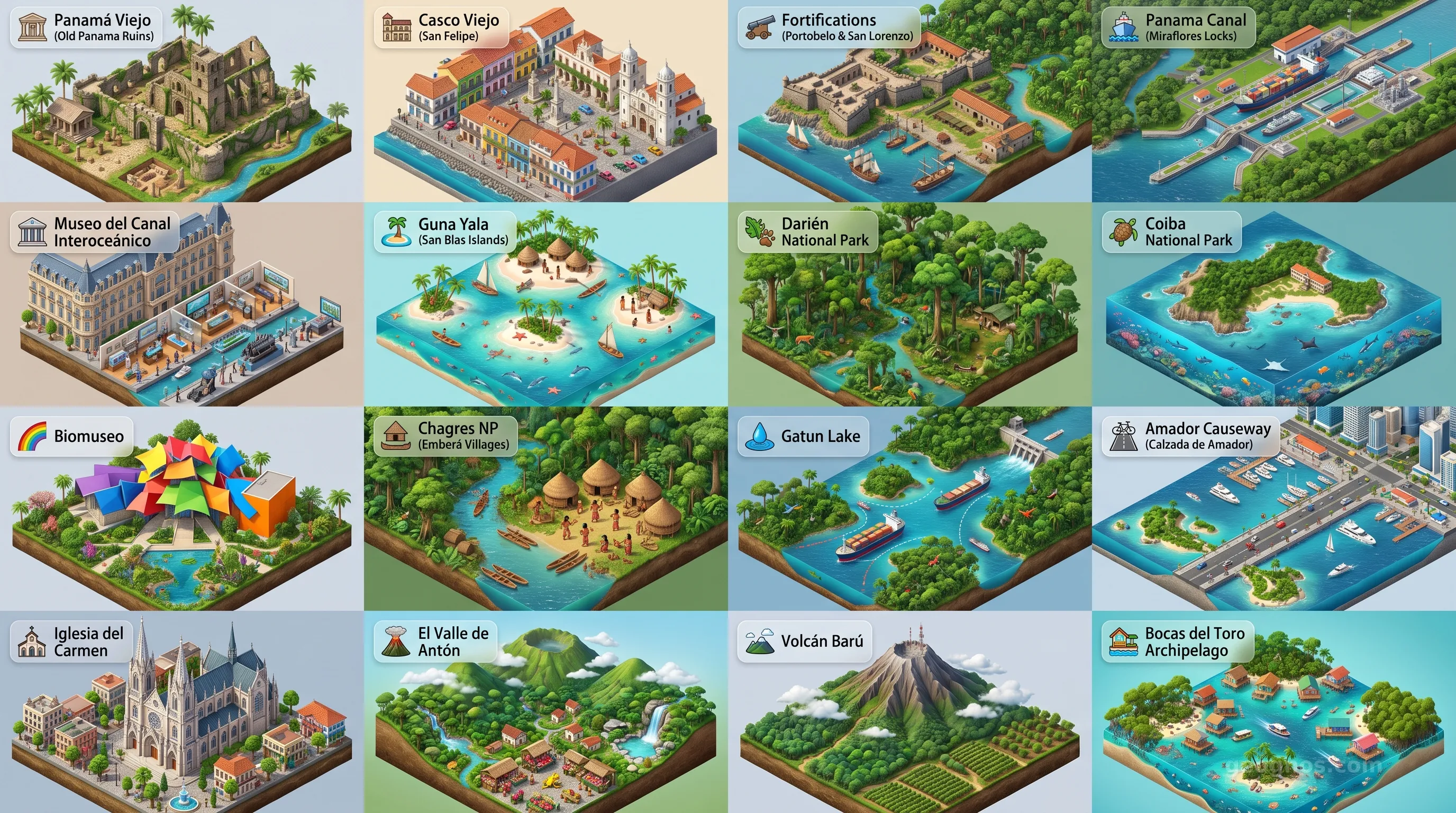
For the traveler, educator, or student, visualizing the beauty of this geography is a gateway to inspiration. Our country is not just a commercial hub, but a biological powerhouse that remains a testament to the preservation of natural heritage. You can immerse yourself in the awe-inspiring geography and local culture through our POI cinematic showcase, which takes you on a visual tour of the most striking locations that make the Panamanian experience unique.
An Eternal Crossroad
What remains most striking about Panama is its resilience and its welcoming, cosmopolitan spirit. It is a nation of many colors and many voices, where the Spanish heritage blends with Afro-Caribbean rhythms, indigenous wisdom, and the influences of a modern global workforce. As we explore the other dimensions of the country in the sections that follow, we must remember that Panama's strength lies in its dual nature. It is a country that stays tethered to the wild beauty of its jungles while facilitating the smooth operation of global commerce. It is a place that understands its role in the global machine, yet remains deeply and unapologetically itself.
Whether you are studying the logistical impact of the locks, the political evolution of the state, or simply planning your next journey into the heart of Central America, this page serves as your hub for deep discovery. From the quiet mist of the central highlands to the steel pulse of the canal containers, Panama invites you to learn, to observe, and to understand the weight and the wonder of living on the bridge of the world.