The Vertical World: Where Earth Meets the Infinite
Ecuador is not merely a country situated at the geographic center of the world. It is a vertical universe, a compressed masterpiece of biological and topographical intensity. To stand in Ecuador is to experience the paradoxical sensation of standing on a bridge between the molten, subterranean power of the Andes and the gentle, breath-taking stillness of the Pacific tide. It is a nation that refuses to be defined by borders alone, instead projecting its soul upward into the thin, crystalline air of volcanic peaks and outward toward the horizon of the Galapagos. Here, in this sliver of South American land, one finds a laboratory of evolution and a living mosaic of humanity that has thrived in the shadows of the "Avenue of the Volcanoes" for millennia.
For the traveler, the scholar, and the curious student, Ecuador serves as a grand classroom. It is a place where history is written not just in ink, but in stone, ash, and textiles. To begin your journey through this landscape, you may first want to explore the comprehensive history of Ecuador, which reveals how the shifting tectonic forces and the resilience of its indigenous populations forged a nation defined by its spirit of survival and artistry.
A Geography of Extremes
The soul of Ecuador is defined by the Andes Mountains, which bisect the nation into two parallel ranges. These mountain chains create a dramatic corridor of high-altitude valleys, each home to distinctive microclimates that support an staggering array of flora and fauna. To the west of the mountains lies a lush, coastal lowland that breathes with the humidity of the Pacific, while to the east, the Andes cascade into the sprawling, verdant expanse of the Amazon basin. It is this sheer concentration of diverse ecosystems, all within a few hours of travel, that makes Ecuador perhaps the most bio-diverse country per square kilometer on the planet.
Understanding this landscape requires more than just map-reading. It requires an appreciation for the historical tides that moved through these mountain passes and coastal jungles. If you wish to challenge your perception of time and sequence, test your knowledge with our interactive history puzzle. By arranging the pivotal milestones of the Ecuadorian past in their correct chronological order, you can earn digital badges and master the narrative of how this nation emerged from ancient tribal chiefdoms to the modern, multifaceted republic we see today.
The Echoes of Time and Stone
The cultural heartbeat of Ecuador is found in the rhythmic convergence of colonial architecture and pre-Columbian tradition. Cities like Quito and Cuenca, both designated as UNESCO World Heritage sites, stand as living museums where Spanish baroque cathedrals rise from foundations laid by Inca stone-masons. These urban centers act as gateways to the past, where the preservation of indigenous languages, textile patterns, and agricultural techniques tells a story of resistance and integration. The history of Ecuador is a rich tapestry, and to truly visualize the grand scale of the events that shaped this country, you can view our curated history cinematic showcase, a collection of artistic interpretations that bring to life the transformative moments of this nation.
Whether you are tracing the routes of the Inca Empire or following the paths taken by early European scientific explorers, the geographic markers remain the most poignant symbols of the Ecuadorian story. The land itself acts as a historical record, where glaciers preserve the secrets of paleoclimates and the rich, volcanic soil narrates the cycle of destruction and renewal. The intersection of humanity and this volatile landscape has forced an adaptation that is uniquely Ecuadorian, characterized by deep ingenuity and a profound reverence for the natural world.
Beyond the Mountains: A Visual Odyssey
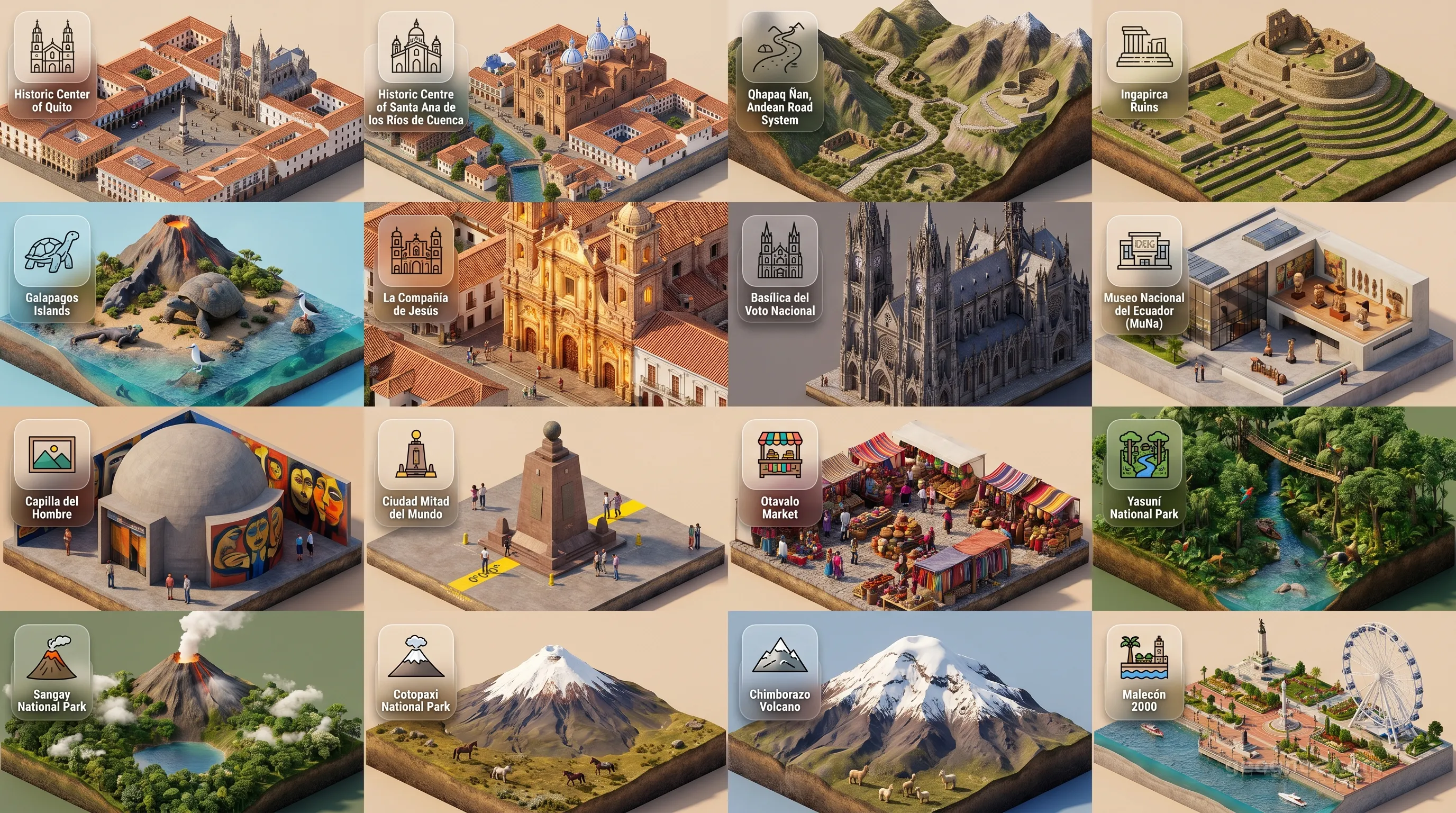
While the Andes provide the dramatic backdrop, the beauty of Ecuador extends far beyond the central highlands. It touches the equatorial line, the mystical "Middle of the World," and reaches out into the Pacific Ocean to the enchanted Galapagos Islands. This archipelagic crown jewel serves as a sanctuary for species that exist nowhere else, a living testament to the wonders of biological evolution. For those eager to witness the splendor of these sites firsthand, we recommend browsing through our comprehensive POI cinematic showcase. This visual collection provides an immersive experience, taking you from the mist-shrouded cloud forests to the pristine beaches of the coast and the vibrant markets of Otavalo.
As you delve into the remaining chapters of this atlas, consider how Ecuador continues to influence the global stage today. From its focus on environmental stewardship to its vibrant agricultural exports and its commitment to educational development, this nation punches well above its weight class. It remains a focal point for those studying environmental science, anthropology, and geography. Ecuador teaches us that our world is interconnected, that mountains can connect oceans, and that a nation, though small in stature, can possess the depth and resonance of an entire world.
In every high-altitude caldera, every bustling street corner, and every sheltered bay, the spirit of "Gnos"—the pursuit of knowledge—remains ever-present in Ecuador. Whether you are studying the geology of the volcanoes, the lineage of its people, or the economic pathways that link it to the rest of the globe, you will find that Ecuador does not simply provide information, it provides perspective. We invite you to continue your study of this extraordinary nation, keeping in mind that in Ecuador, the journey of discovery is only ever as deep as your own curiosity.