The Silent Symphony of Stone and Ice
To understand Sweden, one must first look away from the gleaming architectural spires of Stockholm and toward the vast, hushed expanse of its northern interior. Here, the landscape is defined by the profound interplay between rock and water. Sweden is not merely a country in the northern latitudes, it is a geological testament to the power of the Ice Age, which sculpted its granite archipelagos, carved its thousands of deep, crystalline lakes, and blanketed the northern reaches in the formidable boreal forest. This geography has dictated the Swedish character for millennia, fostering a culture that thrives on a rhythmic alignment with the changing of the seasons and a deep, ingrained reverence for the land itself.
The Swedes call this relationship "Allemansrätten," or the Right of Public Access. It is a social contract as fundamental to their national identity as the parliamentary system. It grants every individual the right to wander, forage, and commune with nature, provided they respect the delicate balance of the environment. In a world of increasing urbanization, Sweden remains a sanctuary where the border between the human domain and the wild is porous. Whether you are traversing the rolling farmlands of Skåne in the south or witnessing the auroral spectacle over the fells of Sápmi in the north, you are experiencing a geography that demands, and rewards, contemplation.
The Arc of Human Endeavor
While the geography set the stage, it was the persistent ingenuity of the Swedish people that transformed this harsh, northern corner of the world into a beacon of global influence. From the early maritime prowess of the Viking Age, which saw Norse influence radiate outward to the coasts of North America and the river systems of the east, to the industrial modernization of the 19th century, the Swedes have always possessed a quiet drive to innovate. To better understand how this small population managed to shape a distinct national path through changing empires and shifting borders, you are invited to explore the history of Sweden, a comprehensive guide that highlights the transformation of the state from a regional power to a model of contemporary progress.
Education is the bedrock of this evolution, and at GeoGnos, we believe that history is a dynamic dialogue with the past rather than a static list of dates. For those who wish to test their understanding of the events that forged this nation, we provide an interactive tool where you can test your wits against the timelines of Northern Europe. By completing our History Puzzle, you can challenge your grasp of cause and effect while earning achievement badges for your digital portfolio. This active approach to historiography ensures that the triumphs, struggles, and transitions of Sweden become an integral part of your intellectual journey.
A Legacy Brought to Life
History, when presented in the right light, takes on the clarity of a living narrative. The transition from tribal confederations to a unified kingdom, and eventually to a constitutional democracy, is a story written in landscapes and monuments. Through our History Cinematic Showcase, you can experience a curated visual journey through the defining moments of Swedish heritage. We pair period-accurate illustrations with brief, expert summaries to anchor each event within its geographical context, bridging the gap between historical fact and emotional resonance for students and travelers alike.
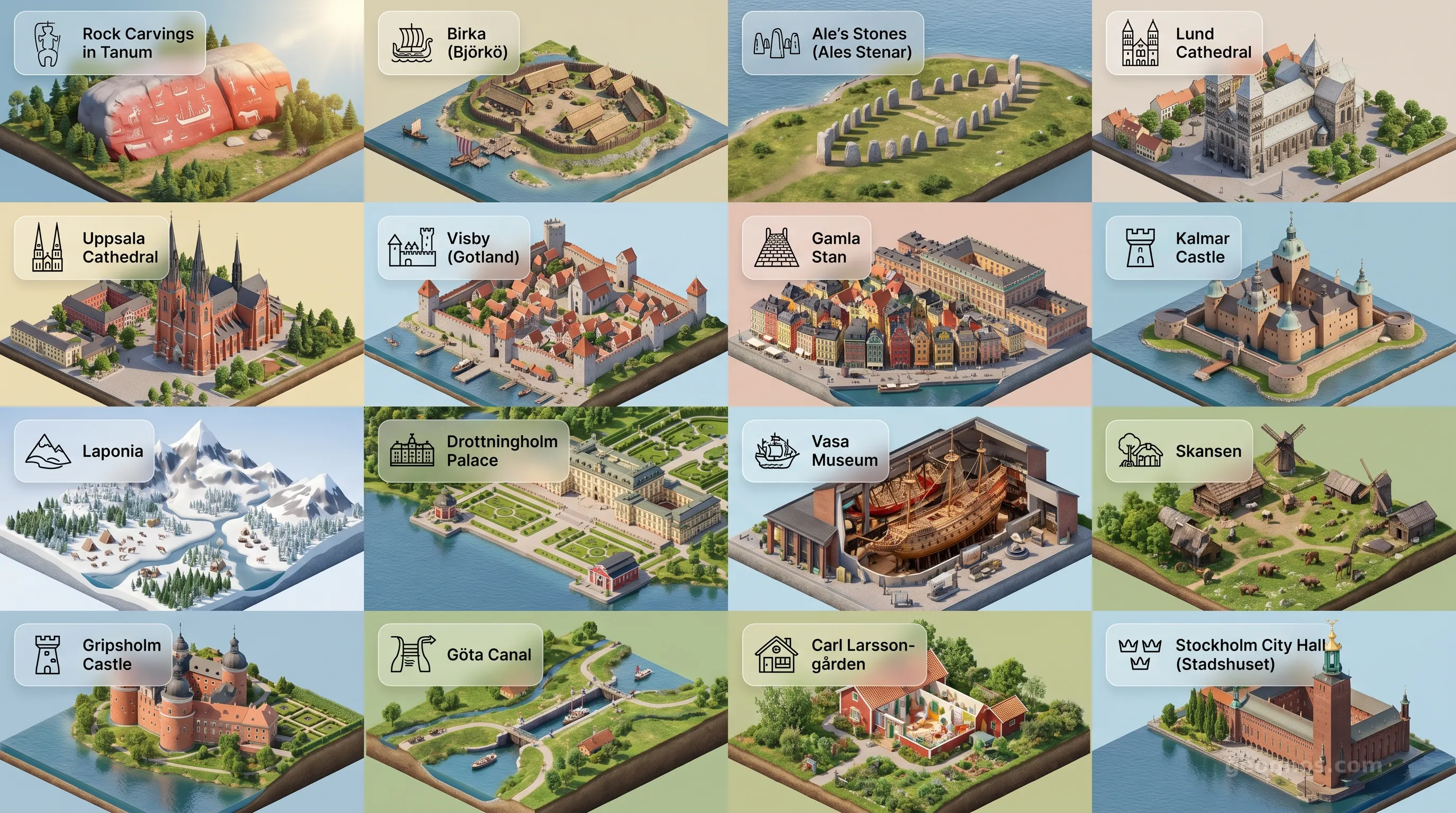
The soul of Sweden is not, however, found solely in the dusty ledgers of the past. It breathes in the architecture of Gamla Stan, the innovative engineering of its maritime heritage, and the preserved rural villages that speckle the countryside. To gain a true appreciation for the aesthetic beauty that defines the Swedish experience, we recommend you engage with our POI Cinematic Showcase. This interactive gallery features a high-definition tour of Sweden's most significant landmarks, providing a necessary perspective on how these cultural hubs continue to shape the Swedish narrative today.
Harmony in Social Design
Sweden today stands as a curious and successful synthesis of tradition and progressive futurism. The nation consistently demonstrates that high industrial productivity can coexist with a deep commitment to sustainable environmental stewardship. The Swedish government and its populace work in a partnership that prizes consensus and the welfare of the collective, often reflected in the orderly, clean, and efficiently run infrastructure that greets visitors.
Whether it is the vast forests of the north that sequester carbon and offer timber, or the precision manufacturing hubs of the south that lead the world in automotive and technological design, Sweden is a masterclass in modern resource management. The energy sector, transitioning toward entirely renewable sources, stands as a lighthouse for other industrial nations struggling to balance growth with ecological limits. For the educator and the student, Sweden serves as a living laboratory, a place to witness how geography shapes not just the terrain, but the very systems by which human beings organize their societies for the common good.
As you delve into the remaining chapters of our Sweden profile, keep in mind that you are studying more than a set of borders on a map. You are examining a model of human persistence and adaptability. From the silent, frozen winters to the frantic, sun-drenched summers of the midnight sun, Sweden offers a study in contrasts that teaches us much about the resilience of the human spirit in the face of nature's majesty.