The Sculpture of Stone and Tide: Defining Norway
To look at a map of Norway is to witness a geographical rebellion. Where most of the world’s coastlines trace soft, predictable curves, the Norwegian fringe is an elaborate, fractal-like rupture. It is a nation carved by the slow, grinding patience of glaciers and the restless, rhythmic persistence of the Atlantic Ocean. Norway does not sit comfortably upon the map; it clings to the edge of the world, a dramatic amphitheater of vertical rock and submerged mountain chains. To understand Norway is to recognize that geography is not merely a stage for its story, but the principal protagonist of the national identity.
This is a land where the sheer scale of the landscape dwarfs the human endeavor. Towering plateaus, known as vidde, roll out like frozen oceans of stone, while deep fjords—drowned valleys of profound, ink-black depths—slice miles into the heart of the terrain. For centuries, this fragmentation of land served to isolate communities, fostering a spirit of radical self-reliance and deep connection to the seasonal cycles of light and dark. It is a place where nature is not a luxury, but the primary language of survival and, eventually, prosperity.
From the Age of Voyages to the Modern Ethos
The history of this nation is a testament to the transformative power of its environment. When one delves into the comprehensive history of Norway, one discovers a narrative defined by external adaptation. From the expansionist era of the maritime Northmen, who used their superior understanding of ocean currents and boat-building to touch the shores of distant continents, to the stoic resilience of mountain farmers navigating the short, feverish summers, Norway has always been shaped by the horizon. These stories of endurance and exploration are woven into the collective memory of the populace, forming a foundation of cultural pride.
For those looking to engage with this legacy on a more tactile, intellectual level, our interactive history timeline puzzle offers a unique way to test your understanding. By placing major turning points—from the unification of the petty kingdoms in the Viking Age to the emergence of modern petroleum-based democracy—into their proper sequence, you gain a sense of the momentum of this northern kingdom. It is a vital exercise for students who wish to move beyond rote memorization and toward a deeper structural appreciation of how events ripple through the centuries.
If you prefer a more sensory immersion into the dramatic narrative of this nation, we invite you to view our cinematic historical showcase. Through a curated sequence of illustrations, you will watch the saga unfold. Witness the transition from the stave church architecture of the Middle Ages, with their unique dragon-head motifs and timber-locked strength, to the rise of independent parliamentarianism. These visuals provide a necessary bridge between the academic study of history and the emotional reality of a people who have lived between the glaciers and the sea for millennia.
A Landscape of Extremes
Norway represents one of the most stunning geographic contradictions in the Northern Hemisphere. Despite its high latitude, the nation is largely shielded from the absolute climate extremes seen elsewhere in the Arctic. The reason is the North Atlantic Current, a warm pulse of ocean water that keeps the coastal fjords ice-free and sustains life in latitudes where one might expect only desolation. This anomaly allowed fishing and trade to thrive, creating a maritime society that looked outward long before the rest of Europe embraced trans-oceanic navigation.
The contrast between the coastal maritime culture and the inland, pastoral traditions is striking. While the coast was focused on trade and maritime engineering, the interior valleys held tight to folklore, intricate music traditions, and communal agricultural systems. The synthesis of these two worlds created a uniquely balanced culture. It is a society that values egalitarianism, perhaps a direct byproduct of a landscape where nature’s harshness necessitates a social structure based on cooperation rather than hierarchy.
Seeking the Sublime: Traveling the Fjordlands
For the traveler, Norway is not a destination of conquest, but a destination of contemplation. Whether you are navigating the steep slopes of the Lysefjord or traversing the snow-swept expanse of the Hardangervidda, the objective is to perceive the sublime scale of the world. The architecture of the cities, from the wooden wharf districts of Bergen to the avant-garde, marble-clad opera house in Oslo that rises like a glacier from the harbor, demonstrates a commitment to blending human comfort with an awe of the physical world.
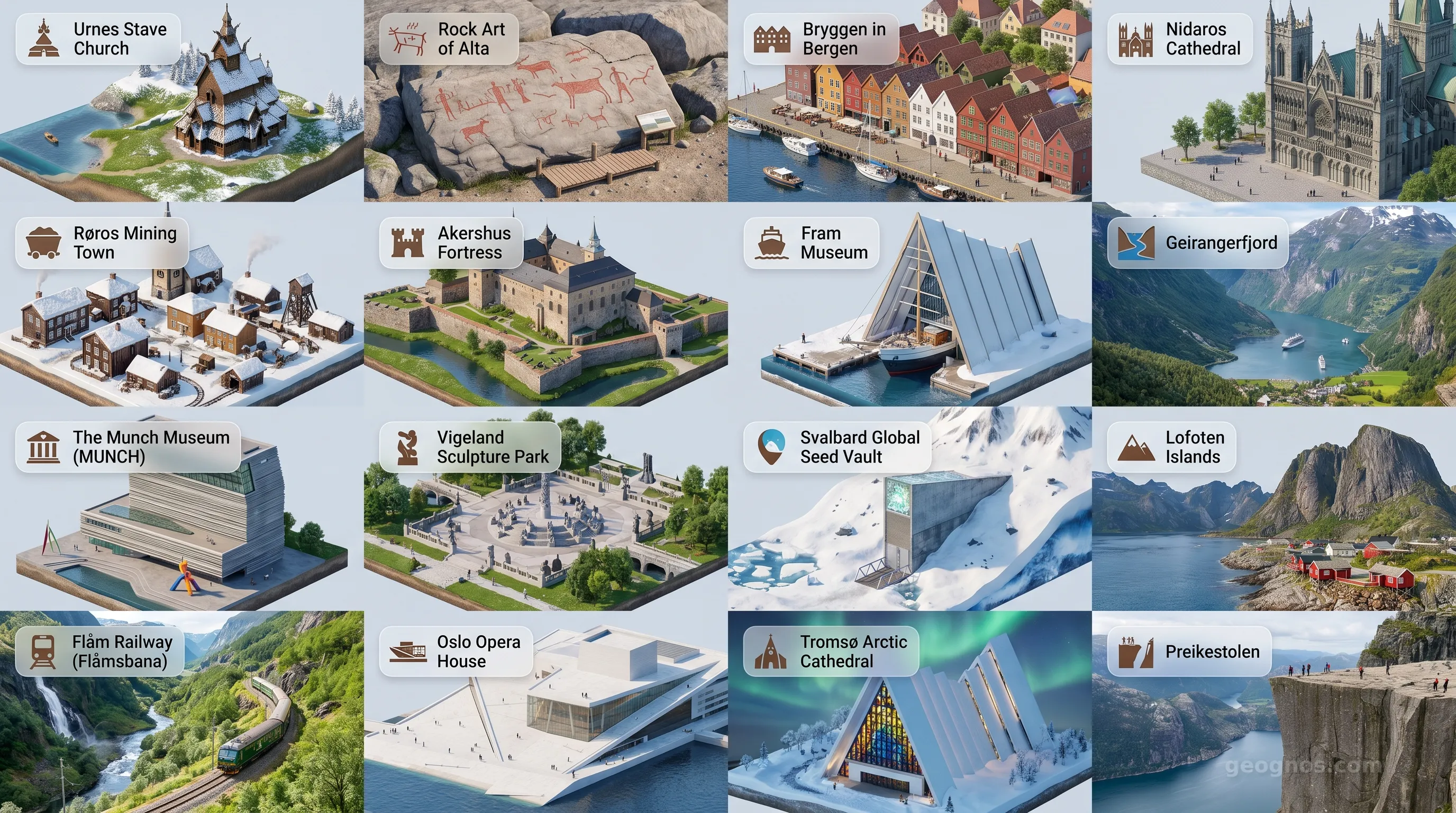
To help guide your imagination toward the most significant landmarks of this vast region, we have compiled the Norway points of interest cinematic showcase. This visual journey traverses the Lofoten Islands with their jagged peaks rising directly from the waves, the quiet beauty of the inland stave churches hidden in deep river valleys, and the industrial ingenuity of the coastal lighthouses. It serves as an essential companion for both the classroom educator looking to illustrate the majesty of European geography and the traveler preparing to step into the fresh, crisp air of the North.
Sustainability and the Stewardship of Space
In the twenty-first century, Norway has turned its gaze toward the stewardship of this environment. Having leveraged its significant natural resources to build one of the most prosperous economies in the world, the nation now acts as a global laboratory for renewable energy, environmental policy, and green technology. This transition is not merely economic, but existential. To inhabit a land that is so inherently delicate, where the mountains are slowly rebounding from the weight of vanished glaciers, is to feel an acute responsibility for the land.
The soul of Norway is found in this quiet equilibrium. It is the silence of a deep fjord at sunrise, the engineering brilliance of roads that weave through impossible mountains, and the persistent, unyielding legacy of its ancestors. It remains a land of profound inspiration, serving as a reminder that with sufficient ingenuity, respect for the elements, and a sense of collective purpose, human societies can flourish even in the most demanding reaches of the earth.