The Pulsing Heart of the Antilles: An Introduction to Trinidad and Tobago
To speak of Trinidad and Tobago is to describe a phenomenon of convergence. Situated just a stone's throw from the northeastern coast of Venezuela, this dual-island nation stands as the southernmost outpost of the Caribbean chain. While its northern neighbor, Tobago, offers the quintessential vision of a tranquil, coral-fringed sanctuary, the larger island of Trinidad acts as the continental bridge, a place where the biological rhythms of South America collide with the oceanic spirit of the Caribbean. This is not merely a country of stunning landscapes, but a complex, vibrant mosaic of humanity, where the legacies of Africa, India, Europe, and the Middle East have fused to create a cultural tapestry unlike any other in the world.
For those looking to ground their understanding of these islands in the reality of the past, we encourage you to explore the comprehensive history of Trinidad and Tobago, which details the profound transformation from indigenous Amerindian territories to a colonial crossroads and finally, a modern sovereign state. This narrative serves as the foundation for the unique rhythm that defines life here today, from the steel pan drum echoing through the valleys of the Northern Range to the sensory richness of local cuisine.
A Convergence of Ecosystems and Cultures
Geographically, Trinidad acts as an ecological anomaly. Because it sits on the continental shelf of South America, the island is home to a startling diversity of flora and fauna more akin to the Amazon than to the smaller volcanic islands of the West Indies. When you study the terrain, you find that it is not defined by singular volcanic cones, but by three distinct mountain ranges and a vast central lowland of plains and swamps. The Caroni Swamp, a sanctuary for the brilliant scarlet ibis, serves as a poignant reminder of the delicate intersection between man and nature. This diversity extends to the soul of the people, who define their identity not through a single heritage, but through the seamless integration of their varied ancestral traditions.
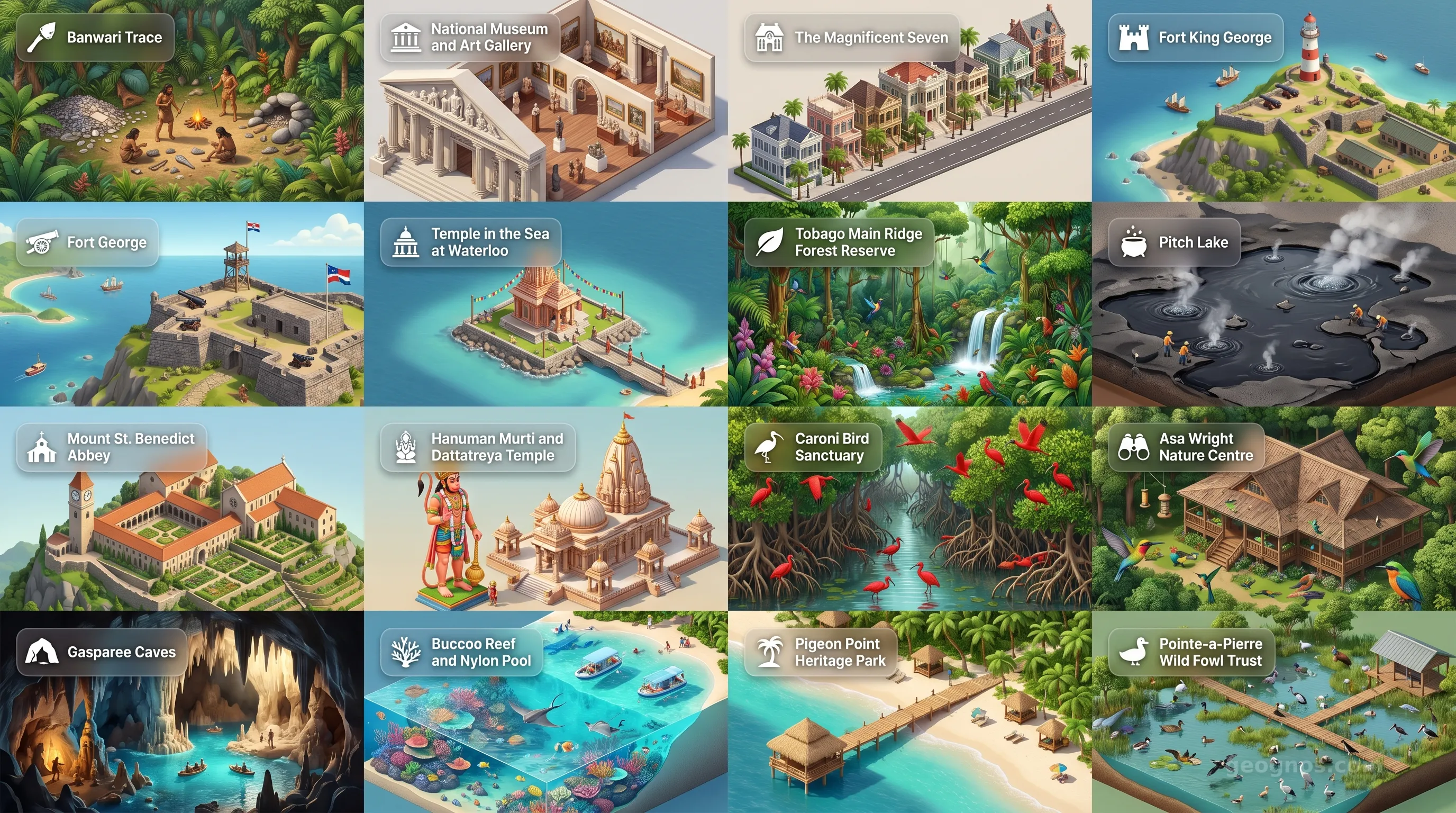
Visitors who want to visualize these diverse geographical highlights and landmark structures should consult our cinematic showcase of top Trinidad and Tobago points of interest, which captures the lush beauty of the Northern Range as well as the pristine, tranquil shores of Tobago’s Pigeon Point.
The Architecture of Memory and Festivity
Trinidad and Tobago possesses an identity that is rhythmically driven. The twin islands host one of the world's most spectacular cultural events: Carnival. Yet, to see Carnival only as a party is to miss its structural significance. It is a release of history, an explosion of artistic synthesis, and a demonstration of the communal bond. This energy is deeply connected to the trials and triumphs of the islands' past. Educators often find that a tactile understanding of these historical turning points fosters a deeper appreciation for the modern festivities. If you wish to test your grasp of the timeline that led to this national character, take a moment to challenge yourself with our interactive historical chronology puzzle, where arranging key dates unlocks badges that celebrate your expertise in the evolution of this island nation.
Beyond the Shores: Understanding the National Evolution
It is crucial to recognize that the modern state of Trinidad and Tobago did not happen in a vacuum. It was shaped by complex global trade networks, the endurance of indigenous cultures, and the resilience of a populace that has successfully turned a colonial legacy into a uniquely sovereign cultural identity. The islands' contribution to world literature, art, and music is disproportionately high, reflecting a society that values oral history and creative expression as essential tools for survival and development.
Whether you are a student piecing together the timeline of colonial governance or a traveler trying to identify the hidden layers of local folklore, the journey of understanding this nation requires visual context. Our curated cinematic history showcase allows you to bridge the gap between abstract academic concepts and the visual reality of historical events. Through this medium, we see how Trinidad and Tobago transformed from an outpost of shifting empires into a regional powerhouse of energy and culture.
Living the Heritage of the Twin Islands
As you navigate the pages of this atlas, consider Trinidad and Tobago not merely as a coordinate on a map, but as a living laboratory of human adaptation. The interplay between the industrial vigor of Trinidad and the ecological preservation of Tobago provides a rare look at a developing nation successfully balancing progress with heritage. The people, known for their warmth and linguistic inventiveness, act as the guardians of this cultural intersection. As you proceed through the data and dioramas on this page, remember that you are exploring a society that welcomes the inquisitive mind, offering lessons in resilience, multicultural harmony, and the celebration of life in all its myriad colors.