The Land of Many Waters: Guyana's Eternal Rhythm
To set foot in Guyana is to experience the raw, pulsing heartbeat of the South American continent. It is a nation that defies the traditional categorization of South American identity, instead existing as a singular bridge between the Amazonian heartland and the Caribbean consciousness. Guyana does not whisper its history. It shouts it through the thunderous cascades of the Kaieteur Falls, the complex web of blackwater rivers that carve through the Guiana Shield, and the dense, emerald canopy that shelters a biodiversity rivaling anywhere on Earth. Here, the landscape is not merely a setting. It is the primary author of the national character.
This is the "Land of Many Waters," a name derived from the Indigenous words that speak to the essential geography of the region. As you navigate the winding waterways that act as the country’s primary veins, you begin to understand how the shifting silt and rising tides have dictated the settlements, the industry, and the resilience of a people shaped by the frontier. To truly comprehend how this delicate balance between nature and humanity has been struck, you may explore the comprehensive history of Guyana, which details the profound saga of colonization, the endurance of indigenous cultures, and the forging of a multicultural state.
An Ancestral Tapestry of Culture
Guyana’s demographic landscape is a vibrant, kaleidoscopic reflection of global migrations. It is a place where South Asian heritage meets African rhythm, Indigenous wisdom meets European colonial influence, and the result is a society unlike any other. This synthesis of cultures defines the country's social fabric, evident in everything from the fragrant, slow-simmered pepperpot of the kitchen to the rhythmic, hypnotic sounds of Chutney music that echo through the coastal villages. The national story is one of navigation and adaptation, a theme that teachers and students alike can analyze through an interactive perspective as they test their knowledge with our history puzzle, challenging themselves to piece together the milestones that shaped the modern Guyanese identity.
The spirit of Guyana lives in the resilience of its inhabitants. Whether it is the descendants of indentured laborers, the legacy of the plantation era, or the ancestral endurance of the Amerindian tribes, the Guyanese people have crafted a shared narrative built upon communal support and distinct linguistic pride. The nation is a living library of cultural endurance, where the boundaries of history are as fluid as the great Essequibo River itself.
A Natural Frontier Defined by Spectacle
For the traveler, the scientist, or the wide-eyed student, the geographical wonders of Guyana are unparalleled. The landscape is dominated by the Guiana Shield, one of the oldest geological formations on the planet. These ancient rock surfaces have been weathered over millions of years, creating a dramatic topography of tepuis and rainforests that act as a refuge for endemic species found nowhere else on the globe. To visualize the grandeur of this rugged terrain, you can immerse yourself in the cinematic showcase of Guyana's major historical events, which captures the visual intensity of the nation's unfolding legacy through high-resolution archival imagery and pedagogical summaries.
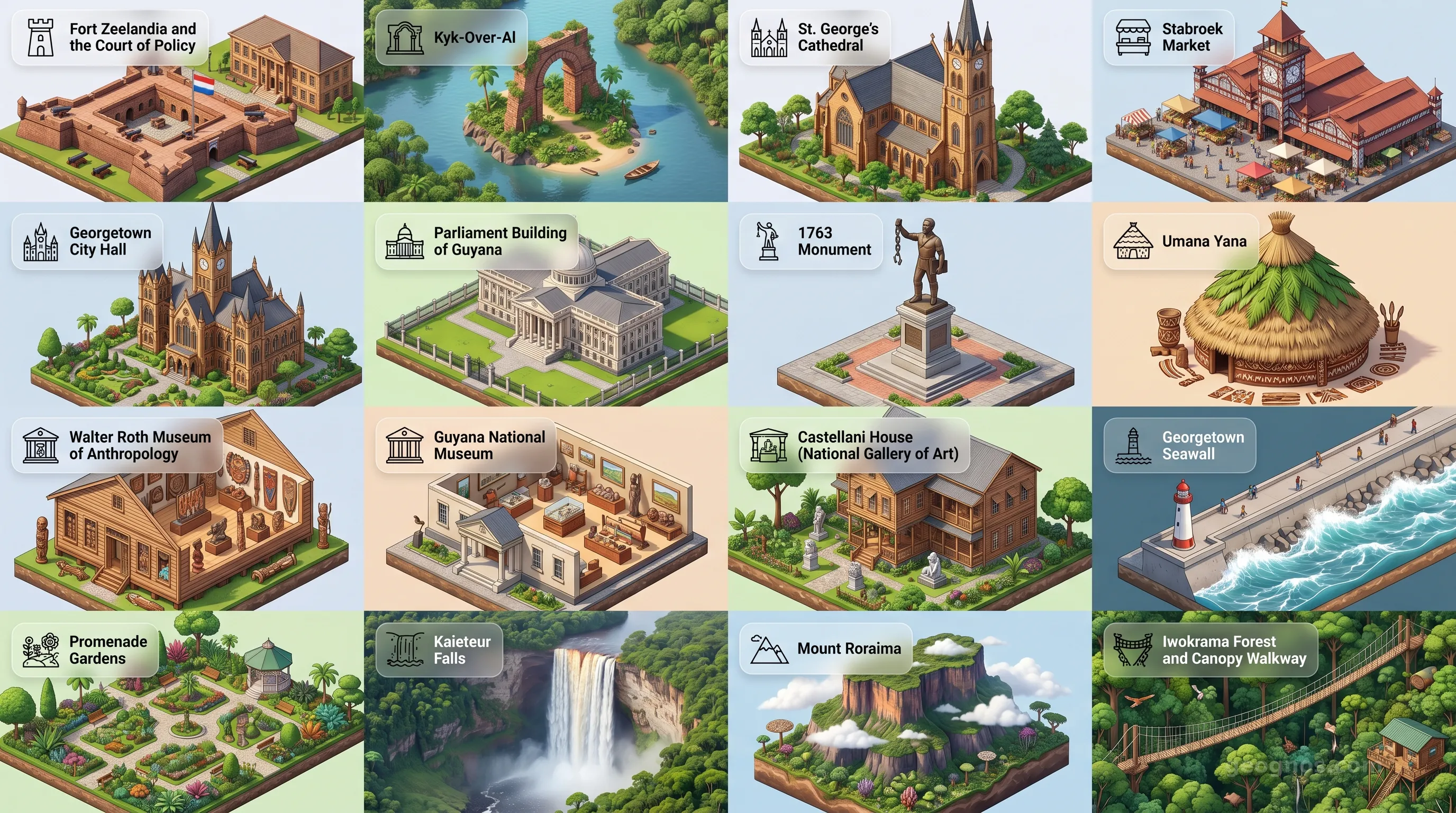
Beyond the forest, the points of interest within the country serve as beacons of both ecological beauty and architectural heritage. From the stately timber structure of St. George’s Cathedral in Georgetown—one of the tallest wooden churches in the world—to the untamed expanses of the Iwokrama Forest, Guyana is a living classroom for geography and environmental science. We invite you to experience the physical majesty of the landscape through our curated cinematic showcase of top Guyana points of interest, where you can traverse the country’s most breathtaking locations from the comfort of your own screen.
Navigating the Guianese Future
As Guyana stands on the precipice of a new era of global prominence, its identity remains rooted in its stewardship of the land. It is a nation that is acutely aware of its role in the global environmental conversation, serving as a vital "lung" of the earth with its vast, carbon-absorbing rainforests. This intersection of ecology and ambition defines the Guyana of the 21st century. It is a place that requires a delicate touch and a respectful eye, inviting visitors to appreciate a pace of life that respects the tidal patterns and the seasonal rains.
Understanding Guyana requires an acceptance of the slow reveal. You do not conquer this land, nor do you simply observe it. You participate in it. Whether you are delving into the nuances of its constitutional evolution, analyzing the complexities of its energy sector, or simply marveling at the sheer verticality of its mountains, Guyana offers a depth of discovery that feels both antique and forward-looking. This is a land where every river branch tells a story, and every forest glade holds a piece of a forgotten, or perhaps yet-to-be-written, history.
As you proceed through this GeoGnos Atlas entry, consider how the interplay of the physical terrain—the coastal lowlands, the riverine arteries, and the highland plateau—continues to influence the lives of those who call this unique territory home. It is a mosaic of human experience, mapped across one of the most biodiverse stretches of the Amazonian basin, waiting for those curious enough to look closer.