An Island Nation of Shifting Horizons
The United Kingdom sits as a testament to the idea that geography is destiny. Nestled on the northwestern edge of the European continent, this collection of islands has functioned for millennia as both a defensive fortress and a bridge to the wider world. To understand the United Kingdom is to look beyond the mist-shrouded moors of the north or the sprawling metropolis of London and recognize a nation whose pulse is inextricably tied to the sea. It is a land defined by its temperate, maritime climate and an identity forged through a restless synthesis of Celtic, Roman, Germanic, and Norse influences.
The essence of the United Kingdom lies in its dual nature: a steadfast preservation of tradition existing alongside a persistent, pioneering curiosity that has consistently reshaped global perspectives. From the rugged peaks of the Scottish Highlands to the rolling, pastoral beauty of the English countryside, the landscape itself dictates the rhythms of life. It is here that history feels present in the very air, layered into the architecture, the local dialects, and the complex, beautiful tapestry of four distinct nations working within a unified sovereign identity.
A Crucible of World Events
The chronicles of this nation are as varied as its geography. The islands have served as the stage for transformations that radiated outward to the corners of the globe, affecting language, law, science, and the arts. To fully grasp how these separate territories—England, Scotland, Wales, and Northern Ireland—eventually entwined their fates, one must dive deep into the forces that shaped them. You can begin your deep exploration by reading our comprehensive history essay of the United Kingdom, which provides a detailed look at the eras that built the nation we know today. These accounts serve as essential touchstones for understanding the cultural DNA that binds the population together.
Engaging with the past in the United Kingdom is not merely an act of rote memorization; it is an exercise in discerning patterns. Educators and curious learners alike often look for ways to make these complex timelines accessible and interactive. By engaging with our interactive history puzzle, students and enthusiasts can challenge their knowledge of chronology, rearranging seminal moments to gain a deeper, more tactile understanding of how historical progress evolved over the centuries.
Witnessing the Living Past
Beyond the pages of history books, the nation invites you to see its heritage brought to life. There is a profound sense of awe in visualizing the events that turned the course of human development. We have curated a specialized history cinematic showcase, where illustrations and detailed summaries transport you from the Roman settlements of Londinium through the transformative tides of the industrial revolution and into the modern era. This allows learners to connect visual cues with the intellectual history of the island, creating a fuller picture of the United Kingdom's development.
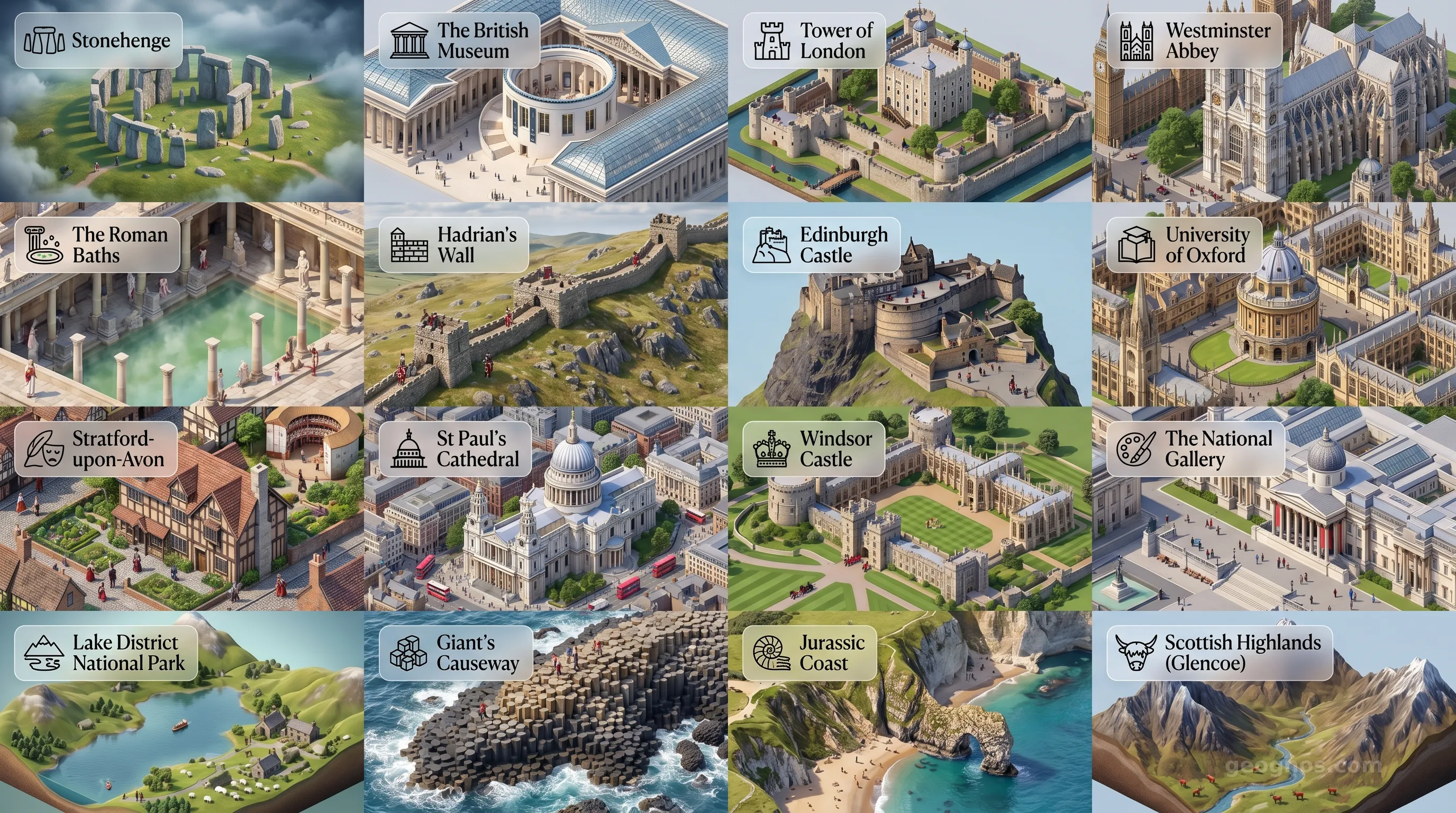
The aesthetic power of the United Kingdom is perhaps best displayed through its architecture and natural wonders. From the soaring spires of gothic cathedrals to the Neolithic mysteries of Stonehenge and the rugged cliffs of the Jurassic Coast, every point of interest tells a story. We invite you to view these marvels through our POI cinematic showcase. This carousel presents a stunning collection of the United Kingdom's most iconic landscapes and structures, allowing viewers to appreciate the sheer diversity of the environment that has inspired artists, architects, and visionaries for generations.
Geography as a Foundation for Culture
The physical composition of the United Kingdom provides a constant dialogue between the land and its people. The presence of significant water bodies, including the English Channel and the Irish Sea, served for centuries as a formidable moat, granting the nation a level of security that allowed its political and cultural institutions to mature in their own unique direction. The geology ranges from the granite heights of the Cairngorms in Scotland to the chalk hills of southern England, creating a patchwork of agricultural potential and industrial raw materials that drove the rise of urban centers.
Urban life in the United Kingdom is also marked by this geographic influence. The Thames in London, the Clyde in Glasgow, and the Mersey in Liverpool all stand as silent witnesses to the nation's reliance on maritime connectivity. Trade and exploration flowed from these points, turning small island harbors into hubs of international dialogue. Even today, despite the technological advancements that minimize physical distance, the "island mentality"—a healthy mix of self-sufficiency and an outgoing spirit—remains a cornerstone of the national character.
A Future Defined by Diversity
In the contemporary era, the United Kingdom flourishes as a modern, multicultural society. It is an intersection of global diasporas, where traditional customs blend with new innovations, fueling the nation’s arts, sciences, and economy. Whether it is the world-class education systems, the bustling, creative industries, or the commitment to preserving the ecological sanctity of its parks and rural zones, the United Kingdom continues to offer a meaningful contribution to the global dialogue.
As you navigate our Atlas pages for the United Kingdom, you will find that the story is not one of a static entity, but of a dynamic, shifting, and enduring landscape. It is a nation that asks its citizens and its visitors to listen to the whisper of its ancient hills while simultaneously keeping pace with the rapid rhythm of its modern streets. We welcome you to GeoGnos as you continue to discover the myriad layers of this fascinating, storied, and ever-evolving kingdom.