Brunei
Top Sights & Landmarks
The Venice of the East
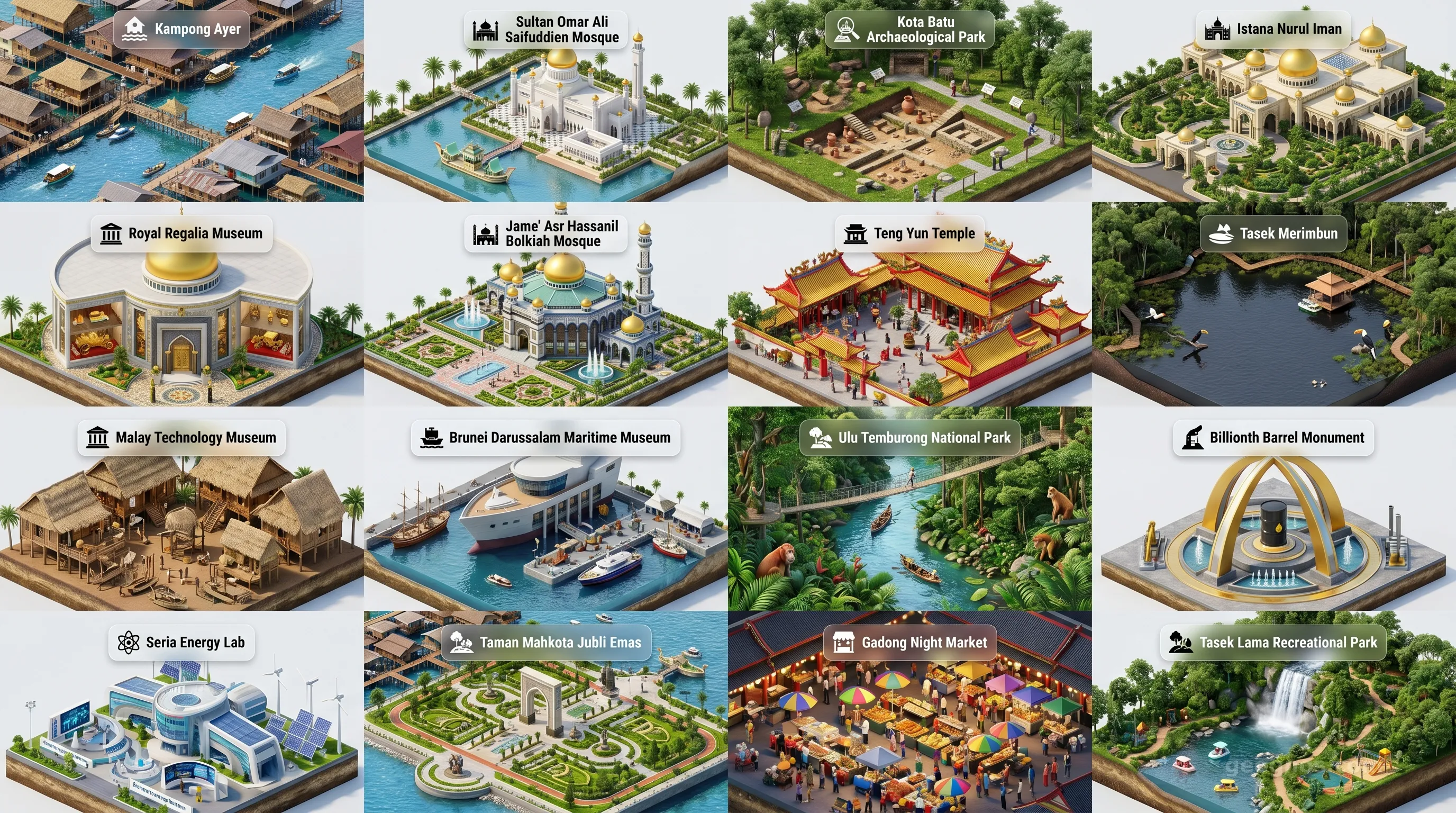
Historically the principal settlement of Brunei, Kampong Ayer is a massive, centuries-old water village built entirely on stilts above the Brunei River. For students of history and urban planning, it offers a fascinating case study of an indigenous aquatic lifestyle that has survived and modernized over a millennium. It once served as the capital of the Bruneian Empire and was described by Antonio Pigafetta in 1521 as the 'Venice of the East'. The best time to visit is during the dry season (February to April) for clear skies during boat rides. Tourist tip: Hire a local water taxi (penambang) at sunset for the most picturesque views and visit the Kampong Ayer Cultural and Tourism Gallery to understand its rich heritage.
Icon of the Bruneian Sultanate
Considered one of the most beautiful mosques in the Asia Pacific, this architectural marvel was completed in 1958 and named after the 28th Sultan of Brunei. It is a striking symbol of the Islamic faith in Brunei, blending Mughal and Italian Renaissance styles. Students of architecture will marvel at its pure gold domes, Italian marble columns, and English stained glass. Historically, it symbolizes the modernization of Brunei fueled by early oil revenues. The mosque is surrounded by an artificial lagoon housing a replica of a 16th-century royal barge. Visit during the dry season (January to May) for brilliant reflections on the lagoon. Tourist tip: Non-Muslims are welcome outside prayer times; dress modestly, as robes are provided but conservative attire is appreciated.
Ancient Capital of the Bruneian Empire
Kota Batu is Brunei's premier archaeological site, marking the location of the ancient capital of the Bruneian Empire from the 14th to the 17th centuries. Excavations have unearthed Ming and Qing dynasty ceramics, ancient coins, and Islamic tombstones, illustrating Brunei's historical significance as a major maritime trading hub. It is an essential site for historians and archaeologists studying pre-colonial Southeast Asian trade networks. The best time to visit is during the cooler early morning hours year-round. Tourist tip: Combine this visit with the nearby Maritime Museum and Malay Technology Museum, as they are all located within the same historically rich district.
The World's Largest Residential Palace
The official residence of the Sultan of Brunei is recorded by Guinness World Records as the world's largest residential palace. Designed by Leandro V. Locsin and blending Islamic and Malay architectural motifs, it is a testament to the nation's immense wealth and deep-rooted monarchical traditions. While primarily a political and royal center, it is highly significant for understanding the modern socio-political structure of Brunei. The palace is generally closed to the public, but the absolute best time to visit is during the annual Hari Raya Aidilfitri festival, when the Sultan opens the doors to the public for three days. Tourist tip: Take a river cruise along the Brunei River for the best vantage point of the palace's sweeping, golden-domed exterior year-round.
Treasures of the Sultanate
Located in the heart of Bandar Seri Begawan, this museum houses an opulent collection of the Sultan's royal paraphernalia, including jewel-encrusted crowns, golden chariots, and ceremonial weaponry. It was established to commemorate the Silver Jubilee of His Majesty's accession to the throne in 1992. The museum is a focal point for understanding the pageantry, history, and constitutional monarchy of Brunei. It provides deep insights into Malay Islamic Monarchy (MIB) philosophy. It is an excellent indoor attraction, making it a perfect visit year-round, particularly during the wet season (October to December). Tourist tip: Visitors must remove their shoes and leave cameras/phones in lockers before entering the main exhibition halls.
Brunei's Grandest Mosque
Built to commemorate the 25th anniversary of the current Sultan's reign, this is the largest mosque in Brunei. It features 29 shimmering 24-karat gold domes, representing the 29th ruler of the dynasty. The interior is lavishly decorated with intricately woven carpets and meticulously detailed mosaics. It stands as a paramount example of contemporary Islamic architecture and the profound religious devotion of the nation. It is a vital study in modern religious monumentalism. Visit from February to May for clear, rain-free photography. Tourist tip: The mosque is beautifully illuminated at night; visiting at twilight offers breathtaking photographic opportunities.
Oldest Chinese Temple in Brunei
Nestled among modern buildings in the capital, the Teng Yun Temple is the oldest surviving Chinese temple in Brunei, built in 1918 and relocated to its current site in 1960. It features vibrant hand-painted tiles illustrating Chinese folklore and legendary figures. It is a crucial cultural touchstone, highlighting the historical presence and contributions of the Chinese diaspora in a predominantly Islamic country. Anthropologists and cultural students will find its survival and active use fascinating. The best time to visit is during the Lunar New Year, when the temple comes alive with lion dances and traditional ceremonies. Tourist tip: Be respectful of worshippers lighting incense and offering prayers during your visit.
Brunei's Largest Blackwater Lake
Designated as an ASEAN Heritage Park, Tasek Merimbun is a stunning S-shaped blackwater lake surrounded by dense swamp forest. The dark color of the water is naturally caused by tannins from falling leaves. The site is deeply intertwined with the folklore of the local Dusun people, making it an excellent field study location for ethno-botanists and cultural anthropologists. It is home to rare flora and fauna, including the pitcher plant and the clouded leopard. The best season to visit is the dry season (February to April) to avoid muddy trails. Tourist tip: The park is remote; arrange private transport and pack your own food and water, as amenities are limited.
Chronicle of Indigenous Innovation
Situated near the historical Kota Batu site, this museum explores the traditional technologies used by the indigenous people of Brunei. It features life-size dioramas depicting traditional boat-making, fishing, metalworking, and gold-smithing, specifically focusing on the historic life in Kampong Ayer. It is highly educational for students of Southeast Asian ethnography and historical engineering, showing how early Bruneians adapted to their riverine environment. The museum is a great year-round indoor activity. Tourist tip: Admission is free; spend time in the metallurgy section to understand how Bruneian brass cannons (bedil) were traditionally cast.
Shipwrecks and Sea Trade
This sleek, ship-shaped museum highlights Brunei's golden age as a maritime empire. The centerpiece is the display of artifacts recovered from a 15th-century shipwreck discovered off the coast in 1997, containing tens of thousands of Chinese, Vietnamese, and Thai ceramics. The museum provides critical context for historians studying the ancient Maritime Silk Road and the regional trade dynamics before European colonization. It is climate-controlled, making it ideal for visiting during the humid monsoon season. Tourist tip: Do not miss the Quanzhou ship model exhibit, which beautifully details historical shipbuilding techniques.
The Green Jewel of Brunei
Accessible only by traditional longboat (temuai), this pristine 50,000-hectare tract of untouched rainforest is Brunei's first national park. It has been preserved from logging for decades, making it a critical site for biological and ecological research. Students of environmental science will be astounded by its extreme biodiversity, including rare hornbills and proboscis monkeys. The park's highlight is a spectacular canopy walkway suspended 50 meters above the forest floor. The dry season (February to May) is best to ensure river levels are safe and trails are less slippery. Tourist tip: You must book through a certified tour operator, as independent travel into the park is not permitted.
Milestone of Modern Brunei
Located in Seria, the birthplace of Brunei's petroleum industry, this monument was unveiled in 1991 to celebrate the production of the billionth barrel of crude oil. The structure features six arches representing the six decades of oil exploration before the milestone, topped by the national emblem. It is culturally and historically significant as oil discovery fundamentally transformed Brunei from a quiet protectorate into one of the wealthiest nations per capita. The coastal location is quite exposed, so visit during the early morning or late afternoon to avoid the midday sun. Tourist tip: Take a walk along the nearby beach to see the original nodding donkeys (pumpjacks) still extracting oil in the distance.
Interactive Science and Energy Hub
Formerly known as the Oil and Gas Discovery Centre (OGDC), this facility was created by Brunei Shell Petroleum to educate the public on science, technology, and the petroleum industry. It offers highly interactive exhibits detailing the geology of oil formation, drilling technology, and recent shifts towards renewable energy. It is a fantastic educational destination for STEM students and families. As an indoor attraction, it is suitable for any season. Tourist tip: Combine this visit with the Billionth Barrel Monument, as they are located in the same town, to get a complete picture of Brunei's economic foundation.
Eco-Corridor Riverfront Park
Opened in 2017 to mark the Sultan's Golden Jubilee, this beautifully landscaped 12-hectare riverfront park replaced a section of the old water village to create an 'eco-corridor' in the capital. It represents Brunei's modern urban planning, emphasizing green spaces and community health while honoring heritage. It offers sweeping views of Kampong Ayer and the Omar Ali Saifuddien Mosque. For urban studies students, it is an excellent example of urban renewal in Southeast Asia. Visit in the late afternoon (around 5 PM) when the heat subsides and locals gather. Tourist tip: Rent a quadricycle near the entrance to explore the extensive paved paths along the Brunei River.
Culinary Heart of Bandar Seri Begawan
Also known as Pasar Pelbagai Barangan Gadong, this bustling night market is the epicenter of Bruneian street food culture. It provides an authentic glimpse into the daily lives and culinary traditions of the locals. Here, culinary students and foodies can study and sample local delicacies like Nasi Katok (rice with fried chicken and sambal), Ambuyat (sago starch), and freshly grilled seafood. The market is covered, so it can be visited comfortably rain or shine. Tourist tip: Arrive around 6 PM when the stalls are freshly set up and the food is piping hot; bring small local currency (BND) as cash is king here.
Urban Jungle Oasis
Located just a short walk from the city center, Tasek Lama is an urban forest park featuring a natural waterfall, serene lakes, and well-maintained jungle trekking trails. It has historical value as one of the oldest protected recreational areas in the capital, providing a vital green lung for the city. It's a great spot for biology students to observe urban edge ecology, frequently spotting macaques and diverse birdlife. The best time to visit is early morning or late afternoon year-round. Tourist tip: Beware of the wild macaques; do not carry food openly or feed them, as they can become aggressive.
Background
The Sultanate of Brunei's influence peaked between the 15th and 17th centuries, when its control extended over coastal areas of northwest Borneo and the southern Philippines. Internal strife over royal succession, colonial expansion of European powers, and piracy subsequently brought on a period of decline. In 1888, Brunei became a British protectorate; independence was achieved in 1984. The same family has ruled Brunei for over six centuries, and in 2017, the country celebrated the 50th anniversary of Sultan Hassanal BOLKIAH’s accession to the throne. Brunei has one of the highest per-capita GDPs in the world, thanks to extensive petroleum and natural gas fields.