The Mirage Made Manifest: The Soul of the United Arab Emirates
To stand upon the shifting dunes of the Empty Quarter or look out from the cloud-piercing glass of a skyscraper in Dubai is to witness the ultimate dialogue between humanity and the environment. The United Arab Emirates is a nation defined not merely by its rapid ascent into the twenty-first century, but by its fundamental resilience. For centuries, this stretch of the Arabian Peninsula was shaped by the rhythms of the sea, the harvest of pearls, and the nomadic wisdom of the desert tribes. Today, it stands as a global crossroads, a unique tapestry where ancient Bedouin heritage weaves seamlessly into a skyline that pushes the limits of modern architecture. This is a land where the extreme heat of the sun has only served to fuel a monumental ambition for connection, innovation, and global engagement.
Understanding this nation requires more than a simple glance at a map. It requires an immersion into the stories of its people, who transformed a landscape defined by scarcity into an engine of global trade and cultural dialogue. Before embarking on your own discovery, we invite you to explore the rich history of the United Arab Emirates, where you will find comprehensive guides, documented events, and educational resources detailing the evolution of this federation from tribal confederations to a powerhouse on the world stage.
From Pearling Dhows to Global Ports: A Chronological Journey
The identity of the Emirates is anchored in its maritime past. For generations, the livelihood of the coastal inhabitants was tethered to the Persian Gulf. Divers relied on little more than courage and the tides to harvest the world’s finest pearls, forging a culture of immense discipline and environmental intimacy. This history was not just a means of survival, but the foundation of the nation’s modern trading spirit.
For those interested in mastering the timeline of this incredible transition, we offer a dynamic challenge. You can sharpen your knowledge and test your critical thinking by engaging with our interactive history puzzle, which tasks you with placing pivotal events in their correct chronological sequence to earn badges and deepen your mastery of the region's heritage.
Beyond the text, history comes to life through the power of imagery. The endurance of the early settlers and the monumental political milestones of the twentieth century can be visualized through our history cinematic showcase. This feature utilizes high-quality illustrations and descriptive summaries to transport you back in time, providing a vivid account of the key milestones that forged the modern UAE, making it an essential resource for students and educators alike.
Architecture and Landscape: The Visual Synthesis
The UAE serves as an open-air laboratory for the marriage of nature and technology. Nowhere else on Earth does the hyper-modern cityscape sit so starkly against the infinite silence of the desert. The landscape is a geological marvel, ranging from the jagged, weather-worn peaks of the Hajar Mountains in the east to the pristine, white-sand beaches that frame the northern coast. These natural wonders are balanced by the architectural ambition of Abu Dhabi and Dubai, where sustainable design and creative engineering seek to mimic the resilience of the indigenous flora and fauna.
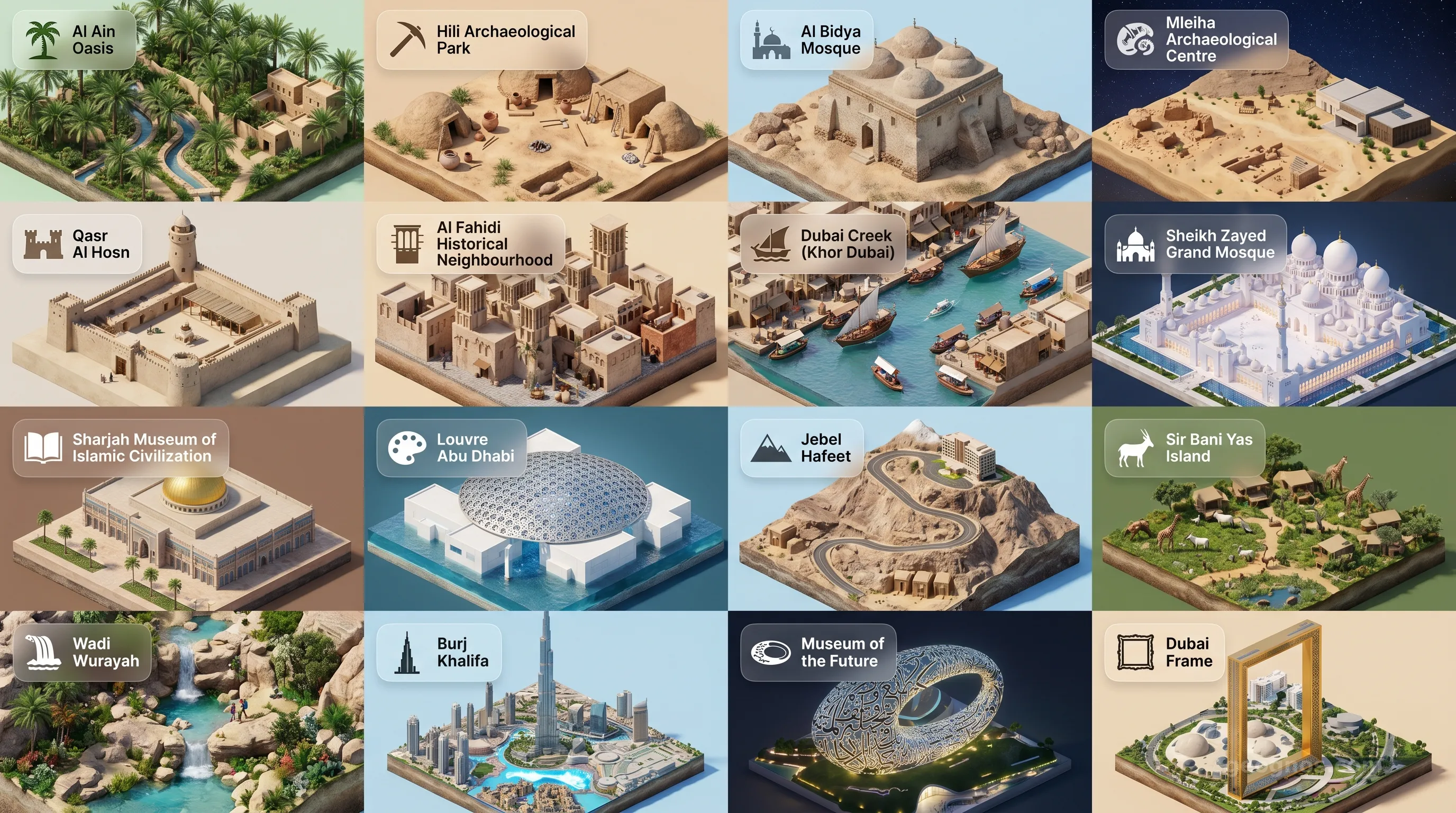
As you plan your journey or prepare your classroom materials, we encourage you to explore the stunning diversity of the nation's landmarks. Whether it is the serene marble of the Sheikh Zayed Grand Mosque or the engineering feats that defy the desert landscape, our POI cinematic showcase allows you to tour these locations through an interactive carousel. It captures the spirit and scale of the country’s most celebrated sites, offering a comprehensive look at what makes the UAE an architectural icon of the modern era.
A Culture of Inclusivity and Future-Facing Vision
Perhaps the most profound characteristic of the United Arab Emirates is its status as a magnet for global talent. While deeply rooted in Islamic tradition and Arabian hospitality, the society thrives on a unique multiculturalism. People from every corner of the globe contribute to the daily life, arts, and economic vitality of the Emirates. This creates a cultural synthesis where diverse cuisines, languages, and philosophies mingle under the canopy of a shared vision for a sustainable future.
Educators and students will find that the UAE offers a case study in development that is entirely its own. From its early reliance on the maritime economy to its current leadership in renewable energy and space exploration, the Emirates is a living lesson in adaptability. The government consistently invests in education, technological infrastructure, and the arts, ensuring that the next generation is equipped to handle the complexities of a changing climate and a globalized economy. As you explore the deeper sections of this atlas, including our detailed data on demographics, environment, and economy, you will see how the nation leverages its geographic location and its most valuable resource, its people, to build a future that is as resilient as the dunes that surround it.