The Crossroads of Civilization: Bulgaria’s Eternal Echo
To stand upon the soil of Bulgaria is to stand at the intersection of antiquity and the modern world. Nestled in the heart of the Balkan Peninsula, this nation is not merely a collection of borders or political designations. It is a palimpsest of humanity. Here, the Neolithic revolution once found its footing, the mighty Thracians left their gold-dusted secrets in earthen mounds, and the Byzantine and Ottoman empires traced the rise and fall of their fortunes. Bulgaria is where the Cyrillic alphabet first took flight, a gift to the Slavic world that redefined literature and thought for centuries.
As you begin to explore the history of Bulgaria, you will uncover a narrative of resilience that spans from the early Bulgarian Khanates to the modern era. This is a landscape characterized by its rugged peaks, deep river valleys, and the gentle embrace of the Black Sea. It is a place where every fold of the mountain holds a monastery, and every fertile plain carries the weight of a legacy that long predates the written record of Western Europe.
A Symphony of Stones and Spirits
The geography of Bulgaria has long been its greatest benefactor. The Balkan Mountains, stretching across the center of the country like a protective spine, divide the nation into contrasting climatic zones, fostering a diversity of life that is unparalleled in this region of Europe. To truly grasp the complexity of these transitions, one must look closely at how each epoch shaped the land. For those who enjoy testing their chronological prowess, we invite you to arrange the major historical events in order to uncover how these civilizations wove their intricate threads into the fabric of the Bulgarian identity.
The soul of Bulgaria resides in its preservation of the old. From the ancient cobblestone streets of Plovdiv, one of the oldest continuously inhabited cities in the world, to the quiet solitude of the Rila Monastery hidden in the pines, the country radiates a sense of continuity. It is not just the artifacts of gold or the monumental statues of the past that define it, but the enduring spirit of its people. The arts, folklore, and vibrant traditions represent a deep connection to the earth, echoing through the ages in haunting choral music and the rhythmic complexity of traditional dances.
Visualizing the Bulgarian Journey
While words can paint the picture of a landscape, sight often provides the spark of understanding. To immerse yourself in the narrative depth of this nation, we provide curated ways to visualize the passing of time and the grandeur of place. You may view our comprehensive cinematic showcase of the most significant moments that molded the Bulgarian state, presented as a flowing sequence of artistic illustrations. It is a perfect tool for both students of history and those wishing to understand the cultural pillars that keep the nation strong today.
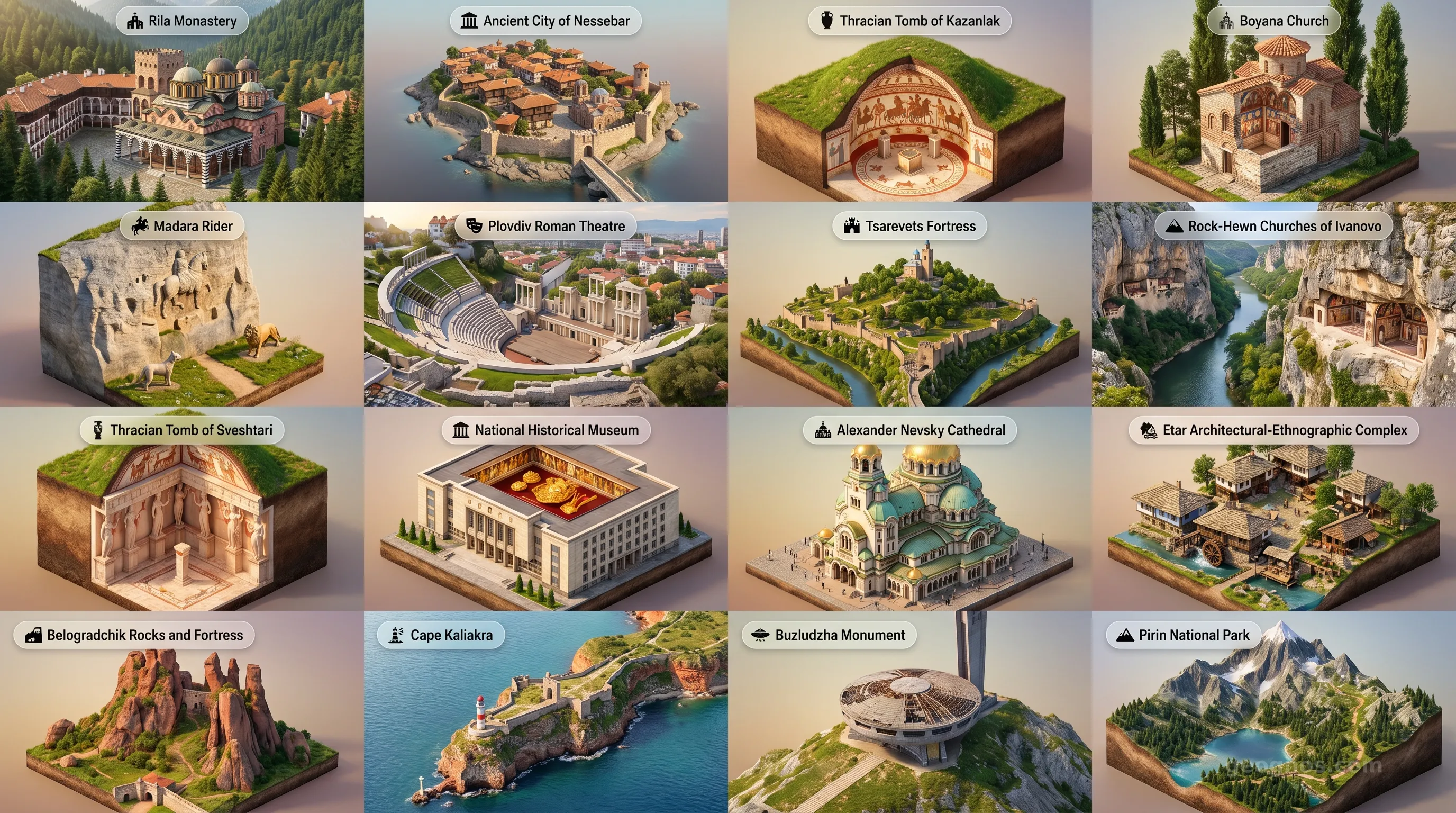
Beyond the pages of history books, the physical landscape offers a feast for the eyes. Bulgaria is a tapestry of natural splendor that spans from the windswept crags of the Vitosha massif to the sun-drenched golden sands of the Black Sea coast. You can witness these breathtaking topographies and architectural marvels by interacting with our cinematic gallery of the top points of interest in Bulgaria. Each slide invites you to appreciate the sheer diversity of the environment and the monuments that serve as landmarks for the national journey.
The Enduring Legacy
What makes Bulgaria truly unique in a global context is its ability to absorb external influences without losing its core essence. It acts as a bridge, linking the East and the West, the classical and the medieval, the sacred and the secular. As a vital cultural crossroads, it has nurtured a heritage that emphasizes learning, the arts, and an profound connection to the surrounding environment.
Whether you are a researcher examining the migration patterns of antiquity, a student charting the evolution of a language, or a traveler seeking the serenity of the Bulgarian wilderness, the nation offers an inexhaustible wealth of discovery. Bulgaria is not a destination you visit and leave behind. It is a profound experience of human history, embedded deep in the bedrock of a continent, always ready to be rediscovered, studied, and cherished by the next generation of global citizens. Welcome to the heart of the Balkans, where every horizon is a story waiting to be told.