The Crossroads of the Danube: Serbia’s Resilient Soul
To understand Serbia is to understand the gravity of a landscape that has acted as the literal and metaphorical bridge between East and West for millennia. Located in the heart of the Balkan Peninsula, this nation is not merely a collection of borders but a dynamic confluence of civilizations. The geography of Serbia dictates its rhythm, with the Pannonian Plain stretching across the north like an endless sea of wheat, only to collide with the rugged, mysterious mountain ranges of the south and west. This is a land defined by the Danube River, which pulses through its veins, carrying with it the remnants of Roman legions, Ottoman merchants, and Austro-Hungarian aristocrats. Here, history is not confined to dusty archives but is breathed into every cobblestone street, every fortified monastery, and every vibrant cafe in Belgrade.
For the traveler, the scholar, or the student, Serbia offers an invitation to witness the convergence of legacy and progress. It is a country that guards its traditions with deep pride while inviting the world to sample its famous hospitality. Whether you are walking through the stone-wrought silence of an ancient monastic courtyard or feeling the electric, modern energy of a metropolitan riverfront, you are participating in a story that began long before our maps were drawn. To truly begin your journey into this complex narrative, you may wish to explore the history of Serbia, where we detail the momentous transitions that have forged this resilient national identity across centuries of shifting tides.
The Geography of Continuity
Serbia is often referred to as the gateway to the Balkans. Landlocked yet deeply aquatic due to the Danube, Sava, and Tisa rivers, the nation serves as a central hub for European transit. Its landscape is one of stark, beautiful contrasts. In the north, the Vojvodina region is a fertile expanse of flatlands that serve as the breadbasket of the nation. Moving south, the terrain shifts into the gently rolling Sumadija region, known as the "heart of Serbia," before rising into the towering Dinaric Alps and the Balkan Mountains.
These natural fortifications have played a profound role in the protection and cultural preservation of the Serbian people. The mountains are scattered with medieval orthodox monasteries, many of which are UNESCO World Heritage sites, serving as spiritual anchors that survived foreign pressures to maintain a distinct language, script, and faith. For those interested in the grand timeline of these enduring landmarks, you can test your knowledge by engaging with our interactive data chronology puzzle, which challenges you to organize the pivotal moments of Serbian sovereignty and societal change.
A Living Heritage in Motion
What makes Serbia truly unique is its ability to synthesize external influences into a singular, warm-hearted, and distinctly Slavic spirit. The architecture tells the story best. In the streets of Novi Sad, you find the elegant pastel hues of Central European Baroque. In the historic quarters of Belgrade, the air is heavy with the scent of coffee and grilled specialties, remnants of the Levant. To visualize how these eras overlap, we invite you to view our history cinematic showcase, a carefully curated collection of illustrations that breathe life into the leaders, movements, and cultural shifts that shaped the Serbian state.
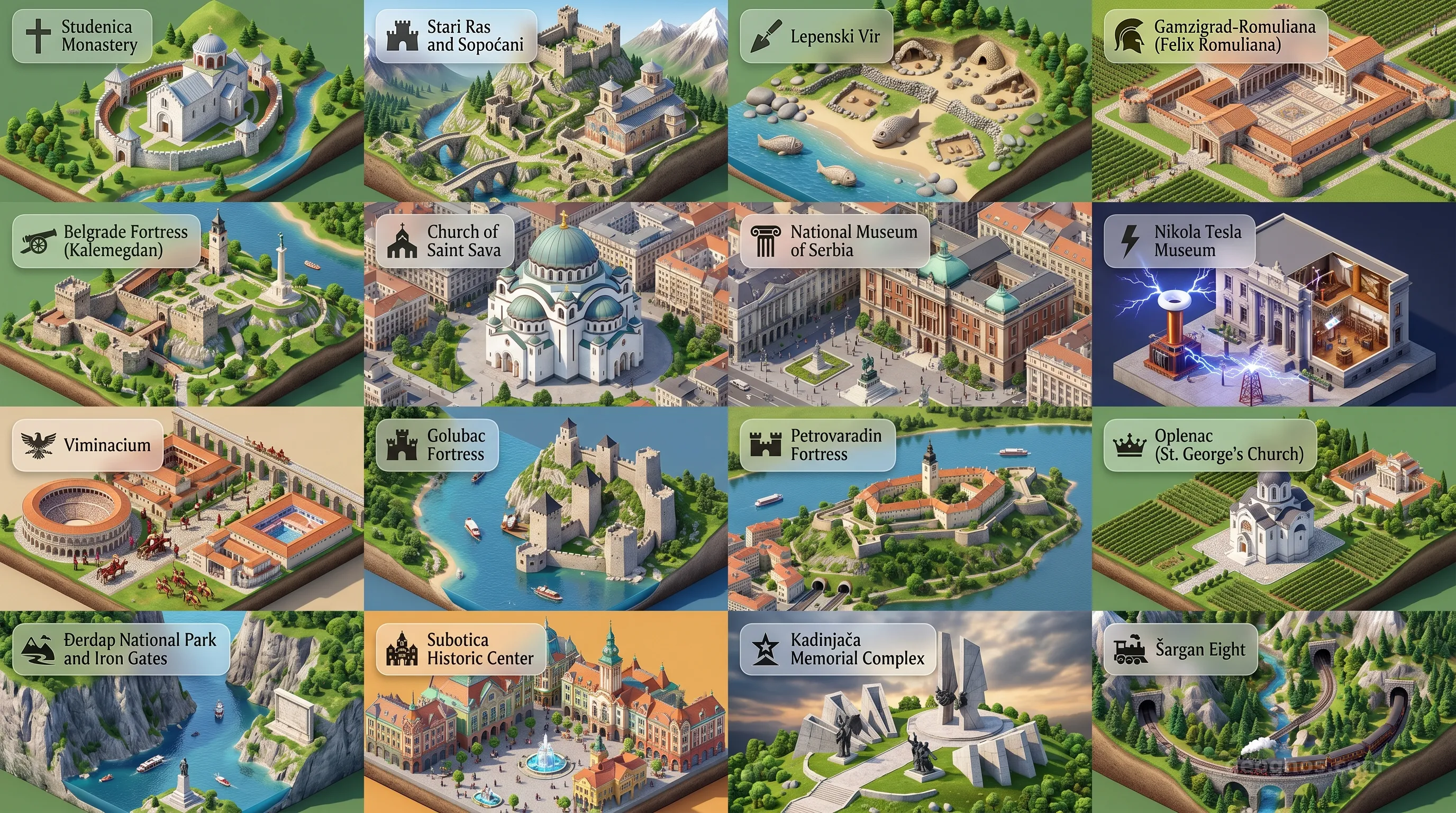
Educationally, Serbia provides a masterclass in adaptation. It is a nation where the youth participate in a global digital economy while simultaneously preserving the agrarian customs of their grandparents. This duality is perhaps most visible in the rural mountain villages, where ancient folklore is practiced alongside modern technology. If you are planning a journey to discover these hidden gems for yourself, our POI cinematic showcase offers a deep-dive look at the must-visit locations, from the massive ramparts of the Belgrade Fortress overlooking the Danube to the dramatic, winding curves of the Uvac Canyon.
The Rhythm of Modern Serbia
As we examine the current landscape of the nation, it becomes clear that Serbia is in the midst of a vibrant metamorphosis. Its cities are centers of academic achievement and artistic ferment. Belgrade, perched at the confluence of the Sava and Danube, remains one of the few European capitals that seems to never sleep, yet maintains a profound reverence for the stillness of its religious sites. The nation represents a fascinating case study for students of social science, economics, and history, as it navigates the path toward greater regional and global integration.
For the GeoGnos community, Serbia stands as a testament to the endurance of identity. It asks its visitors to slow down, to engage with its history, and to acknowledge the weight of its crossroads. The true soul of Serbia is not found in a single monument or a solitary figure. It is found in the communal act of gathering, the shared joy of a meal, the dedication to family, and the pride of a people who have continuously built upon the ruins of yesterday to create a bright, distinct tomorrow. As you explore this page and the further resources linked within our atlas, we encourage you to look beyond the surface of the geography and listen to the layered, enduring voice of a nation that sits firmly at the center of the world's most fascinating historical narrative.