The Aegean Synthesis: A Landscape of Idea and Form
To speak of Greece is to speak of the architect of the Western imagination. It is a nation where the physical landscape—fractured, rugged, and defined by the rhythmic pull of the sea—does not merely support human life, but actively dictates the course of civilization. Unlike the vast, uninterrupted plains of continental empires, Greece is a world of thresholds. Every valley is secluded by mountains, every island a self-contained universe of limestone and salt. This environmental compartmentalization forced the early Greeks toward a maritime destiny, turning the Aegean into a bridge rather than a barrier, and shaping a culture that valued democratic debate, philosophical inquiry, and artistic proportion.
As you begin your journey across this intersection of light and legacy, it is helpful to grasp the gravity of the timeline you are entering. You can explore the comprehensive history of Greece to understand how these rocky peninsulas became the bedrock for concepts of justice, mathematics, and governance that ripple into our modern lives today. It is a story of resilience against a dramatic backdrop, one where the earth itself, seismic and restless, mirrors the intense curiosity of the people who shaped its stones.
The Verticality of Myth and Mountain
Geography in Greece is almost always vertical. Whether climbing the slopes of Mount Olympus, where the veil between the divine and the mundane was once thought to be thin, or navigating the precipitous white cliffs of Santorini, the land demands effort and grants perspective. The central spine of the Pindus mountain range bisects the mainland, creating a backbone that creates distinct climate zones and sheltered enclaves. This fragmentation provided a natural shield for diverse city-states, each refining its own unique identity and customs before they eventually coalesced into the wider Hellenic cultural sphere.
The Greek coastline is among the most intricate on the planet, an erratic serration of deep fjords and hidden coves that made navigation a required craft. To master the art of the Mediterranean trade, the Greeks had to study the stars, the currents, and the seasonal winds. This scientific orientation is a hallmark of the national soul. If you find yourself eager to test your knowledge of how these distinct periods of influence stacked upon one another, try the interactive historical chronology puzzle, where arranging the milestones of this epic journey earns you badges that document your progress as a student of antiquity.
The Living Museum
Greece does not relegate its past to dusty shelves. It is a living, breathing synthesis. When walking through the Agora in Athens or standing in the cool shade of a theater in Epidaurus, you are participating in a conversation that spans thousands of years. The stones are etched with the memories of actors, soldiers, philosophers, and traders. To appreciate the scale of this cultural wealth, you may wish to view the cinematic history showcase, which weaves together the most pivotal moments of the Greek narrative through detailed illustrations and expert synthesis, guiding you from the Bronze Age through the Byzantine transition to the emergence of the modern state.
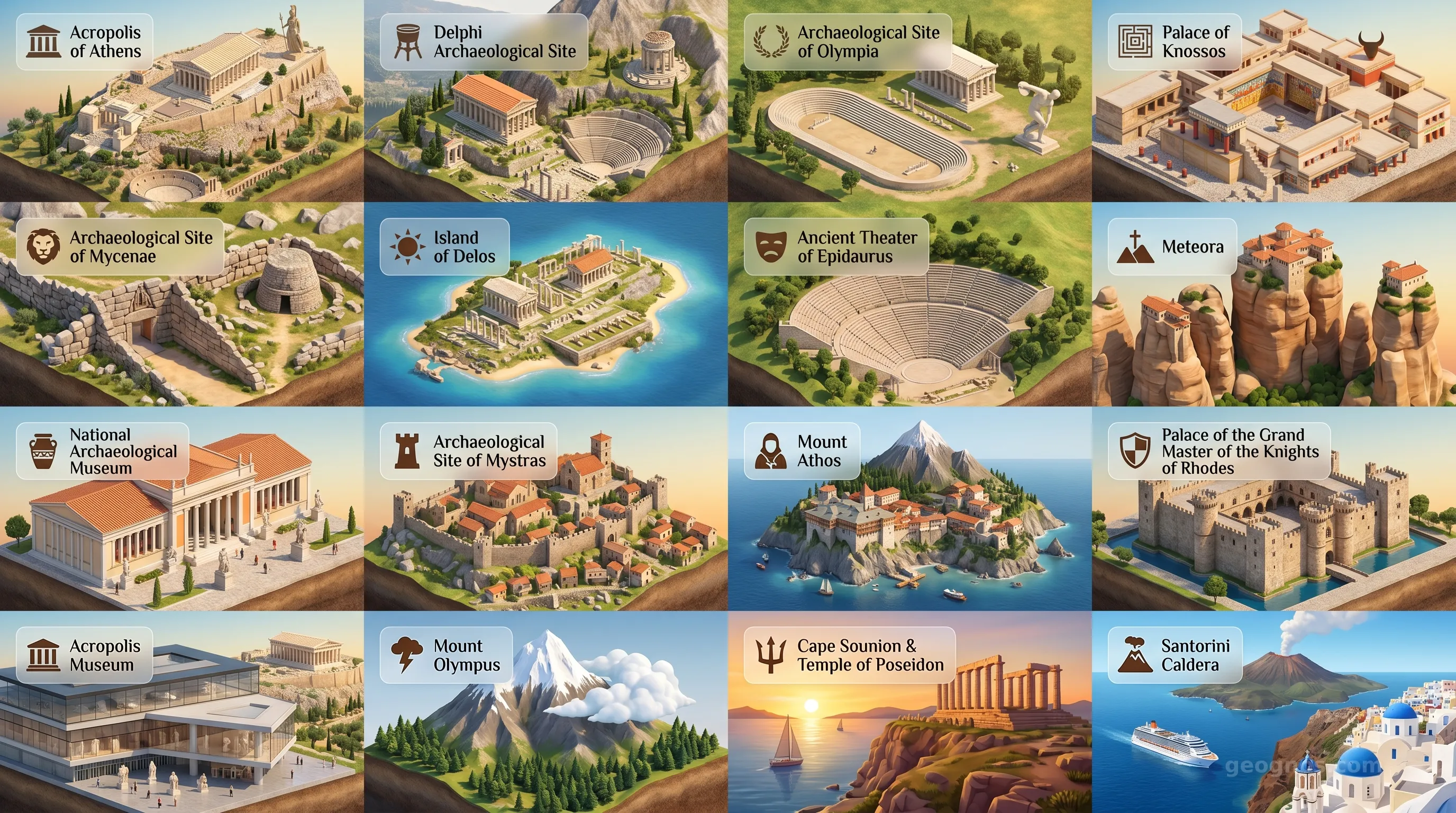
The landscape is punctuated by sites that are globally recognized as monuments to human ingenuity. From the fortified citadels of Mycenae to the medieval fortress cities of the Peloponnese, the variety of Greece is a masterclass in regional development. For a high-definition glimpse into these iconic locations, including their architectural nuances and the environmental settings that protect them, please visit our curated cinematic showcase of major points of interest. It serves as a visual compass for those preparing to navigate the diverse terrains of this sun-drenched country.
A Stewardship of Time and Sea
Looking toward the horizon in Greece, one perceives a unique environmental philosophy. The Aegean sea, crystalline and deep, acts as the regulator of life. The islands serve as nodes of activity, each characterized by a distinct balance of volcanic soil and maritime breeze. Protecting this inheritance—both the marble ruins of the ancestors and the fragile ecosystems of the Cyclades and Ionian islands—is a defining mission for modern Greeks. It is a nation that recognizes that the identity of the future is forged by the preservation of the past.
For students and travelers alike, the value of Greece lies in this realization: humanity is not separate from the terrain, but an extension of it. The wind-whipped olive groves of the Mani Peninsula and the lush, dense forests of Epirus tell as much of a story as the written works of Plato or Aeschylus. By studying this land, we learn about ourselves. We observe how people organize into societies, how they react to scarcity, how they articulate beauty, and how they seek immortality through art. Greece remains, in every generation, the world’s most accessible classroom, an outdoor gallery of human progress waiting to be interpreted by those who are willing to look, listen, and traverse its shores.