The Balkan Crossroads: An Invitation to North Macedonia
There is a specific quality to the air in North Macedonia that feels heavy with the echoes of time. Located in the very heart of the Balkan Peninsula, this nation does not merely possess a location; it exists as a bridge between worlds. To travel through North Macedonia is to walk across layers of human ambition, spiritual devotion, and tectonic shifts that have molded not only the landscape but the collective identity of its people. For the traveler or the student, North Macedonia offers a masterclass in synthesis, where ancient Roman stones support Byzantine frescoes, and where the rhythmic calls to prayer harmonize with the chime of church bells.
The country is a high-altitude sanctuary, defined by its rugged, mountainous terrain and the serene, glass-like surfaces of its ancient tectonic lakes. It is a landlocked nation that feels like it possesses its own internal ocean, anchored by the profound depths of Lake Ohrid. To truly understand how this distinct topography influenced the rise of civilizations here, one should explore the comprehensive history of North Macedonia, a narrative arc that moves from the cradle of Slavic literacy to the enduring legacies of regional empires.
A Mosaic of Human Experience
If you were to piece together the identity of North Macedonia, you would find that no single definition fits. It is a mosaic, composed of Roman military outposts, medieval Orthodox monasteries hidden in emerald valleys, and Ottoman-era bazaars that still hum with the intensity of medieval trade. This complexity is not just historical. It is experiential. Engaging with the heritage of this nation requires a sense of wonder, and for those who wish to test their understanding of its timeline, the interactive history puzzle of North Macedonia provides an immersive way to organize the transformative events that shaped the national consciousness.
The visual culture of North Macedonia is perhaps its most compelling storyteller. From the golden light hitting the spires of Skopje to the ancient, secluded village homes in the Pelagonia region, every corner holds a secret. Students and travelers alike can deepen their connection to these visual treasures by experiencing the history cinematic showcase of North Macedonia, which brings the pivotal moments of this storied land to life through curated illustrations and historical analysis. It is through these visual portals that the abstract dates and names on a map transform into human stories of resilience, artistry, and ingenuity.
The Landscape as a Living Cathedral
Beyond the cities, the environment of North Macedonia serves as a living museum. The nation is cradled by high mountain ranges like the Šar Mountains and the Osogovo, which have historically protected isolated communities and fostered a culture of deep tradition. The lakes—Ohrid, Prespa, and Dojran—are among the oldest and deepest in Europe, functioning as evolutionary laboratories. These bodies of water are not merely scenic; they are the bedrock upon which the nation's spiritual and cultural foundations were laid.
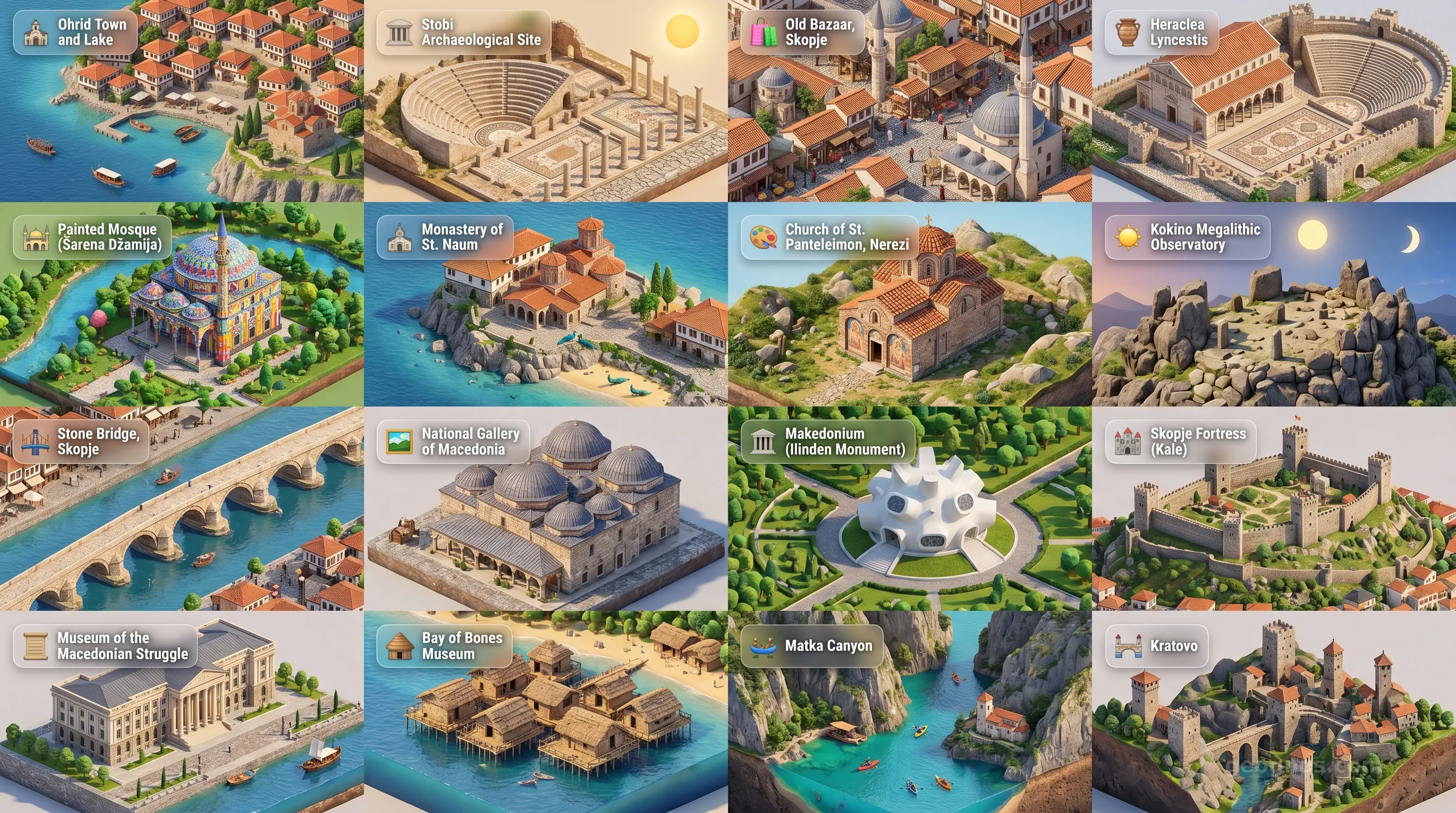
To fully grasp the architectural and natural beauty that dots the landscape, we invite you to immerse yourself in the cinematic showcase of points of interest in North Macedonia. This virtual journey travels from the historic town of Ohrid, a UNESCO World Heritage site, to the stone-carved ruins of Stobi, illustrating why North Macedonia is often described as the "Heart of the Balkans." Here, geography is destiny. The steep mountain passes historically dictated the paths of trade, armies, and pilgrims, leaving behind a legacy of fortress ruins and hidden frescoes that decorate the walls of caves and chapels alike.
The Soul of a Nation
The people of North Macedonia carry a profound sense of heritage. There is a deep, underlying pride in being a cultural waypoint, a place that connects the East and the West, the north and the south. Whether through its rich culinary traditions, which blend Mediterranean freshness with hearty, high-mountain flavors, or its commitment to maintaining the diverse languages and ethnicities that form its demographic tapestry, the nation is an example of persistence. It is a small nation with an immense historical presence, a testament to the fact that cultural richness is not measured by borders but by the depth of a people's memory.
As you navigate the pages of this atlas, consider the mountains not just as natural borders but as sentinels that have watched over the evolution of Slavic, Byzantine, Ottoman, and modern influences. The student of culture will find in North Macedonia a living archive, while the traveler will find a land of incredible hospitality. This site aims to serve as your guide through these narratives, offering a grounded, historical perspective on a country that acts as the quiet, pulsating heart of the European southeast. We invite you to delve deeper into these segments, to look closer at the geography, the governance, and the indomitable spirit of this extraordinary Balkan gem.