The Baltic Whisper: Estonia’s Dance with Silence and Innovation
To set foot in Estonia is to step into a landscape where the ancient rhythm of the peat bogs and primeval forests meets the lightning-fast pulse of a digital frontier. Situated on the northeastern edge of the Baltic Sea, this nation is a testament to the idea that size does not define the magnitude of a people’s impact. Estonia is a land of contradictions: a country where one can find medieval towers standing silent over cobbled streets that house the headquarters of global tech giants. It is a place where deep, quiet connections to folklore and the natural world exist alongside the most advanced digital society in existence.
The soul of Estonia is etched into its geography. Half of the nation is covered in forest, a vast green lung that defines the Estonian identity. These woods have long been sanctuaries, places for reflection and rebellion, where the whisper of the wind through pine needles has served as the soundtrack to centuries of human resilience. To truly understand this resilient spirit, one must engage with the narratives that shaped this coastal state. You are invited to explore the history of Estonia, where our comprehensive essay illuminates the transformation of this territory from a crossroads of empires into a sovereign beacon of Nordic-Baltic culture.
A Crossroads of Northern Winds
Estonia’s story is not a quiet one, despite the stillness of its bogs. It has served as a pivot point for Northern Europe, influenced by Vikings, Danes, Germans, Swedes, and others who vied for control over its strategically vital ports and trading outposts. Yet, beneath these external influences, the Estonian language—a Finno-Ugric relative of Finnish—survived, preserved through song and oral traditions that formed the backbone of a quiet but unshakable cultural independence.
Learning this history is an essential journey for any student of global culture. If you wish to test your grasp of the timeline of these monumental shifts, we recommend participating in our interactive History Puzzle, where you can arrange critical moments in a chronological sequence to earn badges and deepen your archival knowledge. For those who prefer a more immersive approach, you can visualize the passage of time through our History Cinematic Showcase, which brings the evolution of Estonian identity to life through illustrated narrative sequences and archival summaries.
The Architecture of the E-Society
Modern Estonia is perhaps best known for its "e-residency" and its status as a fully digital nation. The geography that once protected villages behind deep forests now acts as the metaphor for a digital security model that leads the world in cyber governance. The Estonians realized early on that their greatest resource was not necessarily their natural amber or timber, but the agility of their minds. This shift toward the virtual has allowed them to bypass the traditional geographical limitations of a small Baltic nation, connecting their innovations to every corner of the planet.
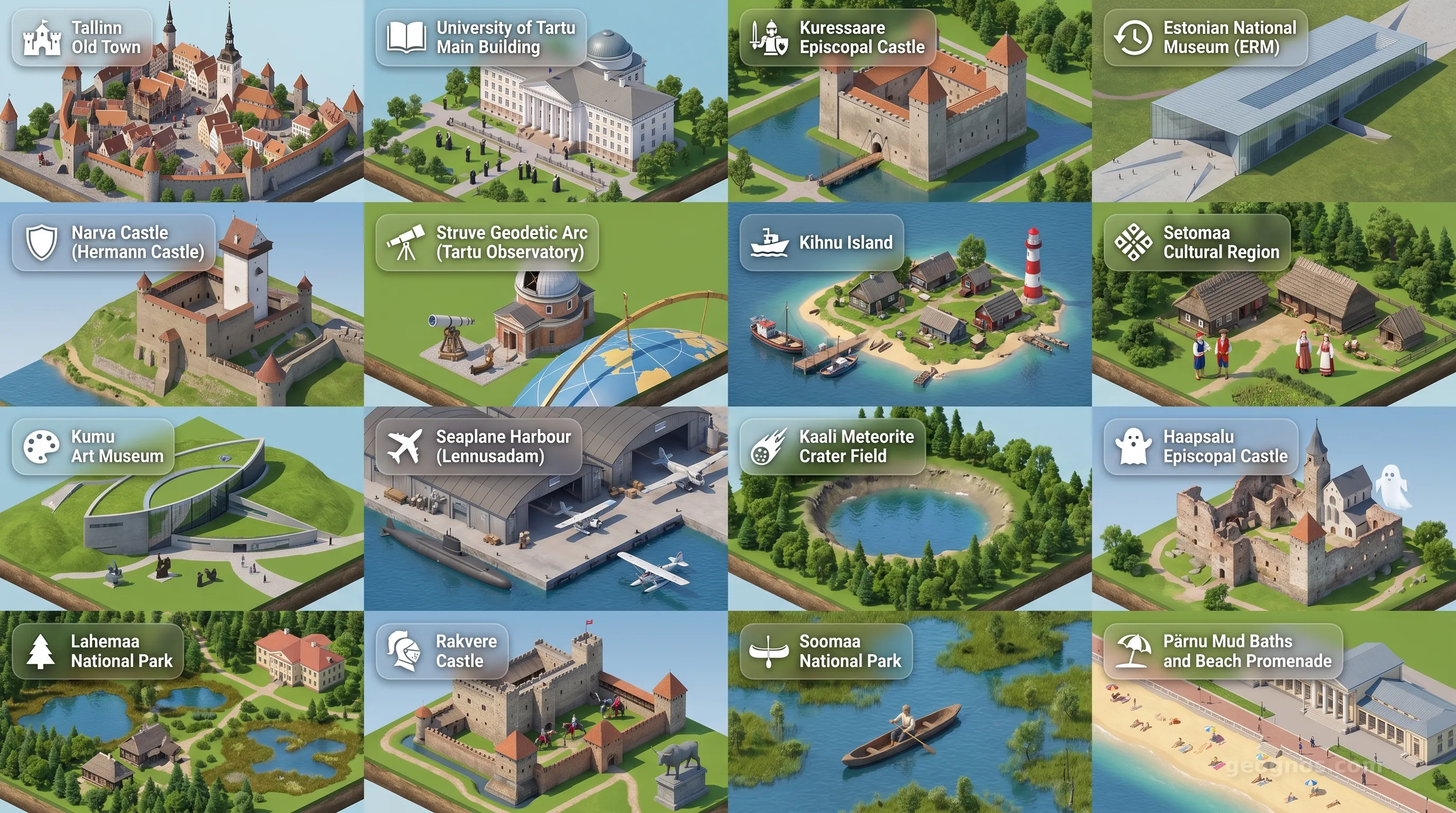
While the digital facade is impressive, it rests on a physical foundation of remarkable beauty. From the medieval charm of Tallinn’s Old Town, with its high-gabled merchant houses and fortified walls, to the wild, rugged stretches of Lahemaa National Park, the terrain remains a profound teacher. If you are preparing to visit or are simply curious about the topographical wonder that anchors this nation, we invite you to view our POI Cinematic Showcase. This visual exploration captures the highlights of Estonian scenery, ranging from the sparkling Tallinn Bay to the marshy islands that define the Estonian archipelago.
The Natural Harmony
Environmentally, Estonia is a land of seasonal extremity. The winter transforms the landscape into a crystalline cathedral of frost, while the summer offers the "white nights," where the sun barely sets, casting a long, golden glow over the wetlands. These bogs are more than just geographical features. They are cultural repositories where archaeologists have discovered remnants of ancient life, preserved by the acidic, low-oxygen peat. It is this synergy—between the earth that holds their ancestors and the fiber-optic cables that carry their future—that makes Estonia a truly distinct corner of the world.
The people of Estonia often describe their home as a quiet place for big ideas. In a world that often prizes volume and urgency, Estonia invites the world to lean in and listen. It is a nation that asks for patience in understanding its complexities, rewarding the observant traveler and the inquisitive student with insights that are as deep as the Baltic trenches and as bright as the northern sky. As we proceed through the pages of this atlas, we shall see how this delicate balance of preservation and innovation serves as a model for future societies.