The Baltic Pulse: Latvia’s Eternal Song
There is a peculiar stillness to the Latvian landscape, a quality that travelers often mistake for silence. But as you walk the deep, pine-scented corridors of the Gauja National Park, or watch the morning mist rise like a ghost off the Daugava River, you begin to understand that this land is not silent at all. It is a place of deep resonance, a country that communicates through the ancient architecture of its wooden towns, the rhythmic cadence of its folk music, and a resilience forged over millennia of transition. Latvia is the heartbeat of the Baltic states, a nation where the primordial forces of nature meet a sophisticated, deeply rooted European culture.
Geography here is not merely a setting, but the primary architect of the national soul. With its long, curved coastline along the Baltic Sea, Latvia has always acted as a gateway between East and West. This status as a historical crossroads has created a fascinating synthesis of tradition and progress. To truly grasp the narrative of this land, one must study how it navigated these crossroads across centuries. We invite you to explore the history of Latvia to understand the intricate shifts of power, culture, and sovereignty that shaped the current borders and collective identity of the nation.
A Canvas of Verdant Lowlands and Seafaring Ambition
Latvia’s topography is deceptive in its simplicity. Much of the nation is comprised of fertile lowlands, sprawling forests, and thousands of lakes that glimmer like silver coins tossed upon a velvet floor. The land is largely the result of the last glacial retreat, which left behind a landscape defined by rolling hills, expansive wetlands, and a coastline that ranges from dramatic sandy dunes to limestone cliffs. This environment has cultivated a population with an intimate connection to the earth, a characteristic perhaps most evident in the annual Summer Solstice celebrations where the rhythm of the sun dictates the rhythm of the people.
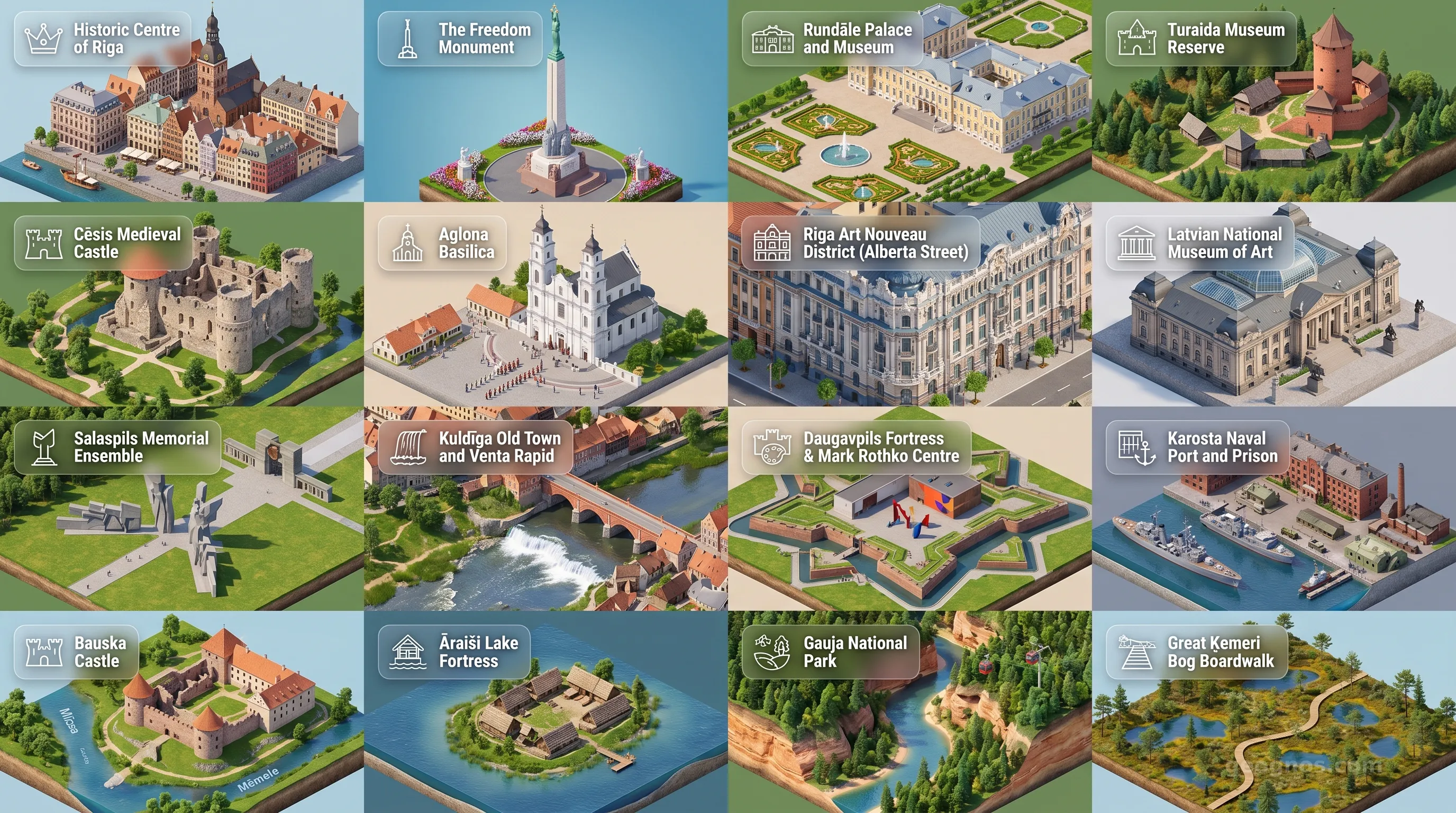
For those looking to visualize these dramatic terrains and the cultural monuments that anchor them, our POI Cinematic Showcase provides a breathtaking journey through the sites that define Latvia, from the Art Nouveau architecture of Riga to the rolling verdant hills of the Latgale region. It is here, in the interplay between the Baltic tides and the quiet interior forests, that one finds the true geographic soul of the country.
The Chronology of Persistence
The story of Latvia is marked by endurance. It is a chronicle of a people who clung to their linguistic heritage and cultural distinctiveness despite waves of regional shifting powers. Learning the timeline of such a history can be a complex endeavor, but we have simplified the process to make it an engaging exploration for learners of all ages. You can challenge your understanding of the major shifts in regional control, independence movements, and cultural renaissance by using our History Puzzle, an interactive tool designed to help you organize the pivotal milestones that constructed the Latvian identity.
The narrative arc of Latvia is not a straight line, but a spiral. It returns often to themes of renewal and the preservation of identity. For a deeper, more atmospheric dive into the pivotal moments that transformed this Baltic nation, we encourage you to watch our History Cinematic Showcase. This visual narrative captures the high stakes of past events through vivid illustration, allowing students and travelers alike to connect emotionally with the timeline of human endeavor in this storied corner of Northern Europe.
Harmony Between Modernity and Myth
Today, Latvia stands as a testament to the idea that a small nation can maintain an outsized influence on the global stage. It is a digital leader in Northern Europe, blending a high-tech infrastructure with an almost reverent preservation of its deep, pagan-rooted folklore. Walking through Riga is, in many ways, like wandering through a living museum of styles, where medieval cathedrals stand within shouting distance of world-class modernist glass structures. The Latvian people approach this dichotomy with a stoic grace and a sharp wit that makes them some of the most welcoming hosts in the region.
The spirit of the nation is reflected in its commitment to sustainable growth and the stewardship of its abundant natural resources. As a traveler or a student, you will find that the deeper you delve into the Latvian experience, the more you discover a culture that values internal quiet as much as it celebrates artistic output. Whether it is through the choral songs that can unite tens of thousands of voices in a single stadium or the careful restoration of the country’s many historical manors, Latvia is a nation currently engaged in the rewarding work of redefining its future while honoring the roots that hold it firm.
A Final Reflection for the Baltic Explorer
As you turn your attention to the data provided in our subsequent sections—the complexities of government, the intricacies of the economy, and the robustness of its modern society—keep in mind that the numbers only reveal a fraction of the reality. Latvia is best understood through participation, whether by listening to the local folk music in a quiet village pub or by walking the historic streets of the capital as dusk falls. It is a nation of many facets, held together by an enduring love for the land and a history that remains vibrant, relevant, and entirely unique.
GeoGnos is proud to provide the framework for your discovery of this Baltic jewel. We encourage you to move through our resources with curiosity, treating every map, historical entry, and regional demographic study as a key to unlocking the greater mystery of Latvia. From its ancient peat bogs to its modern harbors, the nation is waiting to share its story, one layer at a time.