The Vast Horizon: Kazakhstan as the Heart of the World
To stand upon the Kazakh steppe is to experience the raw, unadorned scale of our planet. This is a land where the horizon is not merely a line in the distance, but a concept that defines the spirit of its people. As the ninth-largest nation on Earth, Kazakhstan serves as a gargantuan bridge between East and West, a cradle of nomadic civilization that evolved from the dust of the Silk Road into a modern nexus of energy, industry, and burgeoning cultural discovery. It is a place of profound geographical contradictions, where the shimmering peaks of the Tian Shan mountains drop away into the silent, sun-baked expanse of the Kyzylkum desert.
For the traveler, the scholar, and the curious student, Kazakhstan is more than just a pin on a map. It is the geographic center of the Eurasian landmass, a silent witness to the migration of tribes, the rise and fall of empires, and the incredible resilience of a culture that turned an immense, often challenging environment into a cradle of poetic tradition and historical gravity. To understand this nation, one must first appreciate its relationship with the vast, open space it calls home.
A Tapestry of Ages: The Nomadic Legacy and Global Crossroads
Kazakhstan’s story is not static, nor is it contained by its borders. For millennia, the rolling grasslands of this region were the highways of history. It was here that the domestication of the horse forever altered the course of human development, allowing tribes to conquer distances that once seemed impassable. Through the lens of the history of Kazakhstan, we see a lineage that flows from the ancient Scythian nomads, through the grand period of the Turkic Khaganates, and into the formation of the Kazakh Khanate, which acted as the foundational stone for modern national identity.
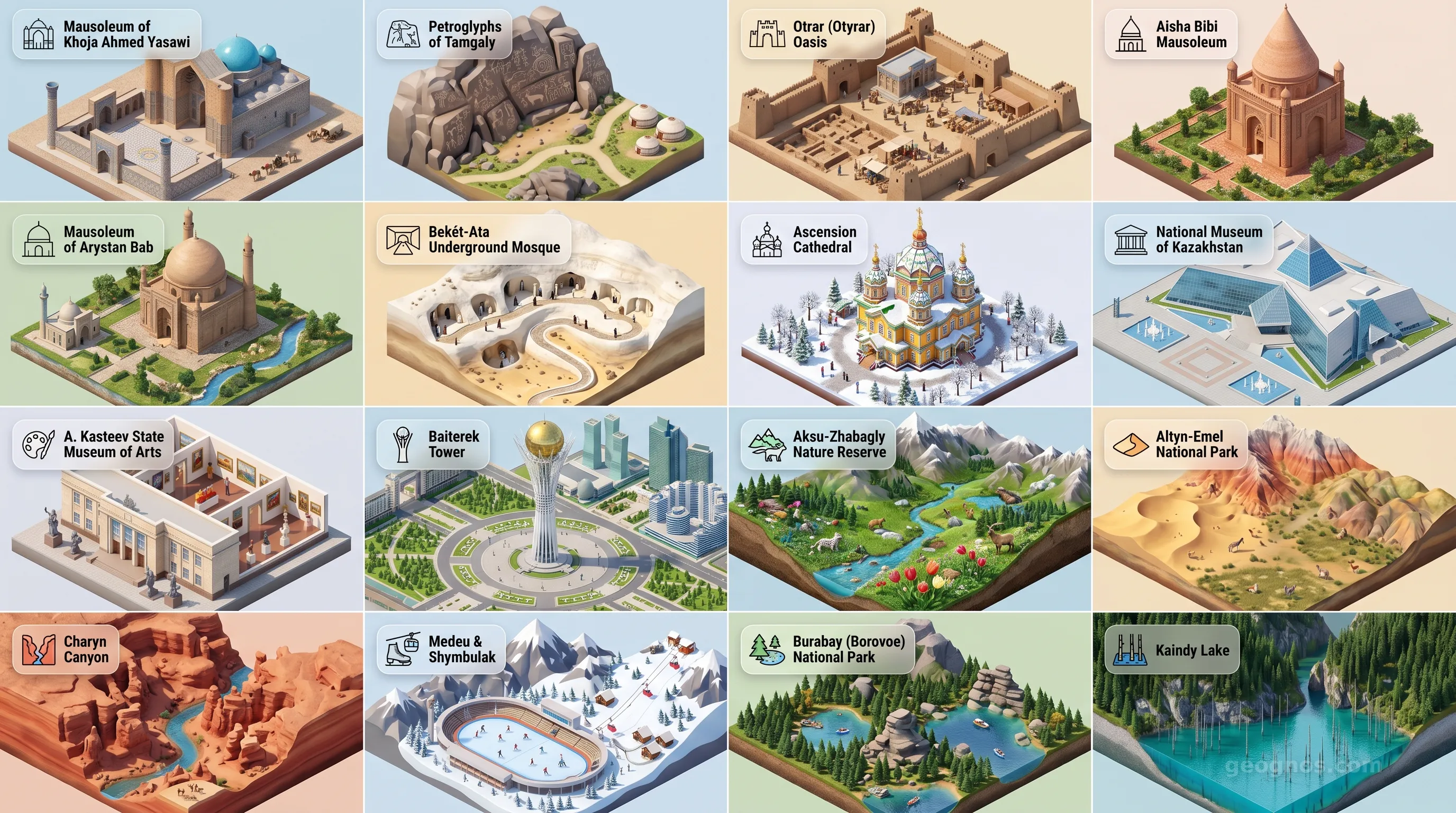
The layers of the past are etched into the soil itself. We encourage students to test their grasp of these transformative eras by engaging with the interactive chronological challenge, where you can arrange these pivotal events in order to gain a clearer understanding of how the medieval past flows into the modern reality of the country. This narrative is further brought to life through our cinematic history showcase, where illustrations reconstruct the grandeur of ancient trade centers like Otrar and the profound cultural shift that defined the Silk Road era.
The Vertical Landscape: From Altai to Aral
While the steppe often occupies the mind’s eye when one thinks of Central Asia, Kazakhstan’s environmental topography is remarkably diverse. In the southeast, the Tian Shan range creates a rugged, vertical architecture of glacier-fed lakes, jagged peaks, and lush alpine meadows that feel lightyears away from the arid plains of the west. To truly comprehend the visual splendor of these geographic landmarks, our comprehensive POI showcase offers a virtual tour through the must-see locales of the nation, from the dramatic Charyn Canyon, often compared to the Grand Canyon of the United States, to the modern, architectural ambition found in the capital city of Astana.
The Soul of the Steppe: Bridging Tradition and Tomorrow
What defines the soul of Kazakhstan today is the way it honors its heritage while leaning into the promise of the future. The Kazakh concept of "dastarkhan," or the communal table, represents the core of the national character, emphasizing hospitality as a sacred duty. Whether one is wandering the labyrinthine markets of Almaty, beneath the shadow of the mountains, or standing in the quiet of the Saryarka steppe under a night sky untouched by light pollution, the sense of connection to both the Earth and to human tradition is overwhelming.
The education system and local cultural institutions are currently placing a renewed emphasis on preserving nomadic folk music, the art of the eagle hunter (a discipline preserved for generations), and the revival of literary traditions. As you explore the various thematic sections on GeoGnos, remember that this country is a mosaic. It is composed of diverse ethnic communities that have harmonized over centuries, creating a multicultural environment where the Russian influence of the 20th century, the ancient Turkic traditions of the past, and a forward-looking technological sector intersect to create something entirely unique.
Educational Context: Studying the Giant of Central Asia
For our academic community, Kazakhstan presents a fertile ground for study. It is a nation currently undergoing a significant transition in its economic profile, moving from a primary dependence on extractive industries to a focus on knowledge, green energy, and transit infrastructure. For those in classrooms, whether you are analyzing the hydro-politics of the region's vast river systems or the linguistic patterns of the Central Asian states, this nation acts as the essential anchor for any Central Asian studies curriculum.
As you progress through this Atlas page, we invite you to view the information through the lens of continuity. How do the irrigation projects of the present impact the environment of the Aral Sea basin? How does the government's approach to the energy sector shape the lives of the pastoral communities in the Mangystau region? These are not mere trivia points. They are the moving parts of a nation that is steadily defining its place as a leader in the region. Dive deeper into these subjects via the navigational menu, and allow the following sections—from the 3d map visualizations to the detailed administrative demographics—to ground your understanding of this vast, majestic, and welcoming nation.