The Heart of the Silk Road: An Uzbekistan Overture
To stand upon the soil of Uzbekistan is to place your hand against the pulse of the ancient world. Nestled at the very core of Central Asia, this landlocked nation is defined not by its distance from the seas, but by its centrality to the land routes that once stitched together the furthest reaches of East and West. It is a country of paradoxes and permanence, where the turquoise tiles of fourteenth-century mosques shimmer against the stark, golden hues of the Kyzylkum Desert. For centuries, Uzbekistan has functioned as a crossroads of civilizations, a fertile basin nurtured by the Amu Darya and Syr Darya rivers that allowed high culture, mathematics, astronomy, and trade to flourish long before the maps of the modern world were drawn.
When you journey through the winding alleys of Samarkand, the fortress-walled streets of Khiva, or the bustling bazaars of Bukhara, you are walking through layers of time. To understand how these empires, scholars, and merchants transformed the topography into an intellectual paradise, you should explore the comprehensive history of Uzbekistan. It is a chronicle of resilience, detailing the rise and fall of great dynasties, the ingenuity of medieval Islamic scholars, and the cultural synthesis that makes Uzbekistan the spiritual hearth of the Silk Road.
The Geometry of Architecture and Ambition
The skyline of Uzbekistan is perhaps its most recognizable signature. It is a horizon dominated by azure domes, minarets that act as celestial anchors, and portals covered in intricate geometric mosaic work. This is the visual language of the Timurid Renaissance. Scholars from across the globe look to these structures not merely as religious sites, but as masterpieces of architectural engineering that preceded the modern era. The precision of the tilework, the acoustic mastery within the vaulted ceilings, and the sheer audacity of the scale reflect a society that placed an immense value on learning and beauty.
To grasp the timeline of the remarkable figures who built these monuments, you might find it helpful to test your knowledge. You can engage with our interactive history puzzle, where you must arrange major historical milestones in the correct chronological order to master the sequence of dynasties and achievements. It is an excellent way to connect the names of legendary rulers and scientists to the architectural wonders they left behind in the oasis cities.
A Landscape Shaped by Oasis and Arid Earth
While the architecture claims the eyes, the geography defines the lifestyle. Uzbekistan is largely a nation of contrasts. Much of the western territory is dominated by the vast, sun-bleached expanse of the Kyzylkum Desert. Yet, life persists in the miraculous emerald-green ribbons of the river valleys. Here, the irrigation networks designed centuries ago transformed arid plains into the breadbasket of the region, famous for its melons, cotton, and silken textiles. In the east, the terrain shifts abruptly, rising into the foothills of the Tian Shan and Pamir mountain ranges, offering a stark, majestic alpine counterpoint to the sweltering plains.
For those who wish to experience the aesthetic beauty of these regions from their desk or classroom, we provide a visual history cinematic showcase. This collection of curated illustrations brings to life the vibrant cultural movements and pivotal events that defined the nation over the millennia. Seeing these artistic interpretations helps bridge the gap between abstract academic facts and the human stories of the travelers and locals who traversed these routes for ages.
Living Tradition in a Modern Crossroads
The soul of Uzbekistan is found in its enduring traditions. The scent of plov, the country’s beloved national dish of spiced rice, lamb, and vegetables, wafts from every village home and bustling restaurant. In the craft workshops of the Fergana Valley, ceramicists continue to fire cobalt-blue plates using techniques passed down through generations, while silk weavers create patterns that mirror the complexity of their ancestors. This is not a static culture relegated to museums. It is a living, breathing heritage that respects the past while constantly moving toward the future.
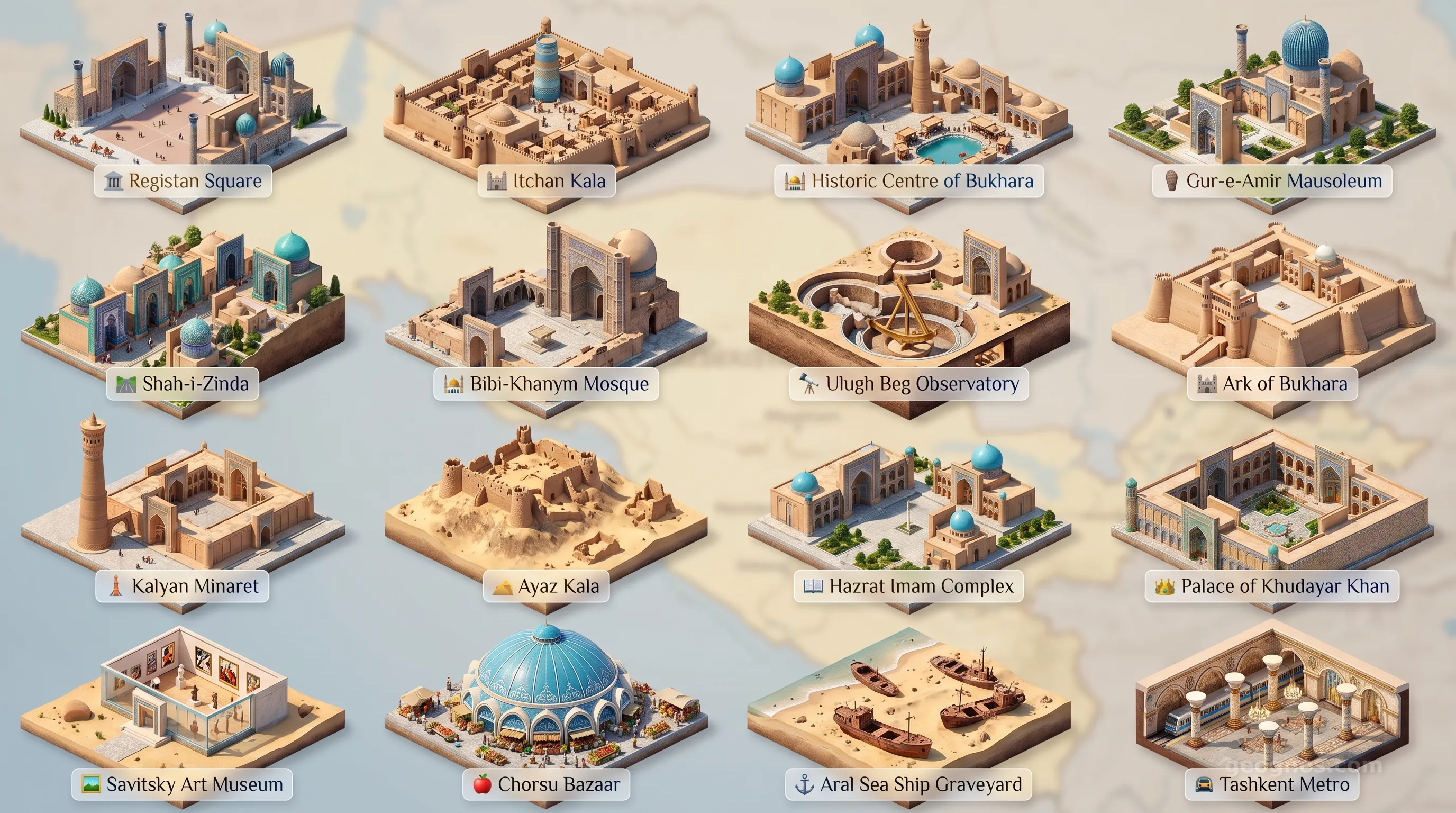
The beauty of Uzbekistan lies in the way its historical narratives are physically manifested in its geography. Whether you are a student researching the influences of the Kushan Empire or a prospective traveler mapping your route across the desert, the points of interest remain consistent pillars of cultural pride. You can explore our point of interest cinematic showcase, which takes you on a guided tour of the major sites, from the iconic Registan Square to the remote mountain outposts, offering a descriptive narrative that contextualizes why these specific locations remain so significant today.
The Promise of the Future
As a crossroads nation, Uzbekistan today acts as a vital bridge once again. Its unique position as the only country in the region surrounded entirely by other landlocked states—what geographers call "doubly landlocked"—has necessitated a spirit of innovation and trade. Modern Uzbekistan is rapidly developing, investing in education, international connectivity, and the preservation of its ecological wonders. By embracing its identity as a historic hub for the exchange of goods and ideas, the nation continues to offer profound lessons for students and global citizens alike about the endurance of trade, the importance of cultural diplomacy, and the necessity of sustaining the natural environment in an arid, precious land.
Whether you are investigating the administrative regions, examining the diverse population that constitutes its society, or exploring the intricacies of its government and economy, this Atlas page serves as your portal. We invite you to delve deeper into the layers of this fascinating country, as every chapter of the Uzbek story adds a necessary line to the map of our collective human history.