Switzerland
Top Sights & Landmarks
Carolingian Monastic Masterpiece
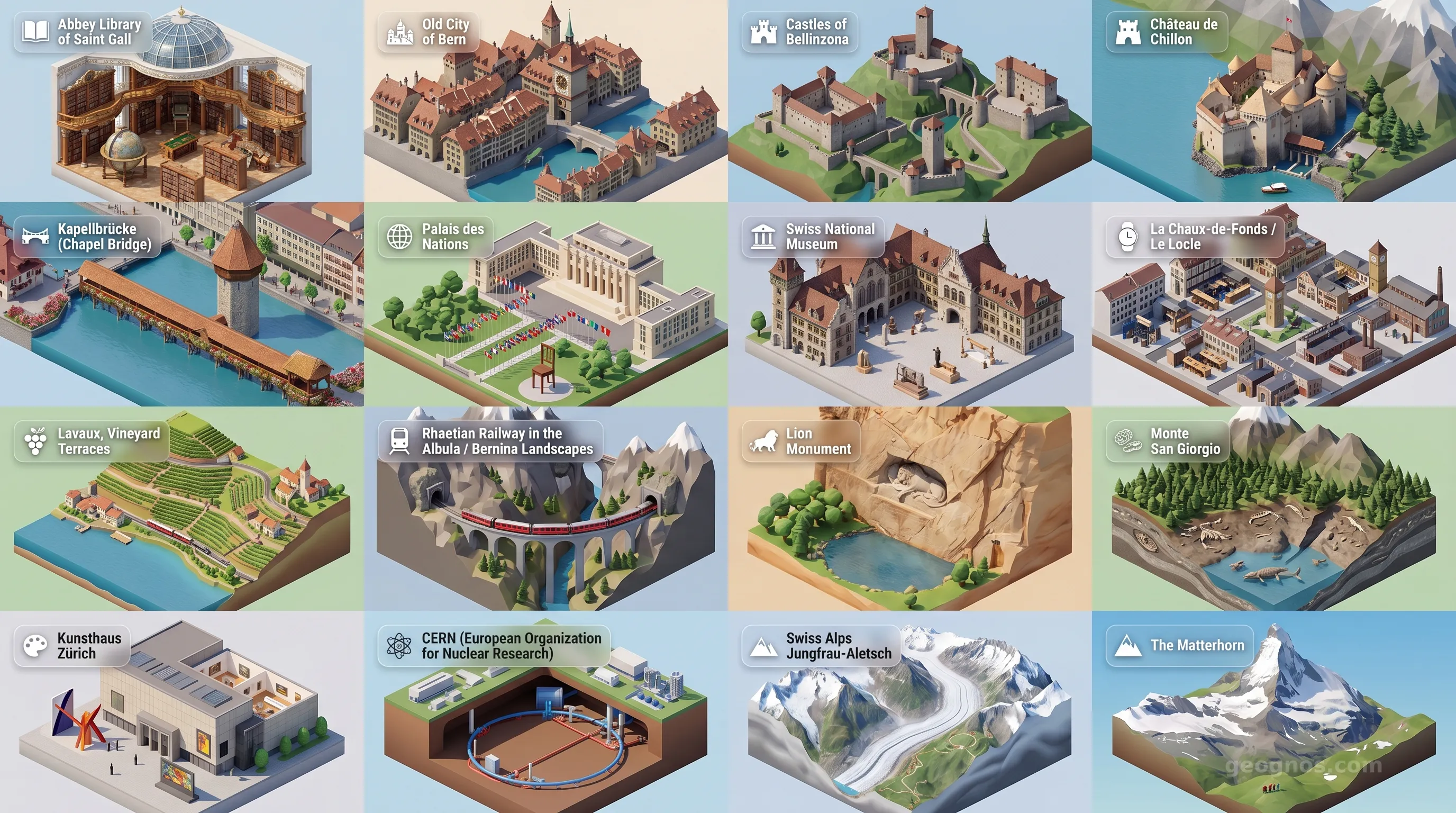
The Abbey of Saint Gall is one of the most significant cultural hubs in Europe, boasting an uninterrupted history from the 8th century. Its awe-inspiring Rococo library holds one of the world's oldest and richest collections of early medieval manuscripts, including the earliest known architectural plan drawn on parchment. For history and architecture students, it provides unparalleled insight into Carolingian monasticism and the preservation of Western knowledge through the Dark Ages. The library's breathtaking hall, with its intricate woodwork and ceiling frescoes, is a marvel of 18th-century design. The best time to visit is during the shoulder seasons (spring or autumn) to avoid intense summer crowds. Tourist tip: Visitors must wear provided oversized felt slippers to protect the historic wooden floors, adding a quirky but memorable element to the visit.
Medieval Capital of Arcades
The meticulously preserved Old City of Bern was founded in the 12th century on a hill surrounded by the Aare River. It stands out as one of Europe's best examples of medieval civic planning. Its 6 kilometers of continuous covered arcades (Lauben) showcase the ingenuity of historical urban adaptation. Culturally, it is deeply important; it houses the Zytglogge (an astronomical clock tower from the 13th century) and the former residence of Albert Einstein, where he developed the Theory of Relativity. Students of urban planning and history will find endless fascination in its remarkably intact layout following a devastating 1405 fire. Summer and early autumn are ideal for visiting, as you can also enjoy swimming in the pristine Aare River. Tourist tip: Time your visit to the Zytglogge four minutes before the hour to witness the mechanical figures perform their ancient rotation.
Gateways to the Alps
The Castles of Bellinzona—Castelgrande, Montebello, and Sasso Corbaro—form a spectacular medieval defensive complex that historically guarded the strategic Alpine passes connecting Northern Europe with Italy. Controlled by the Dukes of Milan before being conquered by the Swiss Confederation in the 15th century, these fortresses represent some of the finest examples of late medieval military architecture in the Alps. For military history students, studying the evolution of these fortifications reveals the geopolitical shifts between Italian and Germanic powers. The Mediterranean microclimate of the Ticino region makes it an excellent year-round destination, though spring is particularly beautiful when the surrounding valleys bloom. Tourist tip: Buy the 'Bellinzona Pass' for discounted access to all three castles and prioritize Castelgrande around sunset for phenomenal views over the valley.
Savoy Fortress on Lake Geneva
Located on a rocky island on the shores of Lake Geneva, Château de Chillon is Switzerland's most visited historic monument. For nearly four centuries, it served as a residence and profitable toll station for the Counts of Savoy. It is famed not just for its striking Romanesque and early Gothic architecture, but for its literary significance; Lord Byron immortalized it in his 1816 poem 'The Prisoner of Chillon', bringing Romantic-era tourism to the region. History students can study the castle's dual purpose as a luxurious noble court and an impenetrable prison. The fortress is majestic year-round, but autumn brings a moody, romantic atmosphere perfectly suited to its history. Tourist tip: Arrive early in the morning to beat the tour buses, and take the scenic boat ride from Montreux for the most dramatic approach to the castle.
Europe's Oldest Covered Bridge
Spanning the Reuss River in Lucerne, the KapellbrĂĽcke is the oldest wooden covered bridge in Europe, originally constructed in 1333 as part of the city's fortifications. What makes the bridge highly culturally significant is the series of triangular 17th-century paintings housed in its roof frames, which depict events from Lucerne's history and the lives of its patron saints. Though heavily damaged in a 1993 fire, it was painstakingly restored. Art and history students can analyze the surviving 'Dance of Death' panels, which provide profound insights into medieval and early modern European mindsets regarding mortality and piety. Summer is vibrant, but winter offers a magical, snow-covered setting. Tourist tip: Pair your walk across the bridge with a visit to the nearby Jesuit Church, and explore early morning when the water is perfectly still for excellent photography.
The Heart of Global Diplomacy
The Palais des Nations in Geneva was originally built between 1929 and 1936 to serve as the headquarters of the League of Nations. Today, it houses the United Nations Office at Geneva and is one of the most critical centers for multilateral diplomacy in the world. Its grand neoclassical architecture overlooking Lake Geneva is a symbol of the 20th-century quest for world peace. For students of political science, international relations, and modern history, touring the Assembly Hall and the Human Rights and Alliance of Civilizations Room is an essential pilgrimage. Weekdays throughout the year are best for experiencing the buzz of international delegates. Tourist tip: Guided tours are mandatory and highly sought after; you must book well in advance online and bring a valid passport for rigorous security screening.
Chronicle of Swiss Cultural Heritage
Housed in an impressive 1898 building designed by Gustav Gull that mimics a French Renaissance city chateau, the Swiss National Museum in Zurich holds the nation's most comprehensive collection of cultural history. The exhibits trace Switzerland's trajectory from prehistoric pile-dwelling settlements and Roman Helvetia to the intricate medieval Confederation and modern times. Students of anthropology, history, and sociology will find exceptional resources here, particularly the extensive medieval armory and Gothic art collections. The striking modern extension completed in 2016 provides a fascinating architectural dialogue between old and new. It is an excellent year-round destination and a perfect rainy-day activity. Tourist tip: Download the museum's excellent free audioguide app before you arrive, which provides detailed context for the vast collections.
The Watchmaking Metropolises
These twin towns in the Jura mountains are unique globally for their town planning, which is entirely dedicated to a single industry: watchmaking. Rebuilt after fires in the late 18th century, their grid-like layouts were designed to maximize natural light for horologists working in their homes and factories. Karl Marx famously analyzed La Chaux-de-Fonds in 'Das Kapital', calling it a 'huge factory-town'. For students of industrial history, urban planning, and horology, this site offers unparalleled insight into the transition from artisanal craft to industrial manufacturing. The Musée International d'Horlogerie is a must-visit. The area is best visited from late spring to early autumn. Tourist tip: Take a guided walking tour to spot the subtle architectural features designed specifically for watchmakers, and visit the underground horology museum.
A Millennium of Viticulture
Stretching for 30 kilometers along the northern shores of Lake Geneva, the Lavaux vineyard terraces represent a millennium of intensive human interaction with the environment. Initially established by Benedictine and Cistercian monks in the 11th century, these steep stone-walled terraces capture the 'three suns': direct sunlight, rays reflected off the lake, and heat released from the stone walls at night. It is a living cultural landscape that offers invaluable lessons in sustainable agriculture and regional heritage. Wine connoisseurs and cultural geographers alike will find the Chasselas wine production fascinating. Late summer and early autumn (harvest season) are the absolute best times to visit. Tourist tip: Walk the 'Terrasses de Lavaux' trail from St. Saphorin to Lutry, and stop at the small 'pintes' (local wine cellars) to taste wine directly from the producers.
Alpine Engineering Triumph
The Albula and Bernina lines of the Rhaetian Railway are celebrated as outstanding technical, architectural, and environmental feats. Completed in the early 20th century, these railway lines opened up the isolated communities of the Central Alps without the use of rack-and-pinion technology, relying instead on brilliant engineering solutions like helical tunnels and the spectacular Landwasser Viaduct. For engineering students and history buffs, the railway demonstrates how socio-economic development can be harmoniously integrated into rugged natural landscapes. Winter offers a magical, snow-globe-like journey, while summer provides lush, vibrant alpine views. Tourist tip: Ride the Bernina Express in the panorama cars, but consider hopping off at Alp GrĂĽm to enjoy a meal with an unforgettable view of the PalĂĽ Glacier.
The Dying Lion of Lucerne
Carved directly into a sheer sandstone cliff face in Lucerne, the Lion Monument (Löwendenkmal) is a profoundly moving sculpture designed by Bertel Thorvaldsen in 1820. It commemorates the Swiss Guards who were massacred in 1792 during the French Revolution while defending King Louis XVI at the Tuileries Palace in Paris. Mark Twain famously described it as 'the most mournful and moving piece of stone in the world.' It is an essential site for art and history students, illustrating the historical reality of Swiss mercenary service and the emotional power of neoclassical memorial art. The site is accessible year-round. Tourist tip: Visit early in the morning or late in the evening to avoid crowds and experience the solemn, quiet atmosphere the monument was designed to evoke.
Triassic Marine Fossil Hub
Rising beside Lake Lugano, Monte San Giorgio appears to be a typical lush pre-Alpine mountain, but beneath its surface lies the world's best fossil record of marine life from the Middle Triassic Period (245 to 230 million years ago). Due to an ancient tropical lagoon environment, the preservation of fish, marine reptiles, and terrestrial insects here is exceptionally complete. For paleontology, biology, and geology students, the site is an irreplaceable window into Earth's evolutionary past. The accompanying fossil museum in Meride features brilliant reconstructions of Triassic life. Spring through autumn is ideal for hiking the educational fossil trails. Tourist tip: Don't miss the Fossil Museum designed by Ticinese architect Mario Botta, and tackle the geo-paleontological path that loops around the mountain.
Premier Swiss Fine Arts Gallery
The Kunsthaus ZĂĽrich is one of the most important art museums in Switzerland, housing collections that span from the Middle Ages to contemporary art. It is particularly renowned for its extensive collection of works by Edvard Munch (the largest outside Norway) and Alberto Giacometti, as well as a stellar array of Impressionist and Post-Impressionist masterpieces. With the recent opening of its striking David Chipperfield-designed extension, it has become Switzerland's largest art museum. Art history students will find the progression of European art vividly represented here, along with significant works of the Swiss Dada movement. The gallery is perfect for any season. Tourist tip: Look into the 'ZĂĽrich Card' for discounted entry, and allocate at least half a day to fully appreciate both the historic building and the modern extension.
Birthplace of the Web & Particle Physics
Located near Geneva, CERN is the global epicenter for particle physics research and the home of the Large Hadron Collider (LHC), the world's largest and most powerful particle accelerator. Culturally and historically, it is also famed as the birthplace of the World Wide Web, invented here by Tim Berners-Lee in 1989 to help scientists share data. For students of physics, computer science, and engineering, a visit to CERN is highly inspirational, showcasing humanity's quest to understand the fundamental building blocks of the universe. The Science Gateway and the Globe of Science and Innovation offer incredible, immersive exhibitions. Tourist tip: Guided tours are free but incredibly popular; they open for booking exactly 15 days in advance, so be ready to book the second they become available online.
Heart of the High Alps
The Jungfrau-Aletsch region was the first Alpine site to be granted UNESCO World Heritage status. It encompasses the mighty Eiger, Mönch, and Jungfrau mountains, as well as the Great Aletsch Glacier, the largest glacier in Eurasia. Historically, this region was the cradle of European Alpinism and inspired generations of artists and writers, shaping the modern concept of mountain tourism. The Jungfraujoch railway, completed in 1912, remains an engineering marvel. Environmental science and geography students will find this an essential site for studying glaciology and the visible impacts of climate change. Best visited in summer for hiking or winter for skiing. Tourist tip: Check the mountain webcams before buying the expensive train ticket to Jungfraujoch; if it is completely clouded over, save the trip for a clearer day.
The Mountain of Mountains
The Matterhorn is arguably the most recognizable mountain peak in the world due to its perfect, isolated pyramidal shape. Towering over the car-free village of Zermatt, its cultural importance is tied to the 'Golden Age of Alpinism.' The tragic first ascent by Edward Whymper in 1865 profoundly changed the relationship between humans and the high peaks, turning mountaineering into a modern sport. For students of sports history, geology, and tourism, the Matterhorn is a definitive case study in how natural features become global icons. Summer is ideal for hiking the surrounding trails, while winter offers world-class skiing. Tourist tip: Take the Gornergrat Bahn at sunrise to see the first light hit the peak, a spectacular golden-red glow known locally as 'AlpenglĂĽhen'.
Background
The Swiss Confederation was founded in 1291 as a defensive alliance among three cantons. In succeeding years, other localities joined the original three. The Swiss Confederation secured its independence from the Holy Roman Empire in 1499. A constitution of 1848, which was modified in 1874 to allow voters to introduce referenda on proposed laws, replaced the confederation with a centralized federal government. The major European powers have long honored Switzerland's sovereignty and neutrality, and the country was not involved in either World War. The political and economic integration of Europe over the past half-century, as well as Switzerland's role in many UN and international organizations, has strengthened Switzerland's ties with its neighbors. However, the country did not officially become a UN member until 2002. Switzerland remains active in many UN and international organizations but retains a strong commitment to neutrality.