The Archipelago of Scattered Pearls: An Introduction to the Maldives
To view the Maldives from a great altitude is to witness a masterpiece of geological happenstance. In the vast, deep indigo of the Indian Ocean, a string of emerald specks emerges, scattered with the grace of a necklace undone. These are the coral atolls of the Maldives, a nation defined not by the expanse of its soil, but by the boundless chemistry between limestone, sea, and light. With over one thousand coral islands grouped into twenty-six natural atolls, the country functions as a living laboratory for the delicate balance between oceanic forces and human resilience.
This is not a land of mountains or sweeping river deltas. It is a nation of lagoons and reefs, where the land rarely rises more than two meters above the tidal mark. Here, the geography is the history. The very existence of the Maldives depends on the polyps that build the calcium carbonate foundations of the reefs, a process that has continued for millennia. For the visitor and the scholar alike, understanding the Maldives requires shifting one's perspective from the terrestrial to the aquatic, acknowledging that here, the ocean is not merely a border, but the essential protagonist of the national narrative.
The Echoes of the Ocean Trade
Positioned along the ancient maritime Silk Road, the Maldives has never been a secluded paradise. Its strategic location served as a vital junction for dhows traveling between the Arabian Peninsula, East Africa, and the bustling markets of Southeast Asia. Mariners recognized the islands as the "money isles," largely due to the abundance of cowrie shells found in the surrounding waters. For centuries, these shells served as a primary global currency, facilitating trade across vast empires and solidifying the archipelago as a hub of maritime commerce.
Because of this constant influx of travelers and merchants, the Maldivian identity was forged through syncretism. Language, culinary traditions, and religious architecture all bear the marks of these diverse encounters. To fully comprehend the tapestry of events that brought the nation to its modern form, one must examine the progression of its development. You are encouraged to explore the comprehensive history of Maldives, where you will find primary source materials, detailed geographic coordinates of key heritage sites, and curated educator guides that bring the past to life.
Learning this history is far more than an academic exercise; it is an exploration of survival. Those wishing to test their knowledge of the milestones that transformed the islands from Buddhist influence to an Islamic sultanate, and eventually to a modern republic, may engage with our interactive historical chronology puzzle. By successfully sequencing the events that defined the nation, participants can earn digital badges and deepen their grasp of the timeline that created modern Maldivian society.
Visualizing the Heritage and Horizons
The beauty of the Maldives is often described as ephemeral, shifting with the angle of the sun and the rhythm of the monsoons. However, its visual history is anchored in deep traditions and physical markers that remain visible today. The architecture of the mosques, built from massive coral blocks, stands as a testament to the ingenuity of a people who mastered the resources their unique environment provided. The traditional wooden boat, the dhoni, continues to ply the waters, an elegant testament to the maritime heritage that still sustains the population today.
To witness these moments in motion, we invite you to view our history cinematic showcase. This curated collection of illustrations and thematic narratives transports you through the turning points of the archipelago, from the arrival of the first settlers to the rise of its contemporary status. These visual vignettes offer a poignant look at the struggle and triumph of a nation built on coral.
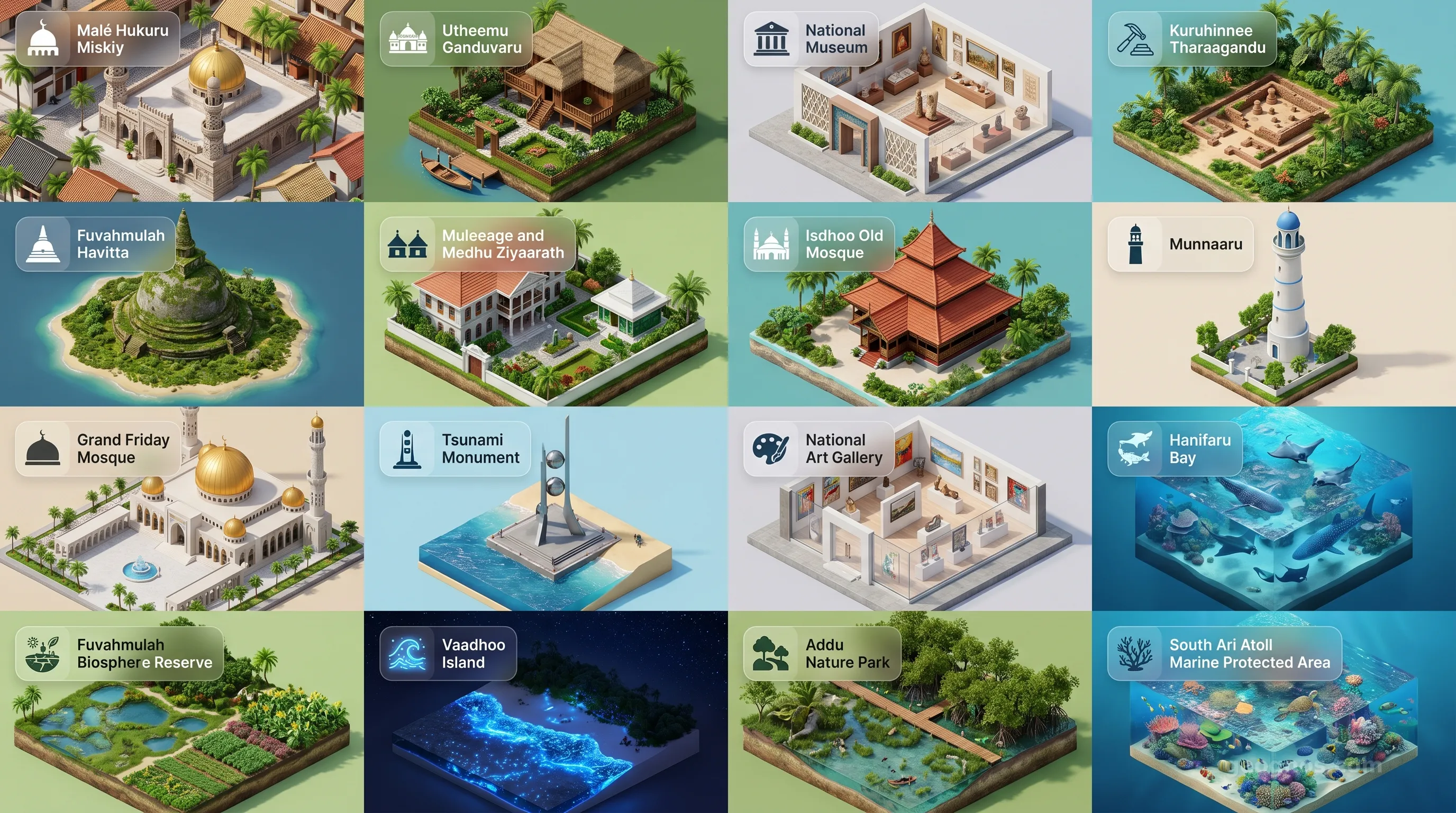
Beyond the pages of history, the physical geography of the Maldives remains an enduring point of wonder. Each atoll possesses a distinct personality, ranging from quiet, local-inhabited islands where the scent of drying tuna and sea salt fills the air, to the vibrant underwater cathedrals teeming with marine life. If you wish to immerse yourself in the natural and architectural grandeur of these islands, browse through our points of interest cinematic showcase. This interactive gallery serves as an essential companion for both the prospective traveler planning an expedition and the student seeking a detailed visual understanding of Maldivian landscape and culture.
A Nation in Harmony with the Tide
The Maldivian spirit is fundamentally defined by "dhivehi"—the language and the soul of the islands—which centers on the concept of living in rhythm with the sea. In a world characterized by fixed continental borders, the Maldives remains an anomaly. Its population has successfully managed the unique pressures of living in an environment that is constantly undergoing shifts in sedimentation and coastal morphology.
As an educator or a student on GeoGnos, you will find that the Maldives provides one of the most compelling case studies in geography. From the scientific study of coral growth rates to the socio-economic evolution of small island developing states, the nation serves as a prism through which we can observe global climate trends and cultural preservation. We invite you to delve deeper into these subjects using our specialized sections below, covering the climate, economy, and the dynamic government systems that navigate the challenges of the twenty-first century. As you study these islands, you are not merely looking at a map; you are learning the architecture of an oceanic oasis that continues to captivate the human imagination.