The Stone Sentinel of the Mediterranean
If the Mediterranean Sea is the cradle of Western civilization, then Malta is the limestone key that unlocks its deepest secrets. Resting like a sun-bleached shard of rock between the southern tip of Sicily and the northern reach of Africa, this archipelago defies its diminutive size. It is a land where geography is not merely a backdrop, but the primary author of its existence. To stand upon the ramparts of Valletta is to witness a confluence of eras, a place where Phoenician ambition, Roman administration, Arab irrigation techniques, and the formidable fortifications of the Knights of Saint John are etched into the very masonry of the streets. Here, the golden light reflected off the honey-hued globigerina limestone creates an ethereal glow, one that has watched over millennia of sailors, scholars, and conquerors.
The essence of Malta lies in its paradox. It is a nation of intense isolation and profound interconnectedness. Its geography, marked by jagged cliffs and sheltered natural harbors, turned a tiny scattering of islands into the most coveted strategic prize in the center of the world. For those wishing to trace the winding path of this unique survival, our comprehensive explore the history of Malta provides an immersive look at how these islands evolved from a neolithic sanctuary into a modern global crossroads. You can visualize the tides of influence by engaging with our History Cinematic Showcase, which brings the major epochs of the archipelago to life through detailed imagery and narrative sequences.
A Stratigraphy of Cultures
Malta is fundamentally a museum without walls. The prehistoric temple complexes, such as Ġgantija and Ħaġar Qim, are older than the Egyptian pyramids and reflect a culture that understood the alignment of the heavens long before the written word. These megaliths serve as a silent testament to the ingenuity of the island’s earliest inhabitants, who thrived in an environment characterized by low rainfall and limited natural resources. This necessity bred a distinct form of adaptability that remains the bedrock of the Maltese character today. The islander, resilient and multilingual, navigates the complexities of European and North African influences with a grace that has been polished by centuries of synthesis.
Education is a core value of the Maltese experience. For students looking to master the complex layers of these influence, we invite you to participate in our interactive data chronology puzzle. By arranging the defining moments of Malta's timeline, you not only learn the chronology of the nation but earn badges that celebrate your journey through its illustrious past. The pedagogical strength of these islands lies in the fact that every field is an archive and every harbor a page of a ledger detailing the world’s changing hands.
Beyond the Ramparts
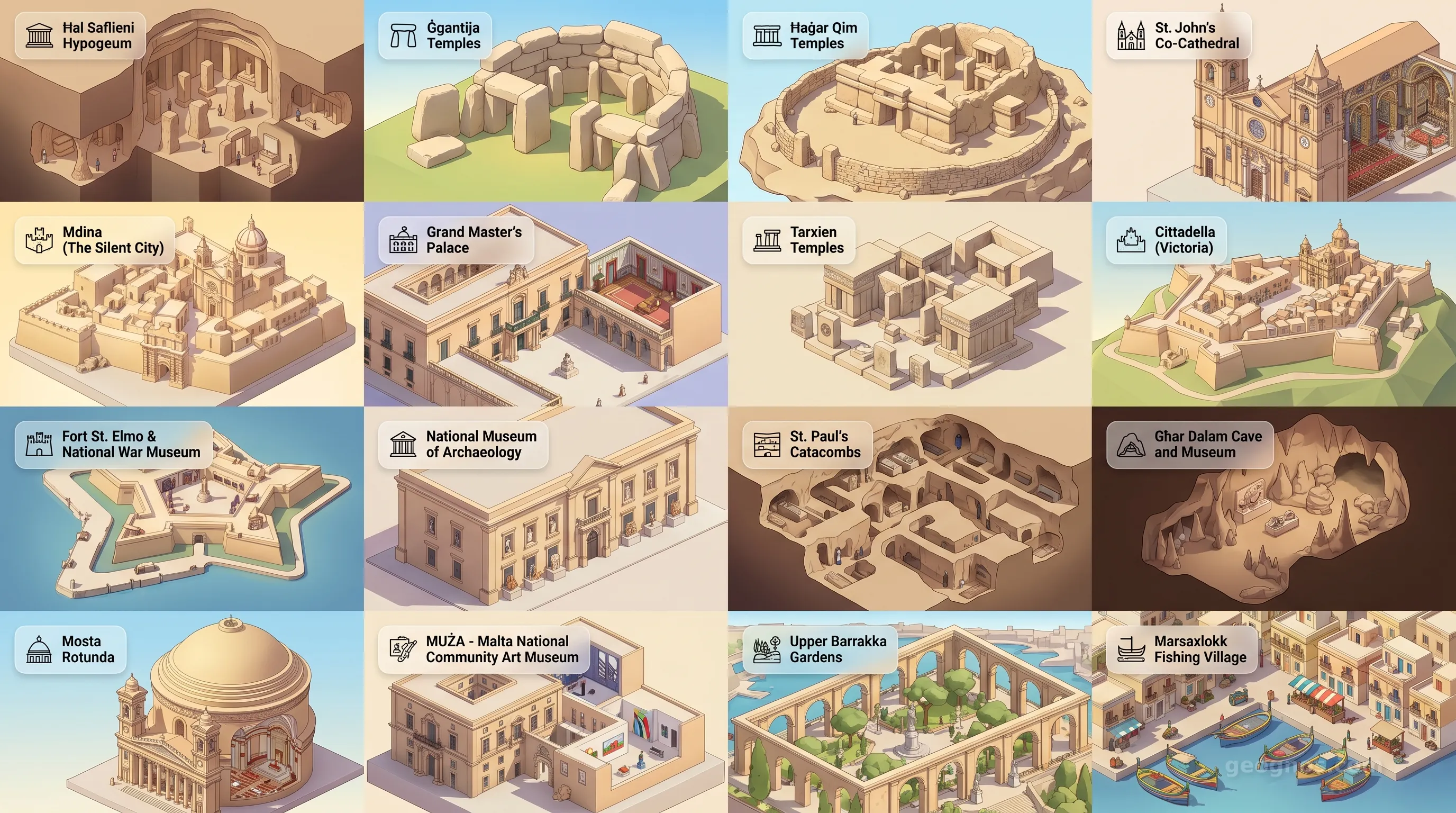
While the history of the nation is carved into its stone, its soul is tied to the restless indigo depths that surround it. The environmental reality of Malta is defined by the absence of permanent rivers and mountain ranges. Instead, the landscape is sculpted by karst terrain, seasonal vegetation, and a climate that balances the warmth of the Sahara with the cooling influence of the central Mediterranean. The visual appeal of these natural landmarks and historic sites is captured in our POI Cinematic Showcase, a curated digital gallery that transports you from the turquoise stillness of the Blue Grotto to the baroque grandeur of the Mdina gates.
Visitors and scholars often remark that time moves differently in Malta. It does not march linearly; it pulses in sync with the waves hitting the harbor walls. Whether one is examining the fossilized remains in the cliffs of Dingli or attending a lecture on the linguistic evolution of the Maltese tongue—a Semitic language written in Latin script—the realization remains the same. Malta is a laboratory of human endurance. It is a testament to the idea that a nation is not defined by its vastness of land, but by the depth of its cultural echoes.
An Enduring Beacon
Today, Malta stands as an independent state of vibrant commerce, rich maritime history, and a modern identity that respects its ancestral roots. It remains a gateway, not for invading armadas as it was in the past, but for ideas and people flowing across the Mediterranean. The archipelago continues to serve as an indispensable partner in regional affairs, offering a bridge between Europe and its southern neighbors. Its commitment to the preservation of its heritage, balanced with a drive toward innovation in digital economy and sustainable tourism, highlights a nation that is constantly looking toward the horizon without ever losing sight of the shore that anchors it.
As you navigate this site, use these resources as a lens through which to observe how the constraints of a small island geography acted as a catalyst for a global contribution. From the enigmatic temples to the bustling Valletta waterfront, Malta invites you to be an active participant in its story. Explore, analyze, and immerse yourself in a nation that, though small, contains the magnitude of human civilization within its golden, limestone boundaries.