Portugal
Top Sights & Landmarks
Epitome of the Age of Discovery
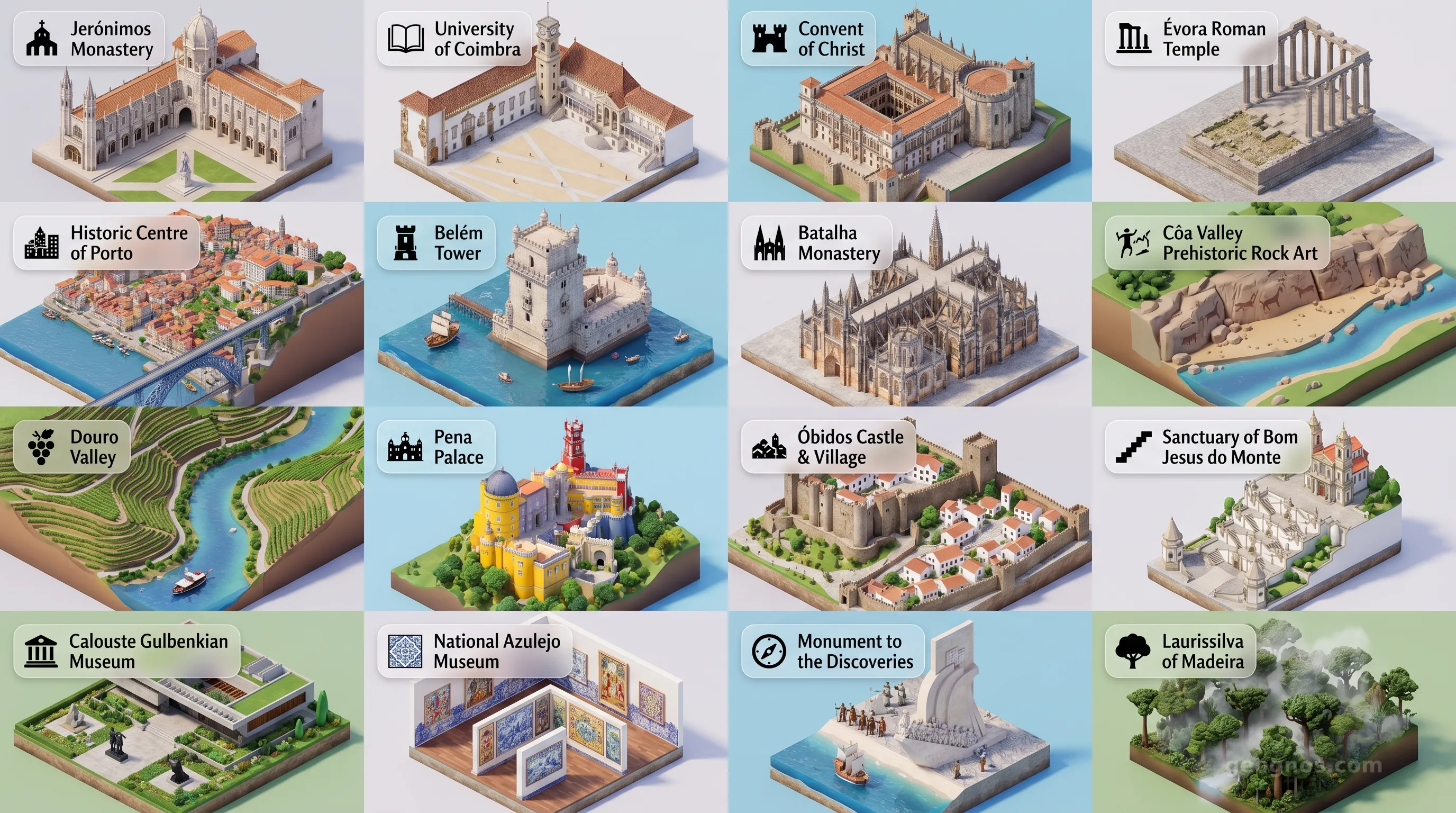
The JerĂłnimos Monastery is an awe-inspiring masterpiece of Manueline architecture and a profound symbol of Portugal's Age of Discovery. Studying its intricate maritime-themed carvings offers invaluable insights into the country's 16th-century global expansion. Commissioned by King Manuel I to honor Vasco da Gama's successful voyage to India, the complex safely houses the iconic explorer's tomb. The best time to visit is during the spring (April to June) when the weather is mild and the adjacent gardens are in full bloom. Tourist tip: Purchase a combined ticket online in advance to bypass the notoriously long queues, and arrive right at opening time to experience the cloisters in relative peace.
Historic Epicenter of Portuguese Academia
As one of the oldest universities in continuous operation in the world, the University of Coimbra is the beating heart of Portuguese intellectual history. Founded in 1290, it shifted permanently to Coimbra in 1537, occupying a former royal palace. Students of history and architecture will be mesmerized by the Joanina Library, a Baroque masterpiece housing over 300,000 ancient volumes protected by a resident colony of bats. The ideal time to visit is in May during the 'Queima das Fitas' (Ribbon Burning) festival, which showcases deep-rooted student traditions. Tourist tip: Book your timed-entry ticket to the Joanina Library well in advance, as daily visitor numbers are strictly capped to preserve the fragile manuscripts.
Stronghold of the Knights Templar
The Convent of Christ in Tomar is a monumental complex that served as the headquarters for the Knights Templar and later the Order of Christ. It is a stunning visual timeline of Portuguese architecture, blending Romanesque, Gothic, Manueline, and Renaissance styles. Historically, it was pivotal in funding the Portuguese maritime discoveries under Henry the Navigator. The magnificent Manueline Window is an absolute must-study for art historians, featuring extravagant nautical motifs. Autumn (September to November) offers crisp weather and fewer crowds. Tourist tip: Allocate at least three hours to explore the vast, labyrinthine cloisters and the original 12th-century octagonal Templar church (Charola).
Ancient Marvel of Roman Lusitania
Often mistakenly called the Temple of Diana, the Évora Roman Temple is one of the most significant and best-preserved Roman ruins in the Iberian Peninsula. Dating back to the 1st century AD, it stands in the historic center of Évora as a testament to the classical origins of Portuguese urban development. It is an essential study site for classical archaeology and the history of Roman Lusitania. The best season to visit is spring or early autumn, as the Alentejo region becomes fiercely hot during the summer months. Tourist tip: Visit the temple at night when the Corinthian columns are dramatically illuminated, offering stunning photography opportunities without the daytime tour groups.
The Ancient Roots of Portus Cale
Porto's Historic Centre, cascading down to the Ribeira district along the Douro River, is the ancient settlement that gave Portugal its name (Portus Cale). Characterized by narrow, winding medieval streets and colorful tiled facades, it boasts monumental landmarks like the SĂ© Cathedral and the ClĂ©rigos Tower. Culturally, it is inextricably linked to the global trade of Port wine. Visiting between May and September ensures vibrant riverside energy and pleasant weather for walking the steep hills. Tourist tip: Cross the iconic Dom LuĂs I Bridge at sunset on the upper deck for the most breathtaking panoramic views of the historic cityscape and the traditional Rabelo boats.
Sentinel of the Tagus River
Built in the early 16th century to defend Lisbon's harbor, the Belém Tower (Torre de Belém) is an enduring icon of Portugal's maritime expansion. Combining Moorish-influenced watchtowers with elaborate Manueline stonework—including the first European stone carving of a rhinoceros—it offers a fascinating case study in military architecture transitioning into decorative statecraft. Over the centuries, it also served as a political prison. Spring and late summer are ideal times to visit. Tourist tip: The interior staircases are incredibly narrow and operate on a red/green light system; to avoid severe bottlenecking, try to visit on a weekday morning right as the gates open.
Monument to Portuguese Independence
The Batalha Monastery (Monastery of Saint Mary of the Victory) was erected to commemorate the 1385 Battle of Aljubarrota, a pivotal clash that secured Portugal's independence from Castile. It is arguably the finest example of late Gothic architecture in Portugal, heavily intertwined with early Manueline style. Students of architecture will be captivated by the 'Unfinished Chapels,' which lay bare the intricate construction methods of the era. The site is spectacular year-round, but visiting in August aligns with local medieval fairs commemorating the historic battle. Tourist tip: Take time to witness the changing of the guard at the Tomb of the Unknown Soldiers located inside the Chapterhouse.
Paleolithic Open-Air Gallery
The CĂ´a Valley is home to the largest and most important open-air collection of Paleolithic rock art in the world. Dating back over 22,000 years, these engravings of horses, aurochs, and ibexes overturned the previous belief that prehistoric art was strictly confined to caves. Historically, the site is a triumph of heritage preservation, having been saved from a dam construction project in the 1990s. The mild temperatures of spring and autumn make the required outdoor hiking comfortable. Tourist tip: Book an official night tour; viewing the ancient incisions under artificial oblique lighting brings the moving, overlapping animal figures vividly to life.
World's Oldest Demarcated Wine Region
The Douro Valley features dramatic terraced vineyards carved into the mountainsides along the winding Douro River. Established in 1756 by the Marquis of Pombal, it is the oldest legally demarcated and regulated wine region in the world, making it an essential destination for enology and agricultural history students. The landscape is a testament to centuries of human labor harmonizing with rugged nature. The absolute best time to visit is September and October during the grape harvest (vindima), when the foliage turns vibrant shades of red and gold. Tourist tip: Experience the valley via a scenic train ride on the Linha do Douro, followed by a local estate (quinta) tasting.
Crown Jewel of European Romanticism
Perched high in the Sintra mountains, the vibrant red and yellow Pena Palace is the supreme expression of 19th-century European Romanticism. Commissioned by King Ferdinand II, it blends Neo-Gothic, Neo-Islamic, and Neo-Renaissance styles into a deliberately whimsical, fairy-tale structure. The surrounding cultural landscape, teeming with exotic flora from the Portuguese empire, offers immense value to botany and landscape design students. Due to its high altitude, it often features a mystical microclimate. Summer is beautiful but crowded; visit in early spring for misty, atmospheric views. Tourist tip: The walk from the entrance gate to the palace is steep; use the shuttle bus if mobility is an issue, and always bring a windbreaker.
The Queens' Medieval Town
Encircled by remarkably preserved medieval walls, Óbidos is a picturesque village characterized by whitewashed houses, cobblestone streets, and a formidable Moorish-turned-royal castle. Historically, it was traditionally presented as a wedding gift by Portuguese kings to their queens, preserving its pristine aesthetic for centuries. It provides a perfect, immersive study of a medieval fortified settlement. Visiting in July allows you to experience the immersive Medieval Market, while December transforms it into a magical Christmas Village. Tourist tip: Walk the entire perimeter of the medieval walls for elevated views, and don't leave without tasting Ginjinha (cherry liqueur) served in an edible chocolate cup.
A Baroque Stairway to Heaven
Located in Braga, the Sanctuary of Bom Jesus do Monte is a spectacular Catholic pilgrimage site famous for its monumental, zigzagging Baroque stairway that climbs 116 meters. The architecture and sculptural allegories meticulously represent the spiritual journey of ascending to heaven, offering profound insights into the theological artistry of the 18th century. Spring brings lush greenery to the surrounding park, enhancing the spiritual tranquility of the ascent. Tourist tip: If you want to avoid climbing the 577 steps, ride the world's oldest water-powered funicular up to the sanctuary, and enjoy a leisurely, scenic walk back down.
A 5,000-Year Journey Through Art
Housing one of Europe's most important private art collections, the Calouste Gulbenkian Museum in Lisbon is an extraordinary cultural repository. Amassed by the Armenian oil magnate Calouste Gulbenkian, the collection spans over 5,000 years, featuring Egyptian antiquities, Islamic art, and European masterpieces by Rembrandt, Monet, and René Lalique. It is an indispensable resource for art history students. The museum is set within beautifully landscaped, brutalist-style gardens that are perfect for a reflective stroll in the spring or summer. Tourist tip: Entry to the permanent collection is free on Sundays after 2:00 PM; use this opportunity to explore the tranquil gardens and the modern art center as well.
The Art of Portuguese Ceramic Tiles
Set within the magnificent 16th-century Madre de Deus Convent, the National Azulejo Museum is dedicated to the quintessential Portuguese art form: the azulejo (ceramic tile). The collection traces the evolution of tile-making from the 15th-century Moorish influences to contemporary designs. Culturally, it reveals how Portugal adopted and mastered this craft, using it to chronicle history, religion, and daily life. The museum is a fantastic indoor activity year-round. Tourist tip: Do not miss the breathtaking 23-meter-long tile panorama of Lisbon, which depicts the city exactly as it looked before the devastating 1755 earthquake.
A Tribute to Portugal's Navigators
The PadrĂŁo dos Descobrimentos is a colossal concrete monument shaped like the prow of a caravel, jutting out over the Tagus River. Built in 1960 to commemorate the 500th anniversary of the death of Henry the Navigator, it features highly detailed sculptural reliefs of 33 prominent figures from the Portuguese Age of Discovery, including explorers, cartographers, and monarchs. It serves as an accessible visual summary of Portugal's global historical impact. Best visited on clear days to appreciate the enormous limestone compass rose embedded in the plaza below. Tourist tip: Pay the small fee to take the elevator to the top for a stunning aerial view of the compass rose and the nearby JerĂłnimos Monastery.
Ancient Subtropical Rainforest
The Laurissilva of Madeira is an outstanding relict of a previously widespread laurel forest type that covered much of Southern Europe millions of years ago. It is the largest surviving area of primary laurel forest in the world, making it an irreplaceable living laboratory for evolutionary biologists and ecologists. The humid, misty environment hosts a wealth of endemic flora and fauna. Spring is magical when the endemic flowers burst into bloom along the 'levadas' (historic irrigation channels). Tourist tip: Hike the Levada do Rei or Levada das 25 Fontes trails for the most immersive experience, and always pack waterproof gear as the forest creates its own rain.
Background
A global maritime power during the 15th and 16th centuries, Portugal lost much of its wealth and status with the destruction of Lisbon in a 1755 earthquake, occupation during the Napoleonic Wars, and the independence of Brazil, its wealthiest colony, in 1822. A revolution deposed the monarchy in 1910, and for most of the next six decades, repressive governments ran the country. In 1974, a left-wing military coup ushered in broad democratic reforms. The following year, Portugal granted independence to all its African colonies. Portugal is a founding member of NATO and entered the EC (now the EU) in 1986.