The Green Heart of Europe: Slovenia’s Resilient Identity
There is a specific cadence to the landscape of Slovenia that defies simple categorization. It is a place where the jagged, austere teeth of the Julian Alps soften into the verdant, rolling embrace of the Pannonian Basin, and where the rhythmic whisper of the Adriatic Sea finally greets the rugged karst plateaus. To travel across Slovenia is to traverse a living manuscript of European heritage, one written not in ink, but in the tectonic shifts of limestone mountains and the steady flow of emerald rivers. As a nation tucked between the colossal influences of Germanic, Roman, Slavic, and Mediterranean cultures, Slovenia has mastered the art of synthesis. It is a country that feels paradoxically intimate and vast, a land where every valley seems to harbor its own distinct dialect, architectural signature, and folklore.
For the traveler, the scholar, or the student, Slovenia represents more than a dot on the continental map. It is the geographic center of the continent's spirit, acting as a natural gateway where the Balkan peninsula yields to Central Europe. The Slovenian identity is inextricably linked to the land itself, a relationship defined by a fierce commitment to preservation and a long-standing harmony with a challenging, subterranean-rich topography.
A Chronology Forged in Stone and Spirit
To understand why this nation remains so distinct despite centuries of proximity to empires, one must first look at the foundations of its development. The resilience of the Slovenian people is best observed by diving deep into their past. For those wishing to anchor their knowledge in the foundational timeline of the region, we invite you to explore the history of Slovenia, a comprehensive narrative that illuminates the rise of duchies, the impact of centuries of outside governance, and the quiet, persistent strengthening of the national language and culture that ultimately carved out the modern sovereign state.
History, however, is rarely a linear path of easy victories. It is a tangled forest of dates, personalities, and cultural shifts. If you are interested in testing your grasp of these defining moments, we have developed a resource that turns education into a dynamic challenge. You can play the History Puzzle, an interactive data-based timeline that rewards your chronological intuition with unique achievement badges. This activity is designed to help students visualize the causal links between medieval migrations and the modern geopolitical status of the country today.
Visualizing the Passage of Time
The essence of Slovenia is not merely intellectual; it is deeply visceral. When we study the layers of its existence, we must reconcile the written word with the visual reality of the sites that still stand today. To witness the evolution of the Slovenian soul, we suggest viewing our History Cinematic Showcase. This curated digital exhibition features a collection of illustrations and artistic reconstructions that bring to life the seminal events that transformed a diverse group of provinces into a unified, thriving republic. It serves as a bridge between the dusty records of the past and the vibrant, breathing reality of contemporary Slovenian society.
The Architecture of the Landscape
What makes Slovenia truly extraordinary for the modern visitor is its geographical diversity, which is contained within a remarkably small land area. From the karst subterranean marvels, such as the Postojna Cave system, to the glacial clarity of Lake Bled, the topography functions as a national identity. The Slovenian people have traditionally acted as stewards of this land, fostering a culture of outdoor pursuit and environmental stewardship that is unrivaled in the region. This reverence for the environment is not a modern fad, but a historical inheritance passed down from generation to generation.
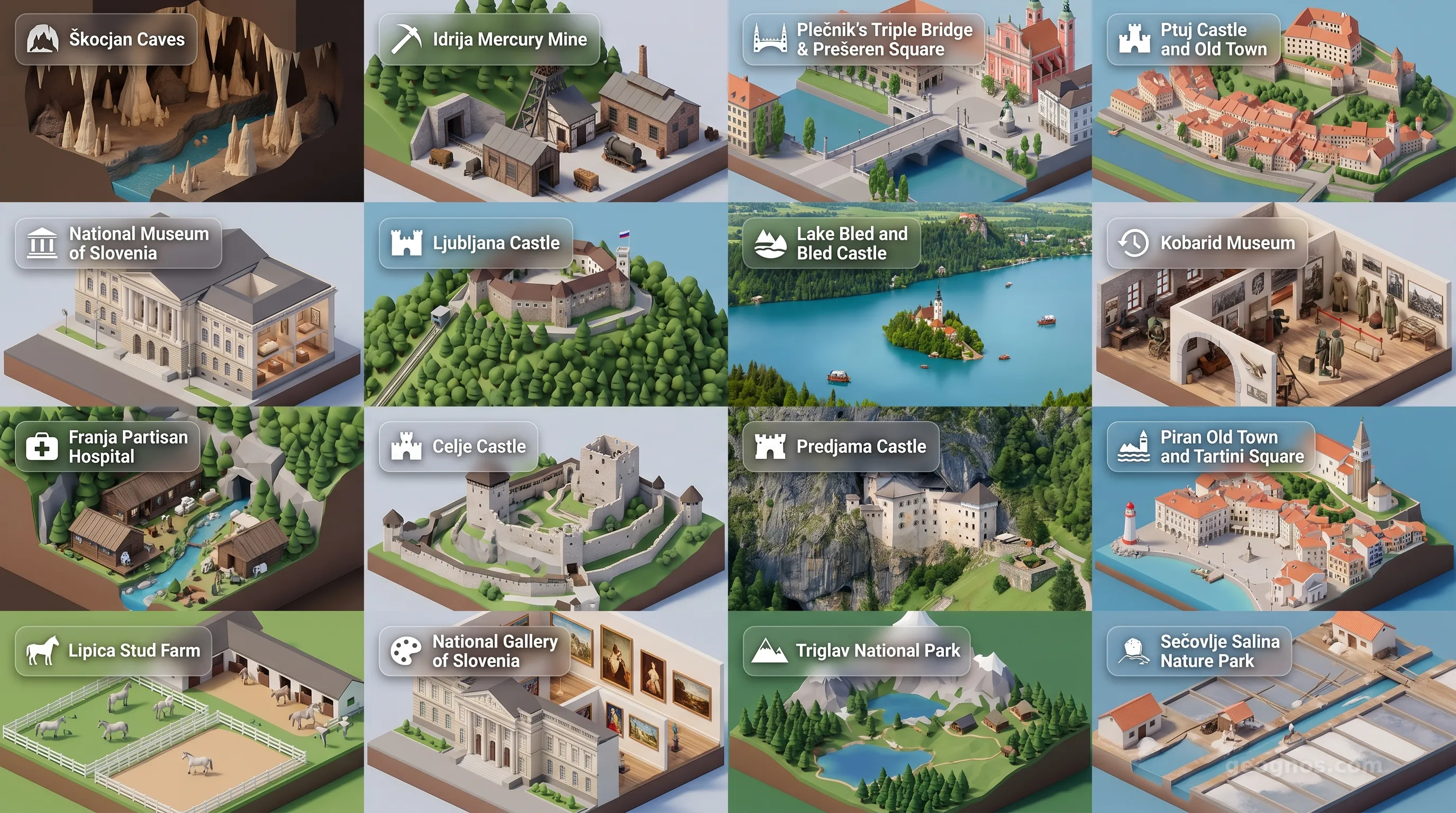
For those looking to prepare for their next adventure or to conduct a classroom exploration of the nation’s scenic diversity, our POI Cinematic Showcase offers an immersive, carousel-style journey through the country’s top sites. Each image tells a story of human ingenuity interacting with raw geological force. You will encounter the terracotta roofs of Piran, the historic bridges of Ljubljana, and the silent, mist-covered peaks of Triglav National Park. It is this proximity of the urban to the wild that characterizes the Slovenian experience; a bustling capital city is rarely more than an hour away from untouched alpine forests.
The Cultural Synthesis of a Crossroads
The true genius of Slovenia lies in its role as a cultural broker. Throughout the centuries, it has sat at the threshold of the Roman Catholic and Eastern Orthodox worlds, and at the junction of the Latin and Slavic linguistic spheres. This position has necessitated a certain grace, requiring the nation to balance the influence of external powers while fiercely guarding its internal cohesion. Today, this translates into a society that is open, exceptionally well-educated, and proud of its local craftsmanship, ranging from intricate pottery traditions to high-tech green energy engineering.
Whether you are exploring the mountainous north with its German-influenced spires or wandering the coastal south with its Venetian-style harbors, you are continuously moving through a landscape that defies simplistic generalizations. Slovenia represents a masterclass in how a small nation can punch far above its weight by capitalizing on its unique environmental and cultural endowments. As we look at the future, the nation remains a testament to the idea that by protecting the local, one gains a unique voice on the global stage. It is an invitation to learn, a space to explore, and a country that leaves a lasting impression on all who walk its diverse trails.