The Alpine Confluence: Understanding the Soul of Austria
To stand in the heart of Austria is to exist at a unique terrestrial crossroads. This is a nation defined not by borders that enclose it, but by the gravitational pull of its central European geography. Austria serves as the connective tissue between the rugged, sky-piercing ambition of the Alps and the rhythmic, life-giving flow of the Danube. It is a land where nature and intellect have historically converged, creating a distinct national identity that functions as both a guardian of tradition and a crucible for artistic evolution. For the curious student and the contemplative traveler, Austria is less a country to simply traverse and more a landscape to decode.
The spirit of this nation resides in the tension between the monumental silence of its mountain peaks and the opulent, gilded echoes of its imperial centers. Here, the sheer scale of the landscape mandates a certain reverence, shaping a population that deeply honors the seasonal rhythm of the environment. Whether one is walking the high-altitude trails of the Tyrol or strolling through the meticulously preserved urban squares of Vienna, there is a pervasive sense of continuity. Austria has transformed its geographical location, perched in the very heart of the continent, into a profound responsibility to bridge Eastern and Western cultural sensibilities.
An Orchestrated Heritage
Austrian history is a multi-layered tapestry woven from the ambitions of dynasties, the genius of composers, and the changing frontiers of continental power. To truly appreciate the breadth of this legacy, one must engage with the events that forged a small mountain territory into the seat of a sprawling global empire. You can begin your deep dive by choosing to explore the comprehensive history of Austria, a resource designed to trace the evolution of the Habsburg influence and the transformation of a state that served as the heartbeat of Europe for centuries. Understanding this past is essential to grasping why the architecture, legal systems, and cultural philosophies of modern Austria remain so foundational to the broader European identity.
For those who prefer a more tactile way to grasp this timeline, our platform offers a unique challenge to test your comprehension of the eras that shaped the nation. You are invited to play our interactive history data puzzle, a tool that tasks you with arranging the most critical turning points in chronological order. Successfully navigating the intricacies of Austrian sovereignty and enlightenment periods earns you digital badges, marking your progress as you master the historical timeline of this central European pillar.
The Visualization of an Imperial Legacy
Words can describe the grandeur of the Hofburg Palace or the somber gravity of battlefield sites, but visual synthesis provides a perspective that text alone cannot capture. The evolution of Austria has been characterized by dramatic visual shifts, moving from feudal fortress architecture to the dizzying heights of Baroque sophistication and the clean, bold lines of the modern era. We invite you to experience our history cinematic showcase, a dynamic, curated collection of illustrations and event summaries that breathe life into the moments that defined the nation. This digital exhibition serves as an immersive companion for K-12 classrooms and history enthusiasts alike, providing a cinematic look at the historical trajectory of the land.
Beyond the Imperial Facade: The Geography of Beauty
While history provides the narrative, geography provides the setting. Austria is a landlocked nation of immense topographical complexity. To the west and center, the Alpine chain dominates, a massive wall of crystalline rock and ancient glaciers that dictates local climate, migration, and the agrarian lifestyle of the mountain provinces. These peaks, including the formidable Grossglockner, create a high-altitude sanctuary that has protected the traditional biodiversity of the region. Conversely, the eastern regions yield to the fertile Danube Basin, where the river serves as the nation’s primary historical and commercial artery.
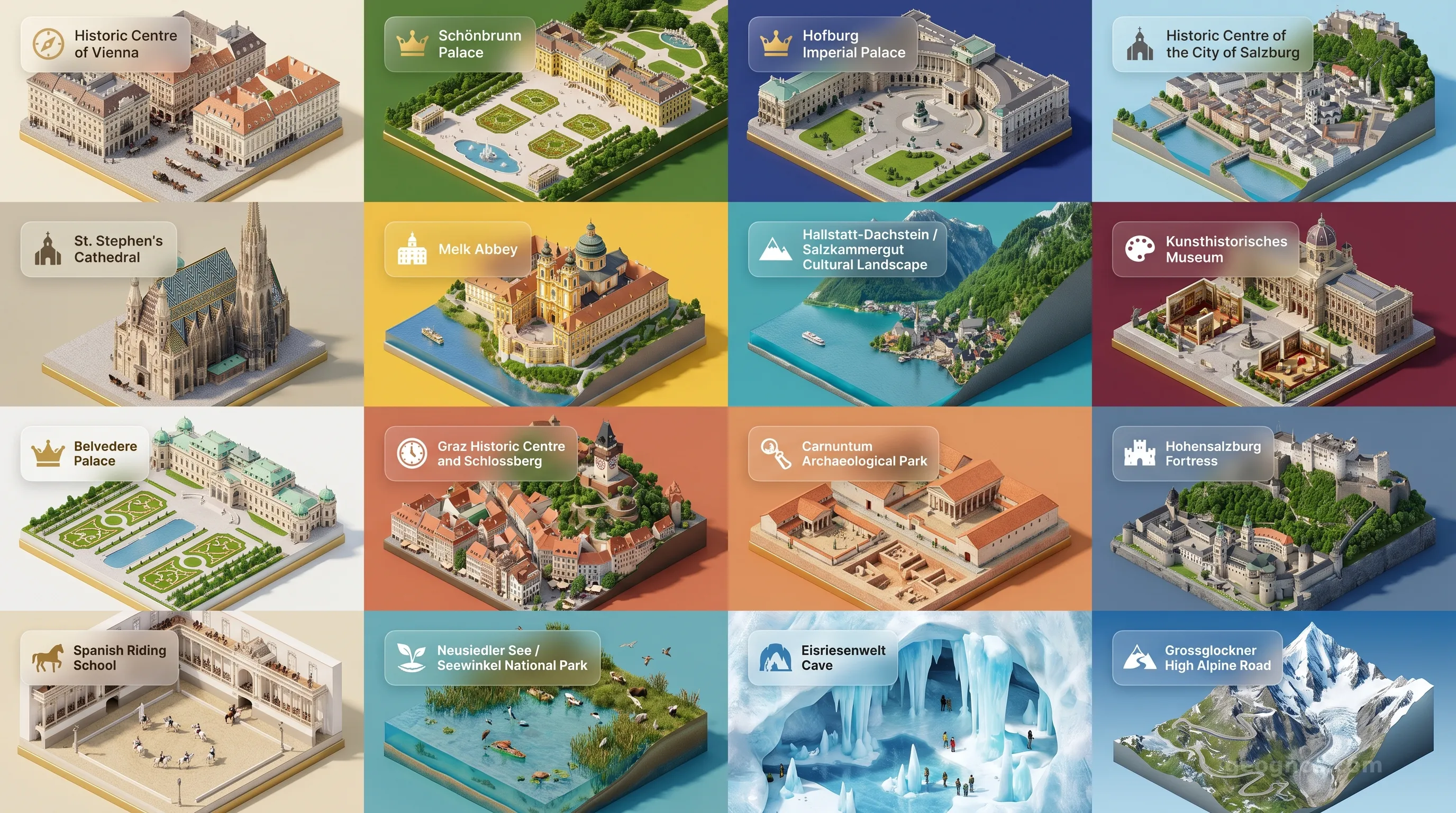
This landscape is not static, and it is best understood through the locations that draw visitors from around the world. From the sparkling emerald surface of the Wolfgangsee to the intricate, snow-dusted spire of St. Stephen's Cathedral, the points of interest within this nation are diverse. To visualize the grandeur of these sites, we recommend exploring our POI cinematic showcase. This visual carousel invites you to witness the splendor of Austrian landmarks through high-resolution photography and historical context, serving as the perfect starting point for any traveler planning a journey or any student researching the cultural geography of central Europe.
A Nation in Sustainable Balance
Modern Austria occupies a rare space in the global community. It is a nation that maintains deep historical pride while actively innovating in sectors of renewable energy and environmental conservation. Because the geography of the Alps is uniquely sensitive to change, the people of Austria have cultivated a sophisticated, modern approach to the relationship between technology and the natural world. This creates a fascinating model for international study, where the conservation of a historic, centuries-old woodland exists in direct harmony with a state-of-the-art national transit system and modern scientific research.
As you progress through the pages of GeoGnos, you will find that the story of Austria is an ongoing endeavor. It is a dialogue between the stone of the mountains and the ink of the composers, between the rigid tradition of the past and the fluid innovation of the future. Whether you are examining the complex government structure that balances federal and local needs, or investigating the intricacies of the Austrian economy and its relationship with the European Union, we hope you find that this nation offers much more than a typical travel destination. It offers a masterclass in how a culture preserves its soul while simultaneously evolving into a vital, modern contributor to our interconnected world.