The Curvature of the Adriatic: Where Stone Meets Sea
To understand Croatia, one must first look at the map, not as a static arrangement of borders, but as a living hinge upon which the cultures of Central Europe and the Mediterranean swing. It is a nation of dramatic verticality, where the rugged, karst peaks of the Dinaric Alps descend sharply into the shimmering, crystalline turquoise of the Adriatic Sea. This geography is not merely a backdrop; it is the silent author of Croatian identity. It has dictated the paths of empires, influenced the masonry of its ancient coastal cities, and carved out the soul of a people whose resilience is mirrored in the limestone cliffs that line their shores.
For the traveler, the student, and the historian, Croatia offers more than a destination. It is a palimpsest. Beneath every sun-drenched cafe and bustling marble piazza lies layer upon layer of Roman ruins, Venetian watchtowers, and Slavic tradition. To truly grasp the gravity and beauty of this transformation across the centuries, I invite you to explore the comprehensive history of Croatia, where the threads of its tumultuous yet triumphant past are woven into a clear, navigable tapestry of scholarly insight.
A Crossroad of Empires and Ideas
Croatia has never been a country of isolation. Throughout its long journey, it has functioned as a grand, porous borderland. This was the meeting point of the Western Roman and Byzantine empires, the front line where the Habsburg influence touched the Mediterranean sphere, and a critical nexus for maritime trade. The country carries the weight of this heritage with an effortless elegance. You can feel it in the air of Zadar’s Sea Organ, where the wind composes music from the waves, and you can see it in the defiant strength of Dubrovnik’s city walls.
This historical narrative is often complex, involving shifting powers and a constant redefinition of self. For those who enjoy testing their mastery of these timelines and discovering how Croatia fits into the wider context of European events, you may enjoy engaging with our interactive history puzzle. It challenges you to arrange major historical events in their correct chronological order, providing a gamified pathway to earning badges while internalizing the rhythmic beat of the Croatian timeline.
Visualizing the Passage of Time
While the written word provides context, the visual weight of history requires a more visceral approach. Croatia’s story is not just one of dates, but of colors, textures, and moments that shaped the human experience in this corner of the world. To fully appreciate the grand scale of the forces that birthed modern Croatia, I highly recommend our history cinematic showcase. This feature uses a high-end carousel player to bring to life the illustrations of the top historical events that shaped the nation, accompanied by expert summaries that connect the visual grandeur to historical fact.
The Living Geography of the Adriatic Coast
Beyond the pages of history, Croatia manifests as an unparalleled natural marvel. The country’s shape, often described as a crescent or a jagged crescent moon, encompasses more than a thousand islands, each with its own unique microclimate and folklore. From the forested, emerald waterfalls of Krka National Park to the deep, fjord-like silence of the Bay of Kotor’s neighbors in the south, the diversity is breathtaking. It is a geography that favors the explorer.
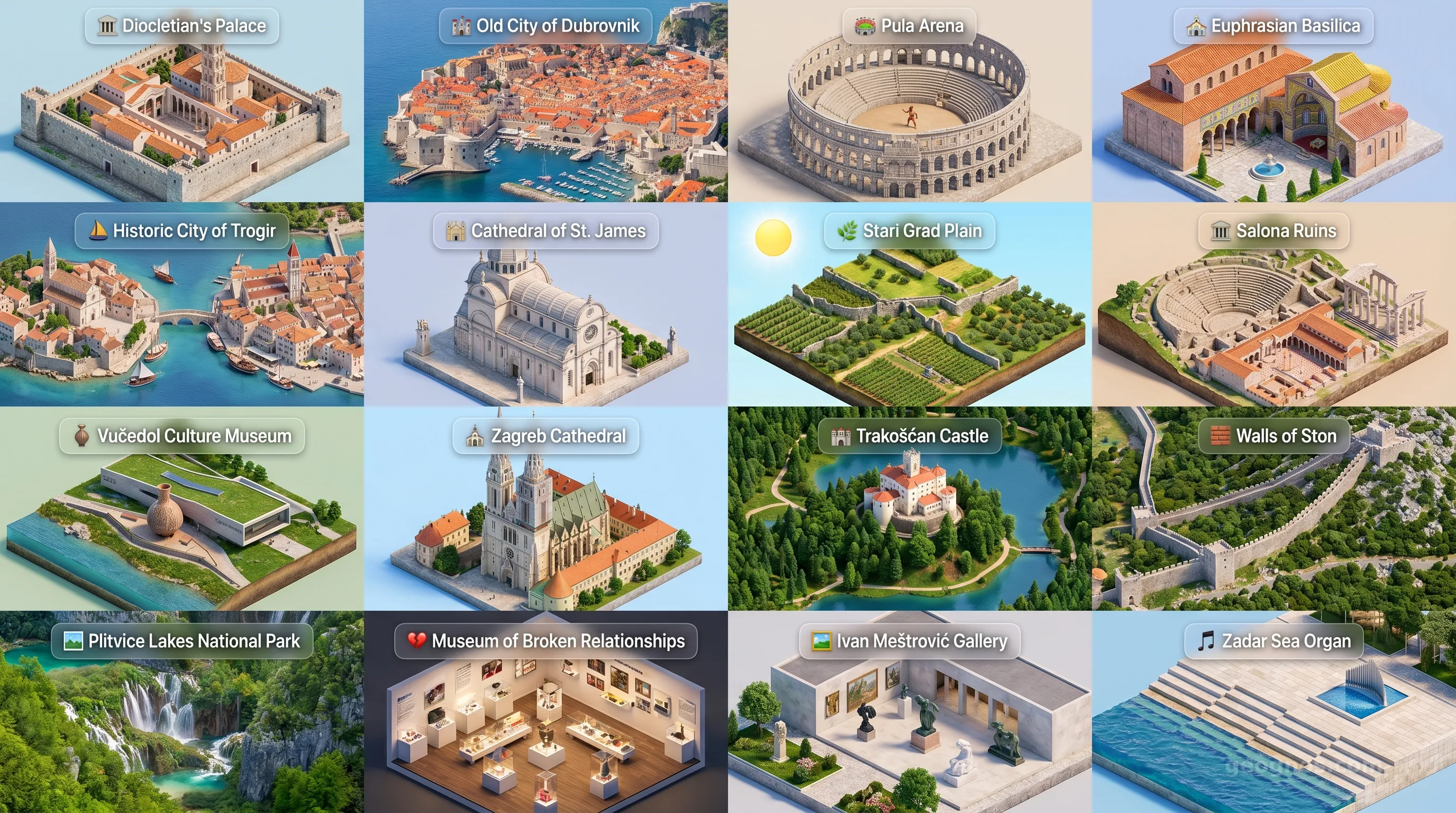
The spirit of Croatia is captured in its architecture and its untamed parks. It is a place where you can find yourself standing amidst an ancient Roman arena in the morning, and exploring an pristine, protected wildlife refuge by afternoon. To help you visualize the beauty of these top cultural and natural wonders, we have curated a specialized POI cinematic showcase. This carousel of images and descriptions highlights the iconic Points of Interest across the country, serving as a gateway to the sites that define Croatia's current identity in the eyes of the global community.
An Invitation to Discovery
Croatia represents a rare synergy of environmental preservation and historical continuity. It is a country that guards its natural assets—its pristine seas, its dense oak forests, and its protected mountains—with a ferocity matched only by its pride in its unique language, music, and cuisine. For the student of geography, it is a living laboratory of karst landscapes. For the student of political science, it is a testament to the peaceful navigation of independence. For the casual visitor, it is the realization of a thousand sunrises over an endless, sapphire horizon.
As you navigate through the subsequent sections of this Atlas page, remember that you are looking at more than just statistics or demographics. You are looking at a nation that has succeeded in maintaining a distinct cultural heartbeat in an ever-globalizing world. Whether you are examining the nuances of its economy, the structural integrity of its governance, or the shifting climate patterns of its diverse landscapes, remember that the true 'soul' of Croatia is found in the interplay between the hard stone of the Alps and the soft, forgiving tides of the Adriatic. Welcome to GeoGnos’s comprehensive study of this Mediterranean jewel, a country whose story is just beginning to be fully told.