The Bridge of Civilizations: Tunisia's Eternal Narrative
To stand upon the soil of Tunisia is to walk upon a layered manuscript where the ink of millennia remains perpetually wet. Nestled at the narrowest point of the Mediterranean, this North African jewel acts as both a gateway and a threshold. For the modern traveler and the serious student alike, Tunisia offers a singular realization: it is not merely a country that possesses a history, but a landscape that has authored the history of the Mediterranean itself. Here, the crystalline turquoise of the sea kisses the arid gold of the Sahara, and in the spaces between these two giants, some of the most significant cultural convergences in human annals have occurred.
The Tunisian identity is carved from the resilience of the Berber, the maritime ambition of the Phoenician, the administrative genius of the Roman, the scholarly pursuit of the Arab, and the aesthetic refinement of the Andalusian. This is not a static museum piece but a living, breathing synthesis. If you seek to grasp the magnitude of how this crossroads became the cradle of Mediterranean identity, you may begin your intellectual journey as you explore the history of Tunisia, a curated deep dive into the forces that shaped this North African anchor.
From Punic Power to Imperial Reach
The story of Tunisia is famously linked to Carthage. From the hills overlooking the Gulf of Tunis, the Punic empire once challenged the supremacy of Rome. While the stones of Carthage speak of great conflicts, the modern observer finds something more profound here: a sense of continuity. The landscape, with its sweeping plains and temperate mountain ranges, provided a stage for monumental developments that echoed far beyond North Africa. To understand how these events unfolded in their proper sequence, and to test your knowledge against the weight of time, we invite you to master our interactive history puzzle. It is a rewarding challenge that invites you to reconstruct the timeline of an empire that defined an era.
When studying these grand narratives, scholars often benefit from visual reinforcement. History is often perceived through texts, but the atmosphere of the past is best captured through sight and sound. We provide a bridge between the academic and the intuitive via our history cinematic showcase, which presents high-resolution illustrations of these defining historical milestones. It is designed to assist both the secondary student visualizing the rise of kingdoms and the traveler seeking to frame their visit with a richer contextual lens.
The Architecture of the Landscape
Tunisia possesses a geography that demands interaction. In the north, the Kroumirie Mountains capture the mist of the Mediterranean, clothing the earth in dense cork forests. As one journeys south, the land yields to the expansive chotts—vast salt lakes that reflect the heavens—before eventually surrendering to the Saharan dunes of the Grand Erg Oriental. This geographic diversity is not merely for display; it has dictated the settlement patterns, the architecture of the medinas, and the lifestyle of the resilient communities that have called this place home for thousands of years.
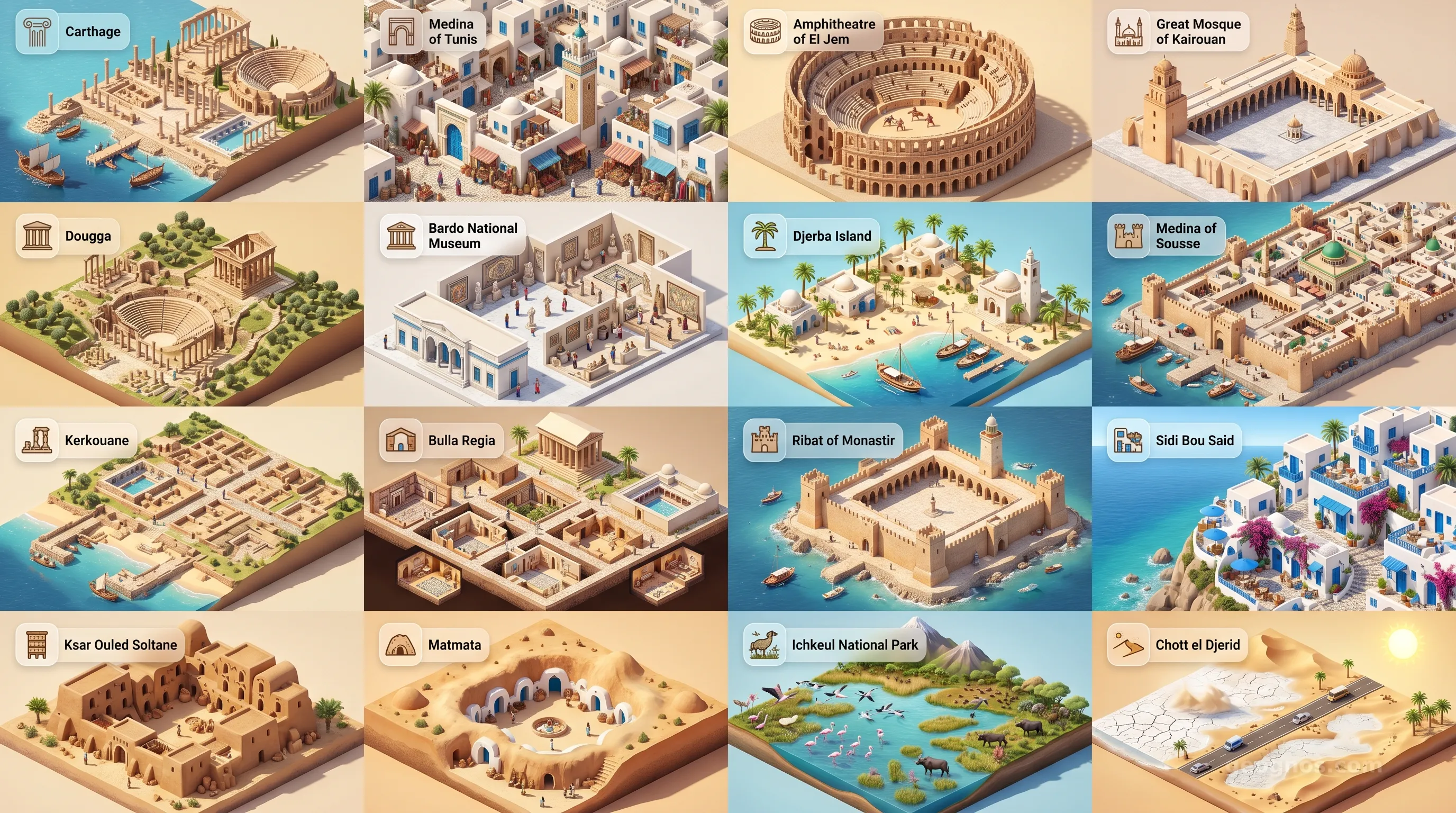
The architecture found throughout the country is a mirror to this diversity. From the iconic white and blue walls of Sidi Bou Said, which draw the eye toward the shimmering sea, to the underground troglodyte dwellings of Matmata, designed to defy the Saharan sun, Tunisia rewards the curious observer. To assist your exploration of these architectural marvels and the natural vistas that host them, browse our POI cinematic showcase. These visuals serve as a digital map for your imagination, highlighting the sites that represent the intersection of nature and human ingenuity.
A Cultural Convergence
Tunisia’s soul is perhaps best expressed through its hospitality and its dedication to education. It is a nation where the call to prayer drifts over Roman amphitheaters and where the tradition of mosaic artistry, perfected two millennia ago, continues in the hands of modern artisans. The interplay of cultures is visible in the local cuisine, a vibrant tapestry of couscous, harissa, and Mediterranean aromatics, and in the quiet intensity of its bustling souks. For the visitor, the Tunisian experience is an education in patience, beauty, and the profound depth of human achievement.
As you delve further into the pages of GeoGnos, we encourage you to view Tunisia not just as a location on a map, but as a vital laboratory of human coexistence. Whether you are analyzing the economy of the modern Maghreb, studying the shifting climate of the Sahara, or planning an itinerary to walk the ancient ruins of Dougga or El Jem, this site serves as your companion. We honor the diversity of Tunisia, celebrate its endurance, and facilitate your deeper understanding of a nation that remains a bridge between worlds.