The Archipelago of Resilience: Understanding the Spirit of Tuvalu
To set foot upon Tuvalu is to stand at the very frontier of the human experience. Situated in the vast, cerulean expanse of the Pacific Ocean, roughly halfway between Hawaii and Australia, this nation is not defined by its landmass, which remains one of the smallest on Earth, but by the profound depth of its relationship with the sea. Comprised of nine tiny coral atolls and reef islands that form a chain of fragile pearls, Tuvalu presents a landscape where the horizon is the only true constant. Here, the ocean is not merely a border, but the pulse of everyday existence, dictating the rhythm of communal life, the harvest of the tides, and the migration patterns that have historically shaped this unique Polynesian culture.
For the traveler, the scholar, or the student of geography, Tuvalu represents a masterclass in adaptation. The islands rise only a few meters above the level of the tide, yet they sustain a vibrant society built upon the pillars of "Fale-Pili," a traditional social obligation to care for one's neighbors. To understand how a community thrives amidst such delicate geography, one must explore the history of Tuvalu, a saga of seafaring ancestors, navigation by the stars, and the enduring resilience of a people who consider the sea to be their greatest guardian and their most unpredictable provider.
The Architecture of the Atoll: A Geography of Connection
Geographically, Tuvalu is a masterpiece of minimalism. Unlike continents forged by tectonic violence or massive volcanic eruptions, Tuvalu is composed of low-lying atolls—ancient corals built upon the submerged summits of long-extinct volcanoes. There are no rivers, no towering mountain peaks, and no vast forests. Instead, the islands consist of porous, sandy soil, dominated by coconut palms and pandanus trees. The scarcity of space is what makes the communal bonds so tight, as the residents of the main atoll, Funafuti, live in close proximity, mirroring the interconnectedness of their island chain.
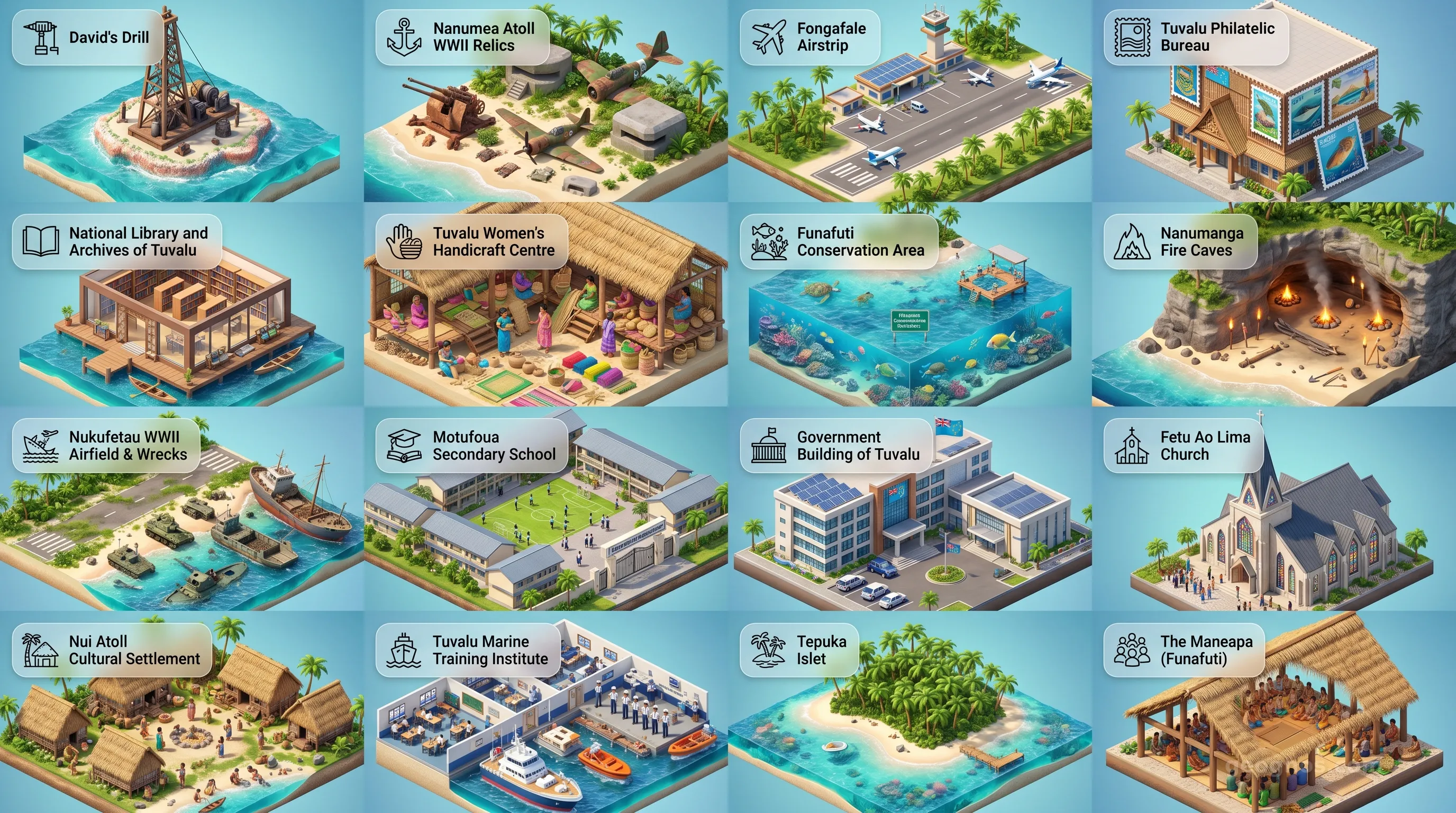
For those interested in how these islands came to be and how they fit into the broader narrative of the Pacific, the nation offers a compelling study of fragility and strength. The dynamic nature of the islands is best observed through their landmarks, both natural and man-made. You can discover the iconic beauty of these remote outposts through our POI Cinematic Showcase, which captures the serene, azure lagoons and the traditional architecture that blends seamlessly into the maritime environment.
A Legacy Etched in the Tides
The history of Tuvalu is a narrative that has traveled across the currents of the Pacific. Unlike the settled, sedentary histories of larger nations, Tuvalu's past is one of mobility. Legends speak of early settlers from Tonga and Samoa navigating the perilous open ocean to reach these hidden specks of green. This legacy of navigation is not just a relic of the past, but a core component of the national identity. Teachers and students looking to engage with this timeline can use our History Puzzle to gain an interactive, rewarding look at the milestones that transitioned these islands from sovereign ancestral lands to a modern constitutional monarchy.
The events of the last few centuries have further enriched this story, from the arrival of European explorers to the complexities of the colonial era and the ultimate transition to independence in 1978. These are not just dates on a page, but a living tradition. Through the History Cinematic Showcase, observers can witness the transition of the islands through vivid illustrations, bringing the oral histories of the elders to life in a way that respects both the narrative tradition of the Pacific and the precision of historical documentation.
The Living Pulse of a Nation
What truly sets Tuvalu apart in the modern world is its soul. In a global era defined by rapid industrialization and the noise of urbanization, Tuvalu offers a pause. It is a place where traditional customs remain integral to the daily flow of time. From the "te katei" culture, which emphasizes social harmony, to the intricate crafts of woven pandanus mats and shell jewelry, the Tuvaluan spirit is one of quiet determination. The culture is sustained by a deep respect for the environment, an essential philosophy in a nation so intimately linked to the ebb and flow of the tide.
As you navigate the pages of this atlas, consider Tuvalu as more than just a coordinate on a map. See it as an essential chapter in the human story, a testament to how geography molds the way we perceive the world. Whether you are analyzing the hydrographic challenges of rising sea levels or tracing the ancestral migration patterns of the Polynesians, the story of Tuvalu remains one of the most compelling narratives in our global family. It is a nation that teaches us that even in the smallest of places, one can find a culture with a heart that is vast enough to encompass the entire ocean.