The Vertical Horizon: Venezuela's Elemental Soul
To contemplate Venezuela is to gaze upon a world of impossible contrasts. It is a land where the earth rises to meet the sky in ancient, jagged sandstone tablelands that defy time, while the Caribbean tide whispers against the softest, most pristine sands on the continent. This is not merely a country situated at the northern apex of South America. It is an intersection of elemental forces. From the lightning that perpetually dances over the southern horizon of Lake Maracaibo to the emerald canopy of the Amazon basin, Venezuela functions as a living laboratory for the planet. Its name, derived from a Venetian suggestion of "little Venice" by early explorers, masks a vast, rugged reality that is far more titanic than its namesake.
For the traveler, the scholar, or the student of geography, Venezuela offers a unique proposition. It is a nation where the physical landscape has long dictated the flow of its human narrative. Whether you are seeking to explore the history of Venezuela to understand the profound shift from a landscape of myth and indigenous autonomy to a colonial nexus and eventually a modern global player, you will find that the story is inseparable from the geography. The country holds the record for the world's highest waterfall, the Angel Falls, a sight that defines the sheer, vertical grandeur of its highland regions.
The Tepuis and the Breath of History
The tepuis of the Guiana Highlands are perhaps the most evocative monuments on the planet. These towering, flat-topped mountains, which have eroded over millions of years, harbor biodiversity that exists nowhere else on Earth. It is as if the highlands have remained suspended in a prehistoric amber. Students and enthusiasts are encouraged to engage with our interactive history puzzle, where you can arrange the transformative moments of this nation's journey, from the pre-colonial movements of the Carib and Arawak peoples to the independence struggles that redefined the fate of South America. Learning about the past here feels like piecing together the timeline of a civilization built upon, and often struggling with, the immense weight of its own natural wealth.
A Canvas of Change
The history of Venezuela is written in layers, much like the strata of its iconic geological formations. For those who prefer a more immersive narrative experience, we recommend our history cinematic showcase, which serves as a visual gateway into the defining events that sculpted the national consciousness. Through these vignettes, one can visualize the impact of the colonial ports, the rise of independence movements led by figures like Simón Bolívar, and the industrial evolution of the twentieth century. The visuals bridge the gap between ancient myths of the El Dorado and the rapid modern transitions that have brought this nation to the global stage.
The Rhythm of the Geography
To truly know Venezuela is to embrace the variety of its regional pulses. The north is a theater of the coast and the Caribbean, defined by warm, azure currents and the lush peaks of the Coastal Range. Traveling inward, one discovers the vast Llanos, the great plains that stretch toward the horizon like an inland sea of grasses. This is the heart of the Venezuelan rural identity, a land of rivers, floods, and legendary horizons. Further south, the terrain shifts into the dense mystery of the Amazon and the towering mystery of the highlands.
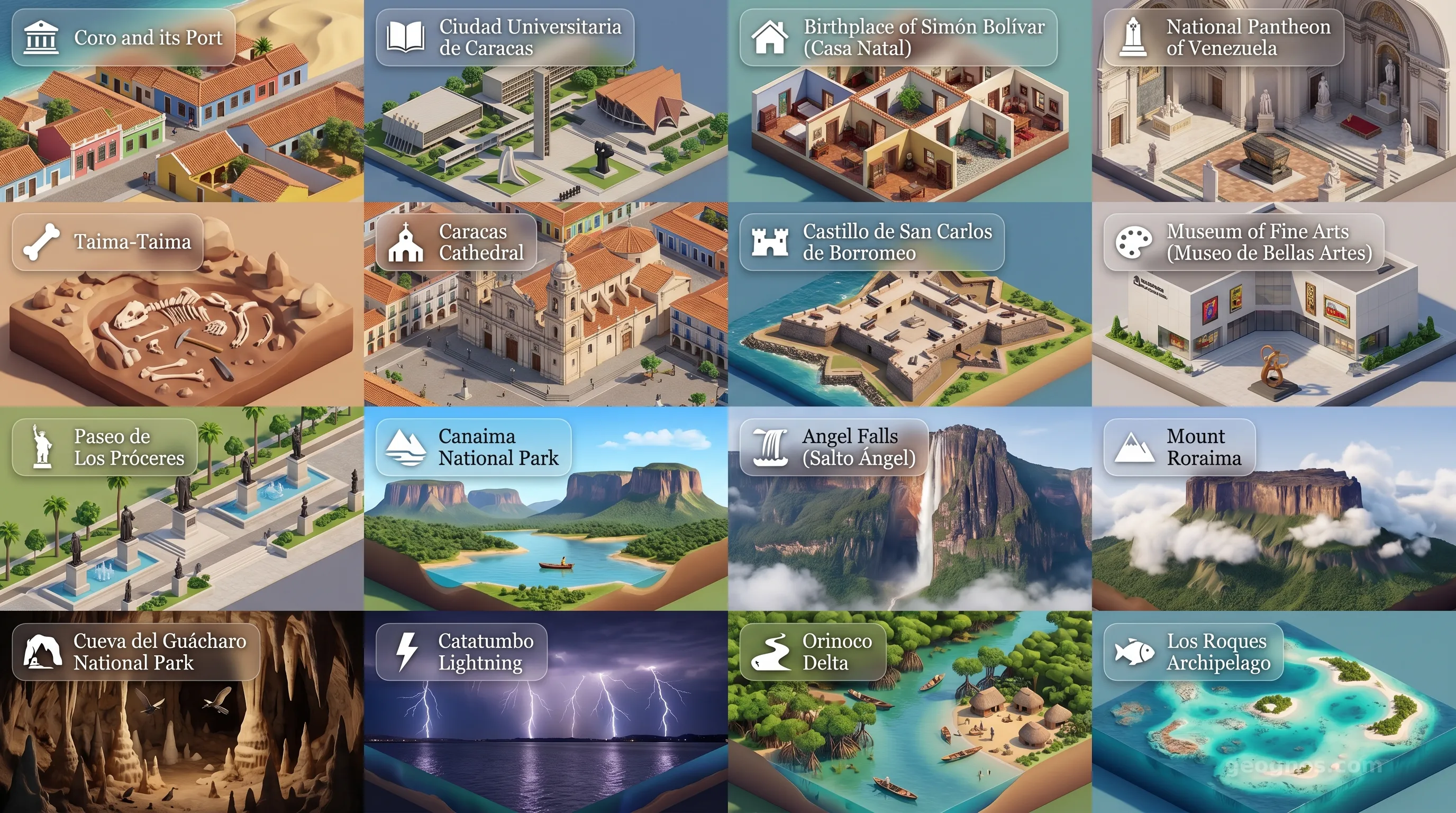
The majesty of this land is best captured through its distinct points of interest, which reflect both nature’s genius and human endeavor. To get a curated sense of the architecture, the monuments, and the breathtaking vistas that characterize the country, please view our comprehensive POI cinematic showcase. This carousel of images acts as a tour guide through the plazas of Caracas, the colonial corridors of Coro, and the mist-shrouded summits of the Gran Sabana.
Living at the Crossroads
Venezuela has always been a place where worlds collide. It sits at the edge of the Caribbean, yet it is rooted firmly in the South American massif. It acts as a gateway to the continent, influenced by indigenous roots, Hispanic traditions, and a history of global integration that has shaped its modern culture. The Venezuelan people possess a resilience and an expansive spirit, reflective of the immense landscapes that surround them. They are inhabitants of a land that possesses the largest oil reserves on the planet, yet they remain tethered to a heritage that deeply values family, vibrant artistic expression, and a storied connection to the land itself.
For students and travelers, the beauty of Venezuela lies in the duality of its nature: the contrast between the fleeting volatility of the news cycle and the enduring, stoic patience of its mountains. As you navigate through the subsequent sections of this atlas—from the complexities of our governmental and economic analyses to the realities of our diverse social and military structure—keep in mind that the soul of this nation is, and always will be, its connection to the earth. It is a geography that invites exploration and rewards the inquisitive mind with insights into what it means to live in one of the most biodiverse and topographically varied nations in the world.