The Heartbeat of the Mekong: Cambodia’s Eternal Rhythm
To set foot in Cambodia is to enter a landscape defined by the eternal, pulsing rhythm of water and stone. Here, geography is not merely a backdrop for human events; it is an active participant in the nation’s narrative. Situated at the crossroads of Southeast Asia, Cambodia is cradled by the sprawling, life-giving basin of the Tonlé Sap Lake and the mighty Mekong River. This unique hydrological landscape has dictated the flow of life for millennia, fostering an agrarian culture deeply rooted in the seasonal migration of water and the resilience of its people.
Understanding the "soul" of Cambodia requires a dual vision. One must gaze upward at the intricate, sky-piercing sandstone towers of the Angkorian era, and downward into the murky, nutrient-rich depths of the river system that feeds the nation. It is a land of profound spiritual gravity, where the ancient past—chiseled into basalt and sandstone—lives in conversation with a vibrant, modern present. As you delve deeper into the national fabric, you can explore the comprehensive history of Cambodia to understand the complex threads that have woven this kingdom into existence, from the rise of mighty maritime empires to its enduring legacy as a bastion of Theravada Buddhism.
The Architectural Echoes of a Golden Age
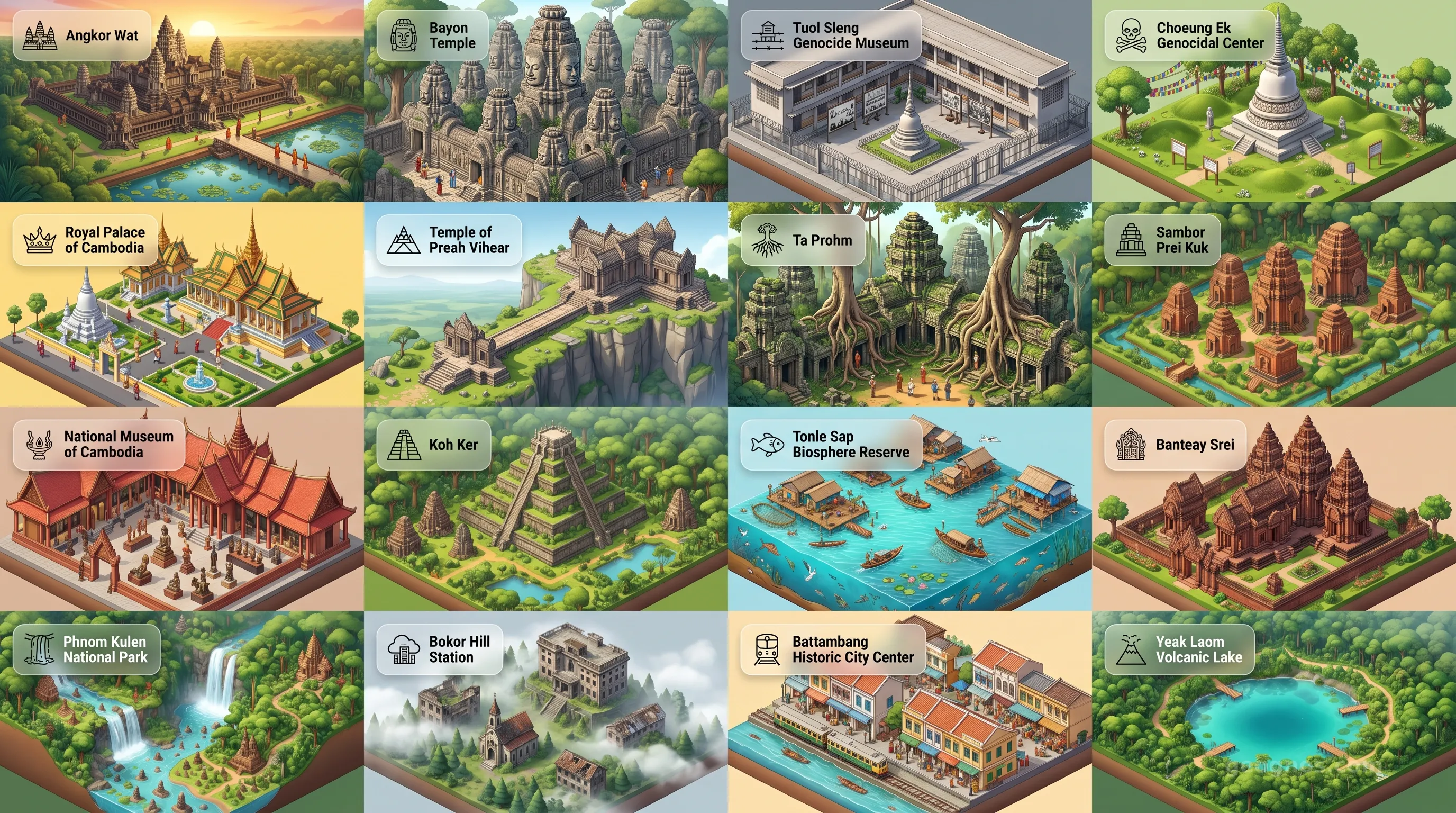
While geography shaped the environment, it was the Khmer imagination that reshaped the earth itself. The Angkor Archaeological Park, a sprawling testament to medieval engineering and religious devotion, remains the world's greatest monument to human ambition. These structures were not merely built; they were aligned with the cosmos. Watching the sun rise over the central tower of Angkor Wat is a visceral experience that connects the observer to a millennium of astronomical precision and artistic mastery.
For those eager to witness these marvels beyond the page, we invite you to experience the POI Cinematic Showcase, which brings the ethereal beauty of Bayon’s smiling faces and Ta Prohm’s strangling tree roots to life in high fidelity. These sites are not stagnant museums. They are living symbols of a culture that prioritized balance, symmetry, and the pursuit of spiritual merit, leaving behind a stone record that continues to intrigue archaeologists and travelers alike.
Mastering the Chronology of Kings
Cambodia’s timeline is a dense, multilayered tapestry that can sometimes be difficult to untangle. Between the zenith of the Khmer Empire and the profound transformations of the nineteenth and twentieth centuries, there is a fascinating progression of power, trade, and cultural evolution. To make sense of this grand arc, one might try the interactive history chronology puzzle. By arranging the pivotal turning points in the correct order, users gain more than just knowledge; they gain a spatial understanding of how specific eras collapsed, transitioned, and were reborn in the Cambodian heartland.
The Synthesis of Water, Land, and People
Beyond the monuments lies a country of incredible botanical and human diversity. The Cambodian countryside, with its shimmering flooded forests and emerald-green rice paddies, represents a form of sustainable harmony that has persisted for centuries. The Tonlé Sap, a unique biosphere reserve, reverses its flow every year, a hydrological miracle that serves as the nation’s biological pump. This phenomenon does more than provide sustenance; it shapes the architectural spirit of the people, from the stilted houses of the floating villages to the riverine traditions of the annual Water Festival.
The vibrancy of the present is best understood through the context of what has come before. If you prefer a visual immersion into the major eras of the kingdom, the History Cinematic Showcase offers an evocative, multimedia journey. Through carefully curated illustrations and concise historical summaries, this feature highlights the shifts in dynasties, the expansion of influence across the Indochinese peninsula, and the resilience of the Cambodian people in the face of centuries of regional volatility.
A Future Written in Continuity
In our exploration of Cambodia, we avoid viewing the country through the narrow lens of temporary struggles or singular eras. Instead, we recognize the inherent continuity that defines the nation. Whether walking the bustling markets of Phnom Penh, participating in the quiet, meditative prayers at a rural wat, or navigating the remote western highlands, one feels a persistent sense of peace. It is a nation that embraces its history with a rare, graceful honesty, inviting the world to learn, observe, and respect its ongoing evolution.
At GeoGnos, our mission is to act as stewards of this geographical knowledge. By mapping the connections between the land and the culture, we strive to bridge the gap between abstract facts and the lived experience. Cambodia is a kingdom of spirit, a geography of devotion, and a testament to the fact that when a culture is aligned with the rhythm of the earth, it possesses an enduring, ageless quality that can weather any tide of history.