Aphrodite’s Island: Where Time Converges at the Edge of Three Worlds
To step onto the island of Cyprus is to step into the beating heart of the Mediterranean, a land where the shimmering cobalt waters serve not as a barrier, but as a bridge between Europe, Asia, and Africa. Situated at the crossroads of ancient civilizations, Cyprus has been shaped by the footsteps of Phoenicians, Greeks, Romans, Byzantines, Venetians, and Ottomans. Each passing epoch has left an indelible mark on the landscape, resulting in an island that feels like a living museum, open to the sky and perpetually kissed by the golden Mediterranean sun.
The soul of Cyprus is tied intrinsically to its mythic origins. According to legend, the goddess Aphrodite rose from the foam of the sea near the craggy shores of Petra tou Romiou. This narrative of beauty, desire, and emergence is not just local folklore; it is the fundamental temperament of the island. There is a luminous quality to the air in Cyprus, a blend of sage, pine, and sea salt that seems to have enchanted travelers for millennia. To truly grasp the complexity of this nation, one must dive deep into its narrative; you can explore the history of Cyprus to understand how its strategic position turned it into the central arena for shifting empires and changing tides of power.
A Landscape Sculpted by Empires and Geology
Geographically, Cyprus is a masterclass in duality. In the north, the Kyrenia Mountains rise like a serrated spine against the horizon, their limestone peaks housing castles that once watched over the sea for approaching fleets. In the south and central regions, the Troodos Mountains rise high and lush, cloaked in ancient pine and cedar forests. These mountains, born from the unique geological process of the Troodos Ophiolite—where oceanic crust was forced above sea level millions of years ago—have been the island's bastion of autonomy and cultural preservation throughout the centuries.
For students and travelers alike, comprehending the sheer density of events that transpired on this island can be a challenge. To sharpen your perspective on the sequential growth of the Cypriot state, try testing your knowledge with our history puzzle. It challenges you to order key milestones, from the island's earliest Neolithic settlements at Choirokoitia to the architectural flourish of the Lusignan dynasty. It is an ideal tool for classrooms looking to transform rote memorization into a tactical game of chronological discovery.
The Living Mosaic: From Archaeology to Aesthetics
One cannot appreciate Cyprus without acknowledging its role as a cross-cultural mosaic. While the island is a testament to the classical world, it also offers profound insight into the Byzantine spirit and the Levant’s intricate trade history. The evidence is etched into the very soil. Whether it is the mosaics of Paphos that remain vibrant despite the weight of sixteen hundred years or the gothic cathedrals converted into centers of reflection, Cyprus acts as a bridge that explains the interconnected nature of the Eastern Mediterranean.
We believe that visuals are the most potent vehicle for understanding such heritage. We encourage you to witness these shifts firsthand through our history cinematic showcase, which weaves together high-resolution illustrations and concise academic summaries. This digital exhibition bridges the gap between historical literature and visual perception, allowing teachers and learners to view the transformation of the Cypriot cultural identity in an engaging, cinematic format that captures the grandeur of its major historical events.
Experiencing the Island: A Path of Discovery
Today, Cyprus presents a vibrant blend of the modern and the eternal. Beyond the historical narratives lie thousands of hidden corners, from quiet fishing villages where tradition dictates the daily rhythm to vibrant urban centers bustling with universities, tech hubs, and cafes that hum until late in the evening. The island’s unique environmental indicators, such as its specialized endemic flora and fauna found in the Akamas Peninsula, make it a natural sanctuary of significant ecological interest.
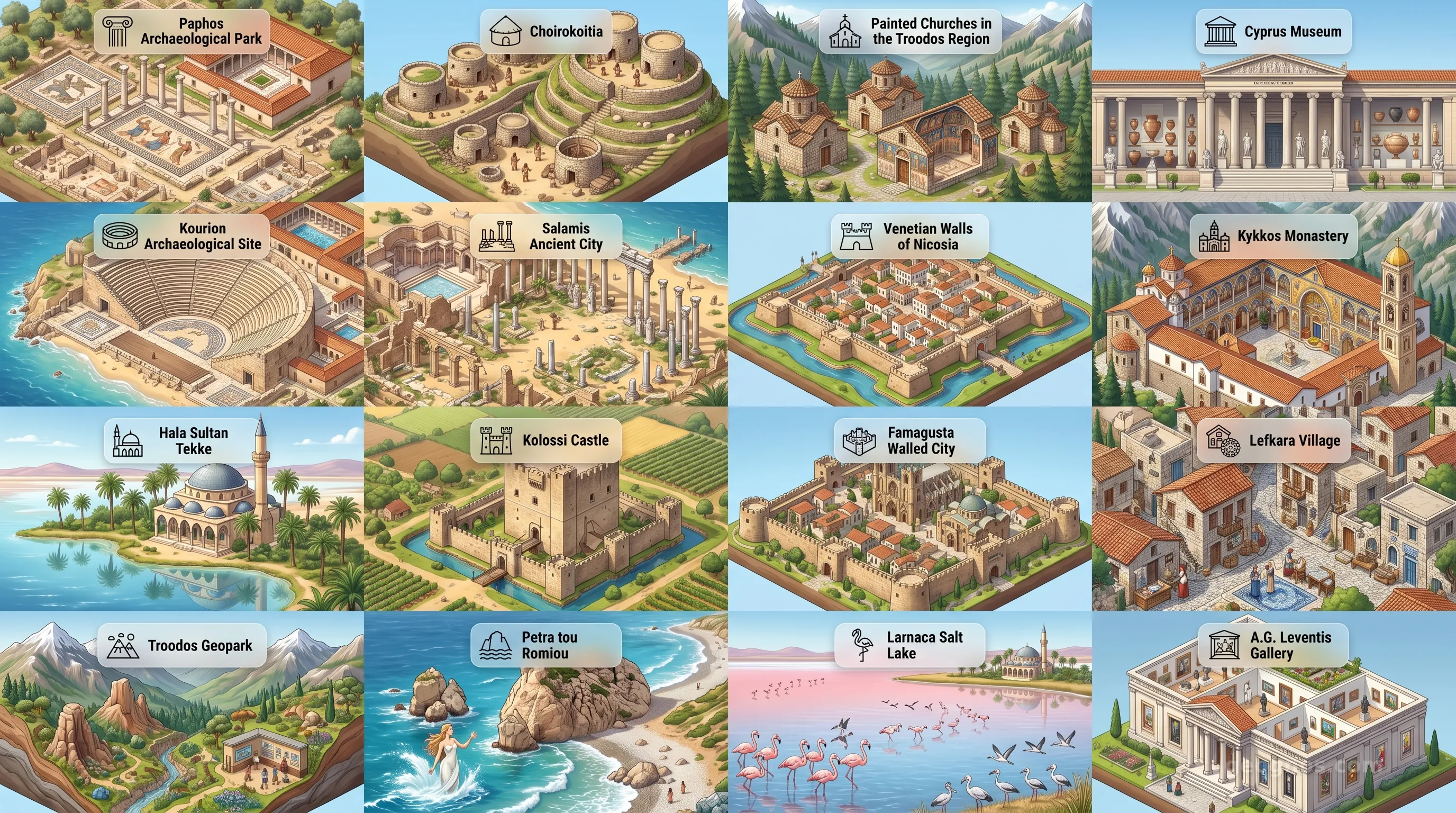
Planning a trip or designing a curriculum unit around this nation? We have curated the very best sites—the ones that remain etched in the memory of every visitor—to help you navigate the geography of wonder. Before you embark on your journey, we invite you to view our POI cinematic showcase. This visual guide presents the breathtaking scale of Cyprus, from the Roman ruins of Salamis to the verdant mountain monasteries that keep the spiritual traditions of the island alive. It is our hope that through these windows of knowledge, you gain a deep, enduring appreciation for an island that serves not merely as a country on a map, but as a central chapter in the story of humanity.
Reflecting on the Cypriot Identity
The resilience of Cyprus lies in its ability to synthesize external influences while remaining fundamentally itself. It is a nation of synthesis. As you progress through our atlas, consider how the interplay of mountainous topography and oceanic horizons has directed the lives of its people. Cyprus teaches us that even the smallest geographical features can harbor immense cultural depth. As you explore the following sections on government, economy, and society, remember that each statistic is grounded in the unique landscape of an island that has thrived at the meeting point of continents for more than nine thousand years.